Curriculum
Science Grade IX
Science Grade 9
0/13
-
Chapter 1: Exploration: Entering the World of Secondary Science
 Preview
 -
Chapter 2: Cell: The Building Block of Life
Preview
-
Chapter 3: Tissues in Action
Preview
-
Chapter 4: Describing Motion Around Us
Preview
-
Chapter 5: Exploring Mixtures and Their Separation
Preview
-
Chapter 6: How Forces Affect Motion
Preview
-
Chapter 7: Work, Energy, and Simple Machines
Preview
-
Chapter 8: Journey Inside the Atom
Preview
-
Chapter 9: Atomic Foundations of Matter
Preview
-
Chapter 10: Sound Waves: Characteristics and Applications
Preview
-
Chapter 11: Reproduction: How Life Continues
Preview
-
Chapter 12: Patterns in Life: Diversity and Classification
Preview
-
Chapter 13: Earth as a System: Energy, Matter, and Life
Preview
Exploration Work Sheets
0/13

Advanced
0/10
Chapter 4: Describing Motion Around Us
|
Grade 9 Science | Chapter 4 Describing Motion Around UsHow do we describe a moving object precisely? This chapter builds the language of motion, from distance and velocity to acceleration, motion graphs and the equations of motion.
|
|
Contents
|
1. Introduction: Describing Motion |
An object is in motion when its position changes with time compared with a fixed point. To describe motion precisely we need more than the everyday word fast; we need measured quantities such as how far an object travels, in which direction, how quickly, and whether its speed is changing. This chapter sets out those quantities and the graphs and equations that link them.
Some quantities, called scalars, have size only, such as distance and speed. Others, called vectors, have both size and direction, such as displacement, velocity and acceleration. Keeping the two apart is the first step to describing motion correctly.
|
Core idea Speed tells you how fast an object moves; velocity tells you how fast and in which direction; acceleration tells you how quickly the velocity is changing.
|
2. Distance and Displacement |
Distance is the total length of the path travelled, a scalar with size only. Displacement is the straight-line distance from start to finish in a stated direction, a vector. If you walk 3 m east and then 3 m back west, the distance travelled is 6 m but the displacement is zero, because you end where you began.
| Quantity | Type | Meaning |
| Distance | Scalar | Total path length, size only |
| Displacement | Vector | Straight-line gap from start to end, with direction |
3. Speed and Velocity |
Speed is the distance travelled in unit time, speed = distance ÷ time, measured in metres per second. Velocity is the displacement in unit time, so it carries a direction. Average speed over a journey is the total distance divided by the total time, which can differ from the speed at any single instant.
4. Acceleration |
Acceleration is the rate at which velocity changes, acceleration = change in velocity ÷ time taken, measured in metres per second squared. If velocity increases, acceleration is positive; if it decreases, the acceleration is negative and is often called deceleration or retardation.
|
Watch out An object can be accelerating even at constant speed, if its direction is changing, because velocity includes direction. A car turning a corner at steady speed is still accelerating.
|
5. Graphs of Motion |
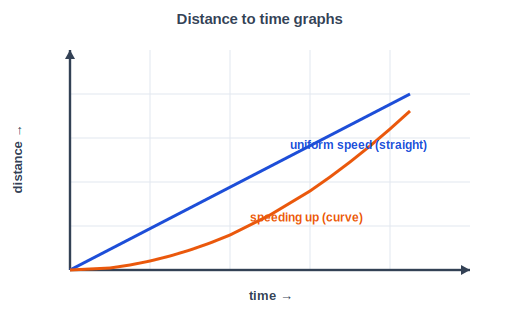
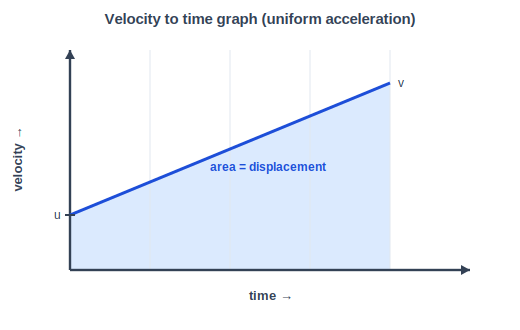
Graphs make motion easy to read. On a distance to time graph, a straight sloping line shows uniform speed and a curve shows changing speed; the steeper the line, the faster the object. On a velocity to time graph, a sloping straight line shows uniform acceleration, and the area under the line gives the displacement.
|
Diagram 1 – Distance to Time Graphs
Fig 1. A straight line means uniform speed; an upward curve means the object is speeding up. The slope of the line is the speed. |
|
Diagram 2 – Velocity to Time Graph
Fig 2. For uniform acceleration the line is straight; the shaded area under it equals the displacement, and the slope equals the acceleration. |
6. The Equations of Motion |
For motion with uniform acceleration, three equations link the initial velocity u, final velocity v, acceleration a, time t and displacement s. They are v = u + at, s = ut + ½ a t², and v² = u² + 2 a s. These let us find any one quantity when the others are known, and they apply only while the acceleration stays constant.
| Equation | Finds | Use When |
| v = u + at | final velocity | time and acceleration known |
| s = ut + ½ a t² | displacement | time and acceleration known |
| v² = u² + 2 a s | velocity or displacement | time not known |
7. Key Reasoning (Principles) |
|
Principle 1: Slope of a distance to time graph is speed Speed is distance divided by time, which is exactly the slope of the line on a distance to time graph. A steeper line therefore means a greater speed. |
|
Principle 2: Area under a velocity to time graph is displacement On a velocity to time graph, the area between the line and the time axis adds up velocity multiplied by time, which gives the displacement covered. |
|
Principle 3: The equations need uniform acceleration The three equations of motion were derived assuming acceleration stays constant, so they may not be used when the acceleration changes during the motion. |
8. Worked Examples |
| Example 1 |
|
Q: A car travels 240 m in 30 s. Find its average speed. ▶ Show SolutionAverage speed = distance ÷ time. = 240 ÷ 30 = 8 m/s. Answer: 8 m/s. |
| Example 2 |
|
Q: Convert 36 km/h into metres per second. ▶ Show Solution36 × 1000 ÷ 3600. = 10 m/s. Answer: 10 m/s. |
| Example 3 |
|
Q: A body starts from rest and reaches 20 m/s in 5 s. Find its acceleration. ▶ Show SolutionAcceleration = change in velocity ÷ time. = (20 minus 0) ÷ 5 = 4 m/s². Answer: 4 m/s². |
| Example 4 |
|
Q: Use v = u + at with u = 5 m/s, a = 2 m/s², t = 3 s. ▶ Show Solutionv = 5 + 2 × 3. = 5 + 6 = 11 m/s. Answer: 11 m/s. |
| Example 5 |
|
Q: A body starts from rest with a = 2 m/s². Find s after 4 s. ▶ Show Solutions = ut + ½ a t² = 0 + ½ × 2 × 16. = 16 m. Answer: 16 m. |
| Example 6 |
|
Q: Using v² = u² + 2as with u = 0, a = 2 m/s², s = 25 m, find v. ▶ Show Solutionv² = 0 + 2 × 2 × 25 = 100. v = √100 = 10 m/s. Answer: 10 m/s. |
| Example 7 |
|
Q: An object moves at a steady 15 m/s for 8 s. Find the displacement. ▶ Show SolutionDisplacement = velocity × time = 15 × 8. = 120 m. Answer: 120 m. |
| Example 8 |
|
Q: A car slows from 20 m/s to rest in 4 s. Find its acceleration. ▶ Show Solutiona = (0 minus 20) ÷ 4 = minus 5 m/s². The minus sign shows it is slowing down. Answer: minus 5 m/s² (deceleration). |
| Example 9 |
|
Q: A runner goes 50 m east, then 50 m back west. Find the distance and the displacement. ▶ Show SolutionDistance = 50 + 50 = 100 m (total path). Displacement = 0 m, since start and end are the same point. Answer: Distance 100 m; displacement 0 m. |
| Example 10 |
|
Q: A car covers 100 m in 20 s, then 60 m in 10 s. Find the average speed for the whole trip. ▶ Show SolutionTotal distance = 100 + 60 = 160 m; total time = 20 + 10 = 30 s. Average speed = 160 ÷ 30 = 5.33 m/s (to 3 figures). Answer: About 5.33 m/s. |
9. Practice Sets A to D |
| Set A – Multiple Choice (Basic) |
|
1. The SI unit of acceleration is: (a) m/s (b) m/s² (c) m (d) s 2. Which is a vector quantity? (a) distance (b) speed (c) displacement (d) time 3. On a distance to time graph, the slope gives the: (a) acceleration (b) speed (c) time (d) distance 4. A straight, sloping line on a velocity to time graph shows: (a) rest (b) uniform speed (c) uniform acceleration (d) no motion 5. 36 km/h equals: (a) 6 m/s (b) 10 m/s (c) 36 m/s (d) 100 m/s ▶ Reveal Answers1. (b) m/s². 2. (c) displacement. 3. (b) speed. 4. (c) uniform acceleration. 5. (b) 10 m/s. |
| Set B – Short Answer (Understanding) |
|
1. State one difference between distance and displacement. 2. Define acceleration and give its SI unit. 3. What does the area under a velocity to time graph represent? 4. When is an object said to have uniform velocity? 5. Why can an object accelerate while moving at constant speed? ▶ Reveal Answers1. Distance is total path length (scalar); displacement is the straight-line gap from start to end with direction (vector). 2. Acceleration is the rate of change of velocity; its SI unit is metre per second squared (m/s²). 3. It represents the displacement covered by the object. 4. When it covers equal displacements in equal intervals of time in the same direction. 5. Because velocity includes direction, so changing direction changes velocity even if speed stays the same. |
| Set C – Application and Reasoning |
|
1. A train moves 360 m in 40 s. Find its average speed. 2. A body accelerates from 4 m/s to 16 m/s in 6 s. Find its acceleration. 3. Find the displacement of a body moving at a steady 12 m/s for 9 s. 4. Using v = u + at, find v when u = 0, a = 3 m/s², t = 5 s. 5. A cyclist travels 100 m north then 100 m south. State the distance and displacement. ▶ Reveal Answers1. 360 ÷ 40 = 9 m/s. 2. (16 minus 4) ÷ 6 = 2 m/s². 3. 12 × 9 = 108 m. 4. v = 0 + 3 × 5 = 15 m/s. 5. Distance 200 m; displacement 0 m. |
| Set D – Higher Order (Challenge) |
|
1. A car starts from rest with a = 2 m/s². Find its velocity and displacement after 10 s. 2. Using v² = u² + 2as, find the distance a body moving at 10 m/s takes to stop with a = minus 2 m/s². 3. Explain, using a graph, why a steeper distance to time line means a faster object. 4. A bus covers 90 m in 6 s, then 90 m in 9 s. Find the average speed and explain why it is not 15 m/s. 5. Why can the equations of motion not be used when acceleration keeps changing? ▶ Reveal Answers1. v = u + at = 0 + 2 × 10 = 20 m/s; s = ut + ½ a t² = 0 + ½ × 2 × 100 = 100 m. 2. 0 = 100 + 2 × (minus 2) × s, so 4s = 100, giving s = 25 m. 3. The slope of a distance to time line equals speed, so a steeper line shows more distance per unit time, that is a greater speed. 4. Total distance 180 m in 15 s, so average speed = 12 m/s; it is not 15 m/s because the two parts took different times, so a simple average of speeds is wrong. 5. The equations were derived assuming constant acceleration, so they do not hold once the acceleration varies. |
|
Chapter Summary
|
|||||||||||||||||||||||||||||||
| 8-Point Exam Quick-Check | ||||||||||||||||||||||||||||||||
|
||||||||||||||||||||||||||||||||
|
School Revise Virtual Lab Explore these ideas with interactive simulations and visual tools.
|
|
Class 9 Science Chapter 4: Describing Motion Around Us, Complete Notes and Practice This revision guide follows the NCERT 2026 to 27 Exploration syllabus and builds the language of motion, covering distance and displacement, speed and velocity, acceleration, distance to time and velocity to time graphs, and the three equations of motion for uniform acceleration, with two graphs, ten worked examples and graded practice. Visit SchoolRevise.com to revise, practise and excel. |
 Google