Curriculum
Science Grade XI Physics
Science Grade XI Physics
0/14
-
Chapter 1: Units and Measurements
 Preview
 -
Chapter 2: Motion in a Straight Line
Preview
-
Chapter 3: Motion in a Plane
Preview
-
Chapter 4: Laws of Motion
Preview
-
Chapter 5: Work, Energy and Power
Preview
-
Chapter 6: System of Particles and Rotational Motion
Preview
-
Chapter 7: Gravitation
Preview
-
Chapter 8: Mechanical Properties of Solids
Preview
-
Chapter 9: Mechanical Properties of Fluids
Preview
-
Chapter 10: Thermal Properties of Matter
Preview
-
Chapter 11: Thermodynamics
Preview
-
Chapter 12: Kinetic Theory
Preview
-
Chapter 13: Oscillations
Preview
-
Chapter 14: Waves
Preview
Work Sheets
0/14

Chapter 1: Units and Measurements
|
Grade 11 Science | Chapter 1 Units and MeasurementsAll of physics rests on careful measurement. This chapter sets out the SI system, dimensions, significant figures and the treatment of errors that every later calculation depends on.
|
|
Contents
|
1. Introduction: Why We Measure |
Physics describes the world with numbers, and a number is only meaningful when it carries a unit. To measure is to compare a quantity with an agreed standard. A length of 5 means nothing until we say 5 metres. This chapter sets up the shared system of units used worldwide, the idea of dimensions that lets us check equations, and the honest reporting of precision through significant figures and errors.
These tools are not a side topic; they run through the whole of physics. A dimensional check can catch a wrong formula in seconds, and a clear grasp of errors tells us how far to trust a result.
|
Core idea A measurement is a number together with a unit. The SI system fixes the standards, dimensions let us check equations, and significant figures and errors report how precise a result really is.
|
2. Physical Quantities and SI Units |
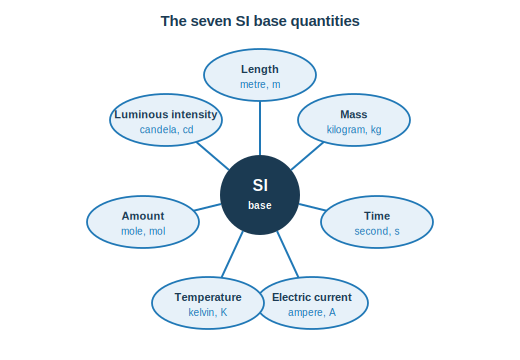
A physical quantity is anything that can be measured. Fundamental (or base) quantities are chosen as independent, and all others are derived from them. The SI system defines seven base quantities and their units; for example speed, a derived quantity, has the unit metre per second built from length and time.
|
Diagram 1 – The Seven SI Base Quantities
Fig 1. The seven base quantities and their SI units, from which every other unit in physics is built. |
3. Dimensions and Dimensional Formulae |
The dimensions of a quantity show how it is built from the base quantities mass (M), length (L) and time (T). Speed is length per time, so its dimensional formula is written [L T-1]. Force, being mass times acceleration, has dimensions [M L T-2]. Two quantities can be added only if they share the same dimensions.
| Quantity | Formula | Dimensions |
| Speed | distance ÷ time | [L T-1] |
| Acceleration | speed ÷ time | [L T-2] |
| Force | mass × acceleration | [M L T-2] |
| Work or energy | force × distance | [M L2 T-2] |
4. Dimensional Analysis |
Dimensional analysis uses the principle that both sides of a correct physical equation have the same dimensions. This lets us check whether an equation is possible, convert between systems of units, and even guess the form of a relationship. It cannot, however, find pure numbers or tell apart quantities with the same dimensions.
|
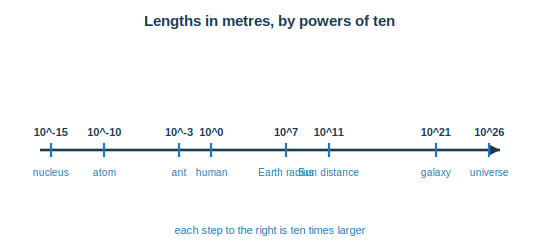
Diagram 2 – Thinking in Powers of Ten
Fig 2. Physical lengths span an enormous range, from the nucleus of an atom to the size of the observable universe, shown here in powers of ten. |
5. Significant Figures and Rounding |
The significant figures in a measurement are the digits known reliably plus one estimated digit; they show how precisely a quantity was measured. All non-zero digits count, zeros between them count, leading zeros do not, and trailing zeros after a decimal point do. When rounding, a final digit of 5 or more rounds the previous digit up.
|
Watch out In a calculation, the result cannot be more precise than the least precise measurement used. Keep the answer to the smallest number of significant figures among the data.
|
6. Errors in Measurement |
No measurement is exact. The absolute error is the difference between a reading and the true value; the relative error is the absolute error divided by the true value; and the percentage error is the relative error expressed as a percentage. When quantities are multiplied or divided, their relative errors add, which is why a result can be less precise than any single measurement.
7. Key Reasoning (Principles) |
|
Principle 1: Dimensional homogeneity In any correct physical equation, every term has the same dimensions. A term that does not match signals an error, so a dimensional check is a fast first test of any formula. |
|
Principle 2: Significant figures reflect precision The number of significant figures in a result must not exceed that of the least precise measurement used, so we do not claim more precision than we actually have. |
|
Principle 3: Relative errors add in products When quantities are multiplied or divided, their percentage errors add. So measuring two quantities each to 1% gives a product known only to about 2%. |
8. Worked Examples |
| Example 1 |
|
Q: Convert 72 km/h into metres per second. ▶ Show Solution72 × 1000 ÷ 3600. = 20 m/s. Answer: 20 m/s. |
| Example 2 |
|
Q: Express 1 m² in cm². ▶ Show Solution1 m = 100 cm, so 1 m² = 100 × 100. = 104 cm². Answer: 104 cm². |
| Example 3 |
|
Q: Express 1 m³ in cm³. ▶ Show Solution1 m³ = 100 × 100 × 100. = 106 cm³. Answer: 106 cm³. |
| Example 4 |
|
Q: Write the dimensional formula of force. ▶ Show SolutionForce = mass × acceleration. = [M] × [L T-2] = [M L T-2]. Answer: [M L T-2]. |
| Example 5 |
|
Q: How many significant figures are in 0.00203? ▶ Show SolutionLeading zeros do not count; 2, 0, 3 do. So there are 3 significant figures. Answer: 3 significant figures. |
| Example 6 |
|
Q: Round 3.14159 to 4 significant figures. ▶ Show SolutionThe first four figures are 3, 1, 4, 1; the next is 5, so round up. 3.14159 becomes 3.142. Answer: 3.142. |
| Example 7 |
|
Q: A length measured as 2.05 m has a true value of 2.00 m. Find the percentage error. ▶ Show SolutionAbsolute error = 2.05 minus 2.00 = 0.05 m. Percentage error = (0.05 ÷ 2.00) × 100 = 2.5%. Answer: 2.5%. |
| Example 8 |
|
Q: Two quantities are each measured to 1%. Find the percentage error in their product. ▶ Show SolutionRelative errors add for a product. 1% + 1% = 2%. Answer: 2%. |
| Example 9 |
|
Q: Convert a density of 1 g/cm³ into kg/m³. ▶ Show Solution1 g = 0.001 kg and 1 cm³ = 10-6 m³. 1 g/cm³ = 0.001 ÷ 10-6 = 1000 kg/m³. Answer: 1000 kg/m³. |
| Example 10 |
|
Q: Light travels at 3 × 10⁸ m/s. Estimate the distance light covers in one year (a light year). ▶ Show SolutionSeconds in a year ≈ 365.25 × 24 × 3600 ≈ 3.156 × 10⁷ s. Distance = 3 × 108 × 3.156 × 107 ≈ 9.46 × 10¹⁵ m. Answer: About 9.46 × 10¹⁵ m. |
9. Practice Sets A to D |
| Set A – Multiple Choice (Basic) |
|
1. The SI unit of amount of substance is the: (a) kilogram (b) mole (c) candela (d) kelvin 2. The dimensional formula of speed is: (a) [L T] (b) [L T-1] (c) [L2 T] (d) [M L T-1] 3. How many significant figures are in 100.0? (a) 1 (b) 2 (c) 3 (d) 4 4. 1 m³ equals: (a) 102 cm³ (b) 104 cm³ (c) 106 cm³ (d) 103 cm³ 5. Dimensional analysis cannot find: (a) units (b) pure numbers (c) errors in dimensions (d) consistency ▶ Reveal Answers1. (b) mole. 2. (b) [L T-1]. 3. (d) 4. 4. (c) 106 cm³. 5. (b) pure numbers. |
| Set B – Short Answer (Understanding) |
|
1. State the difference between a fundamental and a derived quantity. 2. What is meant by the dimensions of a physical quantity? 3. State the principle of dimensional homogeneity. 4. Define percentage error. 5. Why can a result not be more precise than the least precise measurement used? ▶ Reveal Answers1. A fundamental quantity is chosen as independent; a derived quantity is built from fundamental ones. 2. They show how the quantity is built from the base quantities mass, length and time. 3. Every term in a correct physical equation has the same dimensions. 4. The relative error expressed as a percentage of the true value. 5. Because the uncertainty of the least precise value limits how precisely the result can be known. |
| Set C – Application and Reasoning |
|
1. Convert 90 km/h into metres per second. 2. Write the dimensional formula of work. 3. How many significant figures are in 0.0450? 4. A measurement of 5.10 m has a true value of 5.00 m. Find the percentage error. 5. Two lengths measured to 2% each are multiplied. Find the percentage error of the product. ▶ Reveal Answers1. 90 × 1000 ÷ 3600 = 25 m/s. 2. Work = force × distance = [M L T-2] × [L] = [M L2 T-2]. 3. 3 significant figures. 4. (0.10 ÷ 5.00) × 100 = 2%. 5. 2% + 2% = 4%. |
| Set D – Higher Order (Challenge) |
|
1. Use dimensions to check whether v = u + at is dimensionally correct. 2. The period of a pendulum is thought to depend on length L and g. Use dimensions to find how T depends on L and g. 3. A cube has side measured as 2.0 cm to 2 significant figures. State its volume to the correct number of significant figures. 4. A density is found from mass (1% error) and volume (2% error). Find the percentage error in the density. 5. Explain why dimensional analysis cannot find a numerical constant such as 2 or pi. ▶ Reveal Answers1. [v] = [L T-1]; [u] = [L T-1]; [at] = [L T-2][T] = [L T-1]. All terms match, so it is dimensionally correct. 2. Assuming T depends on L and g, matching dimensions gives T proportional to the square root of (L ÷ g). 3. Volume = 2.03 = 8.0 cm³, kept to 2 significant figures. 4. Density = mass ÷ volume, so relative errors add: 1% + 2% = 3%. 5. Dimensional analysis only balances dimensions; pure numbers have no dimensions, so they cannot be found this way. |
|
Chapter Summary
|
|||||||||||||||||||||||||||||||
| 8-Point Exam Quick-Check | ||||||||||||||||||||||||||||||||
|
||||||||||||||||||||||||||||||||
|
School Revise Virtual Lab Explore these ideas with interactive simulations and visual tools.
|
|
Class 11 Physics Chapter 1: Units and Measurements, Complete Notes and Practice This revision guide follows the current NCERT Class 11 Physics syllabus and covers measurement and the SI system, fundamental and derived quantities, dimensions and dimensional formulae, dimensional analysis, significant figures and rounding, and errors in measurement, with two diagrams, ten worked examples and graded practice. Visit SchoolRevise.com to revise, practise and excel. |
 Google