Curriculum
Science Grade XI Physics
Science Grade XI Physics
0/14
-
Chapter 1: Units and Measurements
 Preview
 -
Chapter 2: Motion in a Straight Line
Preview
-
Chapter 3: Motion in a Plane
Preview
-
Chapter 4: Laws of Motion
Preview
-
Chapter 5: Work, Energy and Power
Preview
-
Chapter 6: System of Particles and Rotational Motion
Preview
-
Chapter 7: Gravitation
Preview
-
Chapter 8: Mechanical Properties of Solids
Preview
-
Chapter 9: Mechanical Properties of Fluids
Preview
-
Chapter 10: Thermal Properties of Matter
Preview
-
Chapter 11: Thermodynamics
Preview
-
Chapter 12: Kinetic Theory
Preview
-
Chapter 13: Oscillations
Preview
-
Chapter 14: Waves
Preview
Chapter 4: Laws of Motion
|
Grade 11 Science | Chapter 4 Laws of MotionWhy do objects move as they do? Newton’s three laws connect force to motion. This chapter develops them, with momentum, free body diagrams, friction and circular dynamics.
|
|
Contents
|
1. Introduction: Force and Motion |
A force is a push or pull that can change an object’s motion. The Italian and English physicists who founded mechanics found that motion does not need a force to continue, only to change. Newton gathered these ideas into three laws that connect force, mass and motion, and they remain the basis of everyday mechanics.
|
Core idea An unbalanced force changes an object’s motion. The change is governed by Newton’s three laws, with the second law, F = ma, giving the precise link between net force, mass and acceleration.
|
2. Newton’s First Law and Inertia |
Newton’s first law states that an object continues at rest or in uniform straight-line motion unless acted on by an unbalanced force. This tendency to resist a change in motion is called inertia, and it increases with mass. The first law tells us that force is needed to change motion, not to maintain it.
3. Momentum and the Second Law |
Momentum is the product of mass and velocity, p = m v, a vector measuring the quantity of motion. Newton’s second law states that the net force equals the rate of change of momentum. For constant mass this gives the familiar form F = m a: the net force equals mass times acceleration, in the same direction as the force. A given force produces a smaller acceleration on a heavier body.
| Quantity | Definition | Unit |
| Momentum | mass × velocity | kg m/s |
| Force | rate of change of momentum | newton (N) |
| Impulse | force × time = change in momentum | N s |
4. Newton’s Third Law |
Newton’s third law states that to every action there is an equal and opposite reaction. When one body exerts a force on a second, the second exerts an equal and opposite force on the first. These two forces act on different bodies, which is why they do not cancel. The recoil of a gun and the forward push of a swimmer both follow from this law.
5. Free Body Diagrams |
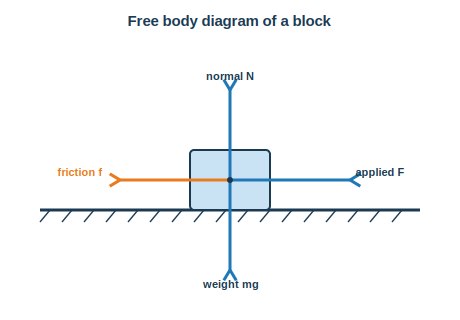
A free body diagram shows every force on a single object as a labelled arrow. For a block on a surface, these are its weight downward, the normal force upward, any applied force, and friction opposing motion. Drawing the diagram makes it straightforward to find the net force and apply F = ma.
|
Diagram 1 – Free Body Diagram
Fig 1. The forces on a block: weight down, normal force up, an applied force forward, and friction backward. Their vector sum is the net force. |
6. Friction |
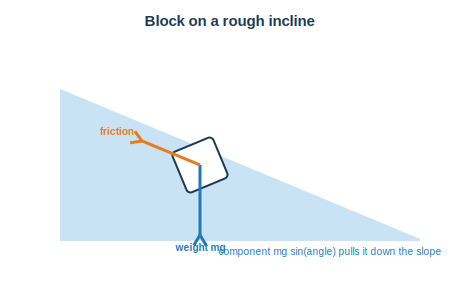
Friction is the force that opposes relative motion between surfaces in contact. Static friction prevents motion starting and can rise to a maximum; kinetic friction acts once sliding begins and is roughly constant. The friction force is proportional to the normal force, f = μN, where μ is the coefficient of friction. On an incline, the component of weight along the slope, mg sinθ, tends to pull the body down.
|
Diagram 2 – Block on a Rough Incline
Fig 2. On an incline, the weight splits into a component along the slope, mg sin(angle), and one into the surface; friction acts up the slope to oppose sliding. |
7. Key Reasoning (Principles) |
|
Principle 1: Force changes motion, not maintains it By the first law, steady motion needs no force. Only a net force changes velocity, and the change is an acceleration in the direction of that force. |
|
Principle 2: Force is the rate of change of momentum The second law in its general form is F equals the change in momentum per unit time, which reduces to F = ma when mass is constant. |
|
Principle 3: Action and reaction act on different bodies The equal and opposite forces of the third law act on two different objects, so they never cancel each other and can still cause motion. |
8. Worked Examples |
| Example 1 |
|
Q: A force of 12 N acts on a 3 kg body. Find its acceleration. ▶ Show Solutiona = F ÷ m = 12 ÷ 3. = 4 m/s². Answer: 4 m/s². |
| Example 2 |
|
Q: Find the force needed to accelerate a 5 kg body at 2 m/s². ▶ Show SolutionF = m a = 5 × 2. = 10 N. Answer: 10 N. |
| Example 3 |
|
Q: Find the momentum of a 4 kg body moving at 6 m/s. ▶ Show Solutionp = m v = 4 × 6. = 24 kg m/s. Answer: 24 kg m/s. |
| Example 4 |
|
Q: A 2 kg body changes velocity from 3 m/s to 7 m/s in 2 s. Find the force. ▶ Show Solutiona = (7 minus 3) ÷ 2 = 2 m/s²; F = ma = 2 × 2. = 4 N. Answer: 4 N. |
| Example 5 |
|
Q: A force of 10 N acts for 5 s on a body. Find the impulse and the change in momentum. ▶ Show SolutionImpulse = F t = 10 × 5 = 50 N s, equal to the change in momentum. Answer: 50 N s. |
| Example 6 |
|
Q: A 10 kg block rests on a surface. Find the normal force (g = 10 m/s²). ▶ Show SolutionOn a level surface N = mg = 10 × 10. = 100 N. Answer: 100 N. |
| Example 7 |
|
Q: Find the kinetic friction on a 10 kg block, μ = 0.2 (g = 10 m/s²). ▶ Show SolutionN = mg = 100 N; f = μN = 0.2 × 100. = 20 N. Answer: 20 N. |
| Example 8 |
|
Q: Two forces 15 N and 9 N act in opposite directions on a 2 kg body. Find its acceleration. ▶ Show SolutionNet force = 15 minus 9 = 6 N; a = 6 ÷ 2. = 3 m/s². Answer: 3 m/s². |
| Example 9 |
|
Q: Find the component of a 100 N weight along a 30 degree incline. (sin30 = 0.5) ▶ Show SolutionComponent = mg sinθ = 100 × 0.5. = 50 N. Answer: 50 N. |
| Example 10 |
|
Q: A 1000 kg car accelerates at 2 m/s². Find the driving force. ▶ Show SolutionF = m a = 1000 × 2. = 2000 N. Answer: 2000 N. |
9. Practice Sets A to D |
| Set A – Multiple Choice (Basic) |
|
1. Newton’s second law is: (a) F = mv (b) F = ma (c) F = m/a (d) F = m + a 2. The SI unit of momentum is: (a) N (b) kg m/s (c) J (d) N s 3. Friction always acts: (a) along the motion (b) opposite to relative motion (c) upward (d) downward 4. Action and reaction forces act on: (a) the same body (b) different bodies (c) no body (d) the ground 5. Inertia of a body depends on its: (a) speed (b) mass (c) shape (d) colour ▶ Reveal Answers1. (b) F = ma. 2. (b) kg m/s. 3. (b) opposite to relative motion. 4. (b) different bodies. 5. (b) mass. |
| Set B – Short Answer (Understanding) |
|
1. State Newton’s first law of motion. 2. Define momentum and impulse. 3. Why do action and reaction forces not cancel? 4. What is the difference between static and kinetic friction? 5. Write the relation between friction and normal force. ▶ Reveal Answers1. A body stays at rest or in uniform straight-line motion unless an unbalanced force acts on it. 2. Momentum is mass times velocity; impulse is force times time, equal to the change in momentum. 3. Because they act on two different bodies, not on the same one. 4. Static friction acts before motion starts and can rise to a maximum; kinetic friction acts during sliding and is roughly constant. 5. f = μN, friction equals the coefficient of friction times the normal force. |
| Set C – Application and Reasoning |
|
1. A 6 N force acts on a 2 kg body. Find its acceleration. 2. Find the momentum of a 3 kg body at 5 m/s. 3. Find the friction on a 5 kg block with μ = 0.4 (g = 10 m/s²). 4. A 0.5 kg ball is hit and its velocity changes by 10 m/s in 0.1 s. Find the force. 5. Why does a passenger jerk forward when a bus stops suddenly? ▶ Reveal Answers1. a = 6 ÷ 2 = 3 m/s². 2. p = 3 × 5 = 15 kg m/s. 3. f = 0.4 × (5 × 10) = 20 N. 4. a = 10 ÷ 0.1 = 100 m/s²; F = 0.5 × 100 = 50 N. 5. By inertia the passenger tends to keep moving forward when the bus suddenly stops. |
| Set D – Higher Order (Challenge) |
|
1. A 1200 kg car reaches 20 m/s from rest in 8 s. Find the driving force. 2. Explain, using the third law, how a rocket accelerates in space. 3. A 5 kg block on a 30 degree incline has μ = 0.2. Will it slide? (g = 10, sin30 = 0.5, cos30 = 0.866) 4. A force gives a 2 kg body 4 m/s² and a 6 kg body some acceleration. Find the second acceleration. 5. Show that impulse equals the change in momentum. ▶ Reveal Answers1. a = 20 ÷ 8 = 2.5 m/s²; F = 1200 × 2.5 = 3000 N. 2. The rocket pushes gas backward (action); the gas pushes the rocket forward with an equal and opposite force (reaction). 3. Driving component = mg sinθ = 25 N; max friction = μ mg cosθ = 0.2 × 50 × 0.866 ≈ 8.66 N; since 25 > 8.66, it slides. 4. Same force F = 2 × 4 = 8 N; for 6 kg, a = 8 ÷ 6 ≈ 1.33 m/s². 5. From F = change in momentum ÷ time, multiplying by time gives F t (impulse) = change in momentum. |
|
Chapter Summary
|
|||||||||||||||||||||||||||||||
| 8-Point Exam Quick-Check | ||||||||||||||||||||||||||||||||
|
||||||||||||||||||||||||||||||||
|
School Revise Virtual Lab Explore these ideas with interactive simulations and visual tools.
|
|
Class 11 Physics Chapter 4: Laws of Motion, Complete Notes and Practice This revision guide follows the current NCERT Class 11 Physics syllabus and develops Newton’s three laws of motion, covering inertia, momentum and impulse, the second law as F equals ma, the third law of action and reaction, free body diagrams, and static and kinetic friction including motion on an incline, with two diagrams, ten worked examples and graded practice. Visit SchoolRevise.com to revise, practise and excel. |
 Google