Curriculum
Science Grade XI Physics
Science Grade XI Physics
0/14
-
Chapter 1: Units and Measurements
 Preview
 -
Chapter 2: Motion in a Straight Line
Preview
-
Chapter 3: Motion in a Plane
Preview
-
Chapter 4: Laws of Motion
Preview
-
Chapter 5: Work, Energy and Power
Preview
-
Chapter 6: System of Particles and Rotational Motion
Preview
-
Chapter 7: Gravitation
Preview
-
Chapter 8: Mechanical Properties of Solids
Preview
-
Chapter 9: Mechanical Properties of Fluids
Preview
-
Chapter 10: Thermal Properties of Matter
Preview
-
Chapter 11: Thermodynamics
Preview
-
Chapter 12: Kinetic Theory
Preview
-
Chapter 13: Oscillations
Preview
-
Chapter 14: Waves
Preview
Chapter 6: System of Particles and Rotational Motion
|
Grade 11 Science | Chapter 6 System of Particles and Rotational MotionExtended bodies can spin as well as move. This chapter introduces the centre of mass, torque, moment of inertia and angular momentum, with the law that conserves it.
|
|
Contents
|
1. Introduction: Beyond the Point Particle |
So far we treated objects as points. Real bodies have size and can rotate as well as move bodily. This chapter introduces the tools of rotational motion: the centre of mass that moves as if all the mass were there, the torque that causes turning, the moment of inertia that resists it, and angular momentum with its conservation law.
|
Core idea Rotation mirrors straight-line motion: torque plays the role of force, moment of inertia the role of mass, and angular momentum the role of momentum. So τ = Iα mirrors F = ma.
|
2. Centre of Mass |
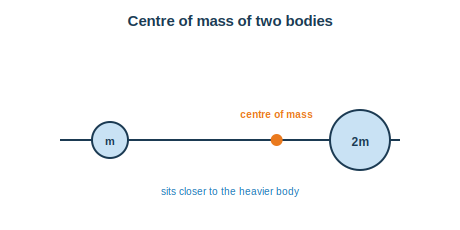
The centre of mass is the point at which the whole mass of a body may be taken to act; the body moves as though all external forces acted there. For two masses on a line it lies closer to the heavier one. The motion of the centre of mass obeys Newton’s laws just as a single particle would, which is why we could treat objects as points earlier.
|
Diagram 1 – Centre of Mass
Fig 1. For two bodies, the centre of mass lies on the line joining them, nearer the heavier body. |
3. Torque, the Turning Effect |
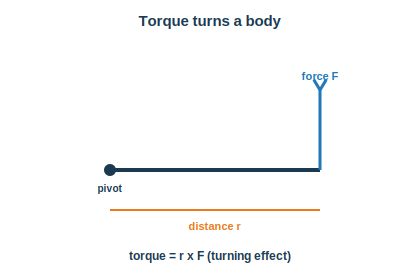
Torque is the turning effect of a force about an axis, equal to the force times its perpendicular distance from the axis, τ = r F sinθ. A larger force or a longer arm gives more torque, which is why a door handle is placed far from the hinge. Torque is the rotational equivalent of force, and a net torque produces angular acceleration.
|
Diagram 2 – Torque
Fig 2. The torque of a force about the pivot is the force times its perpendicular distance from the pivot; it sets the body turning. |
4. Moment of Inertia |
The moment of inertia measures a body’s resistance to a change in its rotation, the rotational counterpart of mass. For a point mass it is I = m r², and for an extended body it depends on how the mass is spread about the axis: mass farther from the axis contributes more. Newton’s second law for rotation is τ = I α, torque equals moment of inertia times angular acceleration.
5. Angular Momentum |
Angular momentum is the rotational analogue of momentum, L = I ω, where ω is the angular velocity. Just as a force changes momentum, a torque changes angular momentum, and the rate of change of angular momentum equals the applied torque. Angular momentum is a vector along the axis of rotation.
6. Conservation of Angular Momentum |
When no net external torque acts, the angular momentum is conserved: I ω stays constant. So if a spinning skater pulls in their arms, reducing their moment of inertia, their angular velocity rises to keep I ω the same. This is the rotational version of the conservation of momentum.
|
Watch out Conservation of angular momentum needs zero net external torque, not zero force. A skater’s internal muscle forces change I but exert no external torque, so L is conserved.
|
7. Key Reasoning (Principles) |
|
Principle 1: Rotation mirrors translation Every translational quantity has a rotational partner: force and torque, mass and moment of inertia, momentum and angular momentum, so τ = Iα mirrors F = ma. |
|
Principle 2: Torque needs a lever arm Torque is force times perpendicular distance, so the same force gives more turning effect when applied farther from the axis. |
|
Principle 3: Angular momentum is conserved without external torque With no net external torque, Iω stays constant, so reducing the moment of inertia speeds up the rotation. |
8. Worked Examples |
| Example 1 |
|
Q: Find the torque of a 20 N force at a perpendicular distance of 0.5 m. ▶ Show Solutionτ = r F = 0.5 × 20. = 10 N m. Answer: 10 N m. |
| Example 2 |
|
Q: Find the moment of inertia of a 2 kg point mass at 3 m from the axis. ▶ Show SolutionI = m r² = 2 × 9. = 18 kg m². Answer: 18 kg m². |
| Example 3 |
|
Q: A torque of 12 N m acts on a body of moment of inertia 4 kg m². Find the angular acceleration. ▶ Show Solutionα = τ ÷ I = 12 ÷ 4. = 3 rad/s². Answer: 3 rad/s². |
| Example 4 |
|
Q: Find the angular momentum of a body with I = 5 kg m² spinning at 4 rad/s. ▶ Show SolutionL = I ω = 5 × 4. = 20 kg m²/s. Answer: 20 kg m²/s. |
| Example 5 |
|
Q: Where does the centre of mass of equal masses 6 m apart lie? ▶ Show SolutionFor equal masses it is midway. So 3 m from each. Answer: At the midpoint, 3 m from each. |
| Example 6 |
|
Q: A 30 N force acts at 0.2 m from a pivot, at right angles. Find the torque. ▶ Show Solutionτ = 0.2 × 30. = 6 N m. Answer: 6 N m. |
| Example 7 |
|
Q: A skater with I = 4 kg m² at 2 rad/s pulls in to I = 2 kg m². Find the new angular velocity. ▶ Show SolutionIω is conserved: 4 × 2 = 2 × ω’. ω’ = 4 rad/s. Answer: 4 rad/s. |
| Example 8 |
|
Q: Find the moment of inertia of a 3 kg mass at 2 m from the axis. ▶ Show SolutionI = m r² = 3 × 4. = 12 kg m². Answer: 12 kg m². |
| Example 9 |
|
Q: A wheel of I = 0.5 kg m² has angular acceleration 6 rad/s². Find the torque. ▶ Show Solutionτ = I α = 0.5 × 6. = 3 N m. Answer: 3 N m. |
| Example 10 |
|
Q: Why does a diver spin faster after tucking in? ▶ Show SolutionTucking lowers the moment of inertia; with angular momentum conserved, the angular velocity rises. Answer: Lower I means higher angular velocity (L conserved). |
9. Practice Sets A to D |
| Set A – Multiple Choice (Basic) |
|
1. Torque is force times: (a) mass (b) perpendicular distance (c) time (d) speed 2. The rotational analogue of mass is the: (a) torque (b) angular velocity (c) moment of inertia (d) force 3. Angular momentum is given by: (a) mv (b) Iω (c) Iα (d) rF 4. τ = Iα is the rotational form of: (a) F = ma (b) p = mv (c) W = Fs (d) v = u + at 5. Angular momentum is conserved when the net external torque is: (a) large (b) zero (c) constant (d) negative ▶ Reveal Answers1. (b) perpendicular distance. 2. (c) moment of inertia. 3. (b) Iω. 4. (a) F = ma. 5. (b) zero. |
| Set B – Short Answer (Understanding) |
|
1. Define the centre of mass. 2. Define torque and give its unit. 3. What does the moment of inertia measure? 4. Write the rotational form of Newton’s second law. 5. State the law of conservation of angular momentum. ▶ Reveal Answers1. The point at which the whole mass of a body may be taken to act. 2. The turning effect of a force, τ = r F sinθ, measured in newton metres. 3. A body’s resistance to a change in its rotation, the rotational counterpart of mass. 4. τ = I α, torque equals moment of inertia times angular acceleration. 5. With no net external torque, the angular momentum Iω stays constant. |
| Set C – Application and Reasoning |
|
1. Find the torque of a 50 N force at 0.4 m, at right angles. 2. Find the moment of inertia of a 5 kg point mass at 2 m. 3. A torque of 20 N m acts on I = 5 kg m². Find the angular acceleration. 4. Find the angular momentum of I = 3 kg m² at 6 rad/s. 5. Why is a door handle placed far from the hinge? ▶ Reveal Answers1. τ = 0.4 × 50 = 20 N m. 2. I = 5 × 4 = 20 kg m². 3. α = 20 ÷ 5 = 4 rad/s². 4. L = 3 × 6 = 18 kg m²/s. 5. To give a larger lever arm, so the same force produces more torque to open the door. |
| Set D – Higher Order (Challenge) |
|
1. A skater with I = 6 kg m² at 3 rad/s reduces I to 2 kg m². Find the new angular velocity. 2. Explain why τ = Iα is the rotational analogue of F = ma. 3. Two masses 2 kg and 4 kg are 9 m apart. Find the centre of mass from the 2 kg mass. 4. A flywheel of I = 0.4 kg m² is spun up to 10 rad/s by a torque of 2 N m. Find the time taken from rest. 5. Explain how a planet speeds up when nearer the Sun using angular momentum. ▶ Reveal Answers1. Iω conserved: 6 × 3 = 2 × ω’, so ω’ = 9 rad/s. 2. Torque replaces force, moment of inertia replaces mass and angular acceleration replaces linear acceleration, giving the same form of law. 3. Centre of mass = (2 × 0 + 4 × 9) ÷ 6 = 6 m from the 2 kg mass. 4. α = τ ÷ I = 2 ÷ 0.4 = 5 rad/s²; time = ω ÷ α = 10 ÷ 5 = 2 s. 5. Nearer the Sun the planet’s distance, and so its moment of inertia, falls; with angular momentum conserved, its speed increases. |
|
Chapter Summary
|
|||||||||||||||||||||||||||||||
| 8-Point Exam Quick-Check | ||||||||||||||||||||||||||||||||
|
||||||||||||||||||||||||||||||||
|
School Revise Virtual Lab Explore these ideas with interactive simulations and visual tools.
|
|
Class 11 Physics Chapter 6: System of Particles and Rotational Motion, Complete Notes and Practice This revision guide follows the current NCERT Class 11 Physics syllabus and develops rotational motion, covering the centre of mass, torque as the turning effect of a force, moment of inertia, the rotational second law torque equals I alpha, angular momentum and its conservation, with two diagrams, ten worked examples and graded practice. Visit SchoolRevise.com to revise, practise and excel. |
 Google