Curriculum
Science Grade XI Physics
Science Grade XI Physics
0/14
-
Chapter 1: Units and Measurements
 Preview
 -
Chapter 2: Motion in a Straight Line
Preview
-
Chapter 3: Motion in a Plane
Preview
-
Chapter 4: Laws of Motion
Preview
-
Chapter 5: Work, Energy and Power
Preview
-
Chapter 6: System of Particles and Rotational Motion
Preview
-
Chapter 7: Gravitation
Preview
-
Chapter 8: Mechanical Properties of Solids
Preview
-
Chapter 9: Mechanical Properties of Fluids
Preview
-
Chapter 10: Thermal Properties of Matter
Preview
-
Chapter 11: Thermodynamics
Preview
-
Chapter 12: Kinetic Theory
Preview
-
Chapter 13: Oscillations
Preview
-
Chapter 14: Waves
Preview
Chapter 5: Work, Energy and Power
|
Grade 11 Science | Chapter 5 Work, Energy and PowerWork transfers energy, and energy is conserved. This chapter defines work, kinetic and potential energy, proves the work energy theorem, and introduces power.
|
|
Contents
|
1. Introduction: Work and Energy |
In physics, work is done when a force moves its point of application along the direction of the force, and doing work transfers energy. Energy is the capacity to do work; it takes many forms and can change between them, but the total is conserved. This chapter makes these ideas precise and proves the central result linking work to the change in kinetic energy.
|
Core idea Work transfers energy: W = F s cosθ. The net work on a body equals its change in kinetic energy, and when only conservative forces act, the total mechanical energy stays constant.
|
2. Work Done by a Force |
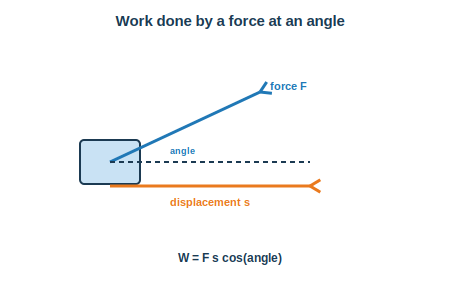
The work done by a constant force F when its point of application moves a displacement s is W = F s cosθ, where θ is the angle between the force and the displacement. Work is a scalar measured in joules. When the force is along the motion the work is positive; at right angles it is zero; and opposite to the motion it is negative, as with friction.
|
Diagram 1 – Work Done by a Force
Fig 1. Only the component of the force along the displacement does work, so W equals F times s times the cosine of the angle between them. |
3. Kinetic Energy and the Work Energy Theorem |
Kinetic energy is the energy of motion, KE = ½ m v². The work energy theorem states that the net work done on a body equals its change in kinetic energy: W = ½ m v² minus ½ m u². It follows directly from the equation v² = u² + 2as combined with F = ma, and it lets us solve many problems without tracking the detailed motion.
4. Potential Energy |
Potential energy is stored energy due to position or configuration. The gravitational potential energy of a mass raised through a height h is PE = m g h. The elastic potential energy stored in a stretched spring of stiffness k and extension x is ½ k x². Forces such as gravity and the spring force, for which the work done does not depend on the path, are called conservative.
5. Conservation of Mechanical Energy |
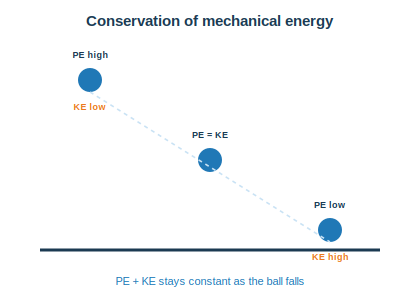
When only conservative forces act, the total mechanical energy, the sum of kinetic and potential energy, stays constant. As a ball falls, its potential energy steadily converts into kinetic energy while the sum remains the same. Where non-conservative forces such as friction act, some mechanical energy is converted into heat, but the total energy of all forms is still conserved.
|
Diagram 2 – Conservation of Mechanical Energy
Fig 2. As the ball falls, potential energy turns into kinetic energy, but their sum stays constant when only gravity acts. |
6. Power |
Power is the rate of doing work, or of transferring energy, P = work ÷ time. Its SI unit is the watt (W), one joule per second. For a force moving an object at velocity v, the instantaneous power is P = F v. Two machines may do the same work, but the more powerful one does it in less time.
7. Key Reasoning (Principles) |
|
Principle 1: Only the along-motion component does work Work is F s cosθ, so a force at right angles to the motion does no work, which is why circular motion at steady speed involves no work by the centripetal force. |
|
Principle 2: Net work equals the change in kinetic energy The work energy theorem, W = ½ m v² minus ½ m u², links force and motion through energy, often avoiding the need for the full equations of motion. |
|
Principle 3: Mechanical energy is conserved for conservative forces When only conservative forces act, kinetic and potential energy trade off while their sum stays constant; friction converts some of it to heat. |
8. Worked Examples |
| Example 1 |
|
Q: A 10 N force moves a body 5 m along its direction. Find the work done. ▶ Show SolutionW = F s cos0 = 10 × 5 × 1. = 50 J. Answer: 50 J. |
| Example 2 |
|
Q: Find the work done by a 20 N force over 4 m at 60 degrees. (cos60 = 0.5) ▶ Show SolutionW = F s cosθ = 20 × 4 × 0.5. = 40 J. Answer: 40 J. |
| Example 3 |
|
Q: Find the kinetic energy of a 2 kg body moving at 5 m/s. ▶ Show SolutionKE = ½ m v² = ½ × 2 × 25. = 25 J. Answer: 25 J. |
| Example 4 |
|
Q: A 4 kg body speeds up from 2 m/s to 4 m/s. Find the work done on it. ▶ Show SolutionW = ½ m (v² minus u²) = ½ × 4 × (16 minus 4). = 24 J. Answer: 24 J. |
| Example 5 |
|
Q: Find the potential energy of a 5 kg body raised 4 m (g = 10 m/s²). ▶ Show SolutionPE = m g h = 5 × 10 × 4. = 200 J. Answer: 200 J. |
| Example 6 |
|
Q: A spring of stiffness 200 N/m is stretched 0.1 m. Find the energy stored. ▶ Show SolutionE = ½ k x² = ½ × 200 × 0.01. = 1 J. Answer: 1 J. |
| Example 7 |
|
Q: A machine does 600 J of work in 30 s. Find its power. ▶ Show SolutionP = work ÷ time = 600 ÷ 30. = 20 W. Answer: 20 W. |
| Example 8 |
|
Q: A force of 50 N moves a body at 4 m/s. Find the power. ▶ Show SolutionP = F v = 50 × 4. = 200 W. Answer: 200 W. |
| Example 9 |
|
Q: A 1 kg ball is dropped from 5 m. Find its speed just before landing (g = 10 m/s²). ▶ Show SolutionBy conservation, ½ m v² = m g h, so v² = 2gh = 100. v = 10 m/s. Answer: 10 m/s. |
| Example 10 |
|
Q: How much work is done by gravity on a body moving horizontally? ▶ Show SolutionGravity is at right angles to a horizontal displacement, so cos90 = 0. Work done = 0. Answer: Zero. |
9. Practice Sets A to D |
| Set A – Multiple Choice (Basic) |
|
1. The SI unit of work is the: (a) newton (b) watt (c) joule (d) pascal 2. Kinetic energy is given by: (a) mgh (b) ½ m v² (c) Fs (d) mv 3. The work energy theorem says net work equals the change in: (a) momentum (b) kinetic energy (c) power (d) force 4. Power is the rate of doing: (a) force (b) work (c) distance (d) mass 5. A force at 90 degrees to the motion does work equal to: (a) Fs (b) zero (c) maximum (d) negative ▶ Reveal Answers1. (c) joule. 2. (b) ½ m v². 3. (b) kinetic energy. 4. (b) work. 5. (b) zero. |
| Set B – Short Answer (Understanding) |
|
1. Define work and give its unit. 2. State the work energy theorem. 3. What is a conservative force? 4. State the law of conservation of mechanical energy. 5. Write the relation between power, force and velocity. ▶ Reveal Answers1. Work is force times displacement along the force, W = F s cosθ, measured in joules. 2. The net work done on a body equals its change in kinetic energy. 3. A force for which the work done does not depend on the path taken, such as gravity. 4. When only conservative forces act, the total mechanical energy stays constant. 5. P = F v, power equals force times velocity. |
| Set C – Application and Reasoning |
|
1. Find the work done by a 15 N force over 6 m along its direction. 2. Find the kinetic energy of a 3 kg body at 4 m/s. 3. Find the potential energy of a 2 kg body at 10 m (g = 10 m/s²). 4. A motor does 900 J in 45 s. Find its power. 5. Why does the centripetal force do no work in circular motion? ▶ Reveal Answers1. W = 15 × 6 = 90 J. 2. KE = ½ × 3 × 16 = 24 J. 3. PE = 2 × 10 × 10 = 200 J. 4. P = 900 ÷ 45 = 20 W. 5. Because it is always at right angles to the velocity, so cos90 = 0 and no work is done. |
| Set D – Higher Order (Challenge) |
|
1. Derive the work energy theorem from F = ma and v² = u² + 2as. 2. A 2 kg body is raised 5 m then dropped (g = 10 m/s²). Find its speed on return to the start. 3. A pump raises 100 kg of water through 10 m in 50 s (g = 10 m/s²). Find the power. 4. Explain why kinetic energy quadruples when speed doubles. 5. A 1000 kg car at 20 m/s brakes to rest. Find the work done by the brakes. ▶ Reveal Answers1. Multiply F = ma by s: Fs = mas; using as = (v² minus u²) ÷ 2 gives Fs = ½ m v² minus ½ m u², the change in kinetic energy. 2. By conservation, the speed on return equals v² = 2gh = 100, so v = 10 m/s. 3. Work = mgh = 100 × 10 × 10 = 10000 J; power = 10000 ÷ 50 = 200 W. 4. Because KE = ½ m v² depends on the square of the speed, so doubling v multiplies energy by four. 5. Work = change in kinetic energy = 0 minus ½ × 1000 × 400 = minus 200000 J, so the brakes do 200000 J of work. |
|
Chapter Summary
|
|||||||||||||||||||||||||||||||
| 8-Point Exam Quick-Check | ||||||||||||||||||||||||||||||||
|
||||||||||||||||||||||||||||||||
|
School Revise Virtual Lab Explore these ideas with interactive simulations and visual tools.
|
|
Class 11 Physics Chapter 5: Work, Energy and Power, Complete Notes and Practice This revision guide follows the current NCERT Class 11 Physics syllabus and develops work and energy, covering work done by a force, kinetic energy and the work energy theorem, gravitational and elastic potential energy, the conservation of mechanical energy, and power, with two diagrams, ten worked examples and graded practice. Visit SchoolRevise.com to revise, practise and excel. |
 Google