Curriculum
Science Grade XI Physics
Science Grade XI Physics
0/14
-
Chapter 1: Units and Measurements
 Preview
 -
Chapter 2: Motion in a Straight Line
Preview
-
Chapter 3: Motion in a Plane
Preview
-
Chapter 4: Laws of Motion
Preview
-
Chapter 5: Work, Energy and Power
Preview
-
Chapter 6: System of Particles and Rotational Motion
Preview
-
Chapter 7: Gravitation
Preview
-
Chapter 8: Mechanical Properties of Solids
Preview
-
Chapter 9: Mechanical Properties of Fluids
Preview
-
Chapter 10: Thermal Properties of Matter
Preview
-
Chapter 11: Thermodynamics
Preview
-
Chapter 12: Kinetic Theory
Preview
-
Chapter 13: Oscillations
Preview
-
Chapter 14: Waves
Preview
Work Sheets
0/14

Chapter 10: Thermal Properties of Matter
|
Grade 11 Science | Chapter 10 Thermal Properties of MatterHeat changes size, temperature and state. This chapter covers temperature scales, thermal expansion, specific heat and calorimetry, and the three ways heat travels.
|
|
Contents
|
1. Introduction: Heat and Temperature |
Temperature measures how hot or cold a body is, while heat is the energy that flows from a hotter to a colder body because of that difference. Adding heat can raise temperature, expand a body, or change its state. This chapter quantifies each of these effects and the ways heat moves from place to place.
|
Core idea Heating a body raises its temperature by Q = m c ΔT, expands it by ΔL = L α ΔT, and at a change of state supplies latent heat. Heat travels by conduction, convection and radiation.
|
2. Temperature Scales |
Temperature is measured on the Celsius and Kelvin scales. Water freezes at 0 degrees Celsius and boils at 100, while the Kelvin scale starts at absolute zero, the lowest possible temperature. The two are simply related: a temperature in kelvin equals the Celsius value plus 273.15, so a change of one degree is the same size on both scales.
3. Thermal Expansion |
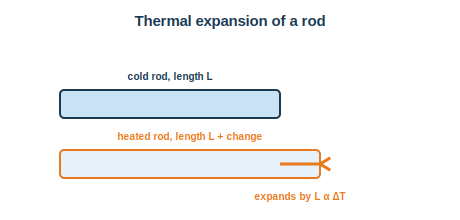
Most substances expand on heating as their particles vibrate more and move apart. For a rod, the increase in length is ΔL = L α ΔT, where α is the coefficient of linear expansion and ΔT the temperature rise. This is why gaps are left in railway lines and bridges to allow for expansion in hot weather.
|
Diagram 1 – Thermal Expansion
Fig 1. Heating a rod increases its length by L times alpha times the temperature rise, as its particles move further apart. |
4. Specific Heat Capacity |
The specific heat capacity c is the heat needed to raise the temperature of one kilogram of a substance by one degree. The heat supplied is Q = m c ΔT, where m is the mass and ΔT the temperature change. Water has an unusually high specific heat, which is why it warms and cools slowly and is used as a coolant.
5. Calorimetry and Latent Heat |
Calorimetry measures heat by the principle that, in an insulated system, the heat lost by the hot body equals the heat gained by the cold body. During a change of state, heat is absorbed or released at constant temperature; this is the latent heat, given by Q = m L. Ice melting and water boiling both take in latent heat without any change in temperature.
6. Heat Transfer |
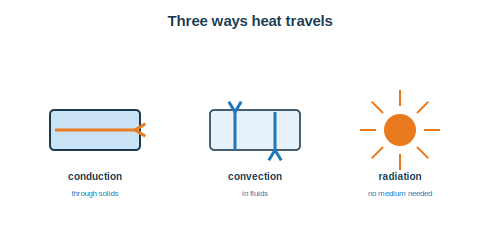
Heat travels in three ways. In conduction, energy passes through a material by particle vibrations without the material moving, as along a metal rod. In convection, warm fluid rises and cool fluid sinks, carrying heat with it. In radiation, heat travels as electromagnetic waves and needs no medium, which is how the Sun’s heat reaches the Earth.
|
Diagram 2 – Three Ways Heat Travels
Fig 2. Conduction passes heat through solids, convection carries it in moving fluids, and radiation sends it as waves needing no medium. |
7. Key Reasoning (Principles) |
|
Principle 1: Heat raises temperature by Q = m c ΔT The heat needed depends on the mass, the specific heat and the temperature change, so a substance with a high specific heat needs more heat for the same rise. |
|
Principle 2: Heat lost equals heat gained In an insulated mixture, energy is conserved, so the heat given out by the hot body equals the heat taken in by the cold body, which lets us find a final temperature. |
|
Principle 3: A change of state takes latent heat Melting or boiling absorbs heat at constant temperature, Q = m L, because the energy goes into breaking the bonds between particles rather than raising the temperature. |
8. Worked Examples |
| Example 1 |
|
Q: Convert 27 degrees Celsius to kelvin. ▶ Show SolutionK = C + 273.15 = 27 + 273.15. = 300.15 K (about 300 K). Answer: About 300 K. |
| Example 2 |
|
Q: Find the heat to raise 2 kg of water by 10 degrees (c = 4200 J/kg per degree). ▶ Show SolutionQ = m c ΔT = 2 × 4200 × 10. = 84000 J. Answer: 84000 J. |
| Example 3 |
|
Q: A 1 m rod (α = 1.2 × 10⁻⁵) is heated by 50 degrees. Find the expansion. ▶ Show SolutionΔL = L α ΔT = 1 × 1.2 × 10-5 × 50. = 6 × 10⁻⁴ m. Answer: 6 × 10⁻⁴ m. |
| Example 4 |
|
Q: Find the heat to melt 0.5 kg of ice (latent heat L = 336000 J/kg). ▶ Show SolutionQ = m L = 0.5 × 336000. = 168000 J. Answer: 168000 J. |
| Example 5 |
|
Q: Find the heat to raise 3 kg of a metal (c = 500) by 20 degrees. ▶ Show SolutionQ = 3 × 500 × 20. = 30000 J. Answer: 30000 J. |
| Example 6 |
|
Q: Convert 100 degrees Celsius to kelvin. ▶ Show SolutionK = 100 + 273.15. = 373.15 K. Answer: 373.15 K. |
| Example 7 |
|
Q: Name the three ways heat travels. ▶ Show SolutionConduction, convection and radiation. Answer: Conduction, convection, radiation. |
| Example 8 |
|
Q: Which mode of heat transfer needs no medium? ▶ Show SolutionRadiation travels as electromagnetic waves and needs no medium. Answer: Radiation. |
| Example 9 |
|
Q: Find the heat to raise 0.5 kg of water by 40 degrees (c = 4200). ▶ Show SolutionQ = 0.5 × 4200 × 40. = 84000 J. Answer: 84000 J. |
| Example 10 |
|
Q: Why is water used as a coolant? ▶ Show SolutionIts high specific heat lets it absorb a lot of heat for a small temperature rise. Answer: Because of its high specific heat. |
9. Practice Sets A to D |
| Set A – Multiple Choice (Basic) |
|
1. A temperature in kelvin equals Celsius plus: (a) 100 (b) 273.15 (c) 32 (d) 0 2. The heat to change temperature is: (a) mL (b) m c ΔT (c) L α ΔT (d) F ÷ A 3. Linear expansion is given by: (a) L α ΔT (b) m c ΔT (c) mL (d) hρg 4. Heat through a solid without it moving is: (a) convection (b) radiation (c) conduction (d) latent heat 5. Heat that needs no medium travels by: (a) conduction (b) convection (c) radiation (d) calorimetry ▶ Reveal Answers1. (b) 273.15. 2. (b) m c ΔT. 3. (a) L α ΔT. 4. (c) conduction. 5. (c) radiation. |
| Set B – Short Answer (Understanding) |
|
1. State the difference between heat and temperature. 2. Write the formula for heat needed to change temperature. 3. Write the formula for linear thermal expansion. 4. What is latent heat? 5. Name and describe the three modes of heat transfer. ▶ Reveal Answers1. Temperature is how hot a body is; heat is the energy that flows due to a temperature difference. 2. Q = m c ΔT. 3. ΔL = L α ΔT. 4. The heat absorbed or released during a change of state at constant temperature, Q = m L. 5. Conduction through solids, convection in moving fluids, radiation as waves needing no medium. |
| Set C – Application and Reasoning |
|
1. Convert 50 degrees Celsius to kelvin. 2. Find the heat to raise 1 kg of water by 25 degrees (c = 4200). 3. A 2 m rod (α = 1.2 × 10⁻⁵) is heated by 100 degrees. Find the expansion. 4. Find the heat to melt 1 kg of ice (L = 336000). 5. Why are gaps left in railway lines? ▶ Reveal Answers1. 50 + 273.15 = 323.15 K. 2. Q = 1 × 4200 × 25 = 105000 J. 3. ΔL = 2 × 1.2 × 10-5 × 100 = 2.4 × 10⁻³ m. 4. Q = 1 × 336000 = 336000 J. 5. To allow the rails to expand in hot weather without buckling. |
| Set D – Higher Order (Challenge) |
|
1. Hot water at 80 degrees is mixed with equal mass at 20 degrees. Find the final temperature (same substance). 2. Find the heat to turn 0.2 kg of ice at 0 degrees into water at 0 degrees (L = 336000). 3. Explain why coastal areas have milder temperatures than inland areas. 4. A 5 kg block of metal (c = 400) cools by 30 degrees. Find the heat released. 5. Explain why latent heat is absorbed without a temperature change. ▶ Reveal Answers1. Heat lost = heat gained; equal masses and specific heat give the average, (80 + 20) ÷ 2 = 50 degrees. 2. Q = m L = 0.2 × 336000 = 67200 J. 3. Water’s high specific heat means the sea warms and cools slowly, moderating the temperature of nearby land. 4. Q = m c ΔT = 5 × 400 × 30 = 60000 J. 5. Because the energy goes into breaking the bonds between particles during the change of state, not into raising the temperature. |
|
Chapter Summary
|
|||||||||||||||||||||||||||||||
| 8-Point Exam Quick-Check | ||||||||||||||||||||||||||||||||
|
||||||||||||||||||||||||||||||||
|
School Revise Virtual Lab Explore these ideas with interactive simulations and visual tools.
|
|
Class 11 Physics Chapter 10: Thermal Properties of Matter, Complete Notes and Practice This revision guide follows the current NCERT Class 11 Physics syllabus and develops the thermal behaviour of matter, covering temperature scales, thermal expansion, specific heat capacity, calorimetry and latent heat, and the three modes of heat transfer, with two diagrams, ten worked examples and graded practice. Visit SchoolRevise.com to revise, practise and excel. |
 Google