Curriculum
Science Grade XI Physics
Science Grade XI Physics
0/14
-
Chapter 1: Units and Measurements
 Preview
 -
Chapter 2: Motion in a Straight Line
Preview
-
Chapter 3: Motion in a Plane
Preview
-
Chapter 4: Laws of Motion
Preview
-
Chapter 5: Work, Energy and Power
Preview
-
Chapter 6: System of Particles and Rotational Motion
Preview
-
Chapter 7: Gravitation
Preview
-
Chapter 8: Mechanical Properties of Solids
Preview
-
Chapter 9: Mechanical Properties of Fluids
Preview
-
Chapter 10: Thermal Properties of Matter
Preview
-
Chapter 11: Thermodynamics
Preview
-
Chapter 12: Kinetic Theory
Preview
-
Chapter 13: Oscillations
Preview
-
Chapter 14: Waves
Preview
Chapter 8: Mechanical Properties of Solids
|
Grade 11 Science | Chapter 8 Mechanical Properties of SolidsSolids bend, stretch and break in predictable ways. This chapter defines stress and strain, states Hooke’s law, and introduces the elastic moduli, including Young’s modulus.
|
|
Contents
|
1. Introduction: Elasticity |
A solid resists being stretched, squashed or twisted, and largely returns to its shape when the force is removed. This property is elasticity. To describe it precisely we need two ideas, the stress applied and the strain produced, and the law that links them for small deformations.
|
Core idea For small deformations, stress is proportional to strain (Hooke’s law). Their ratio is an elastic modulus; for stretching it is Young’s modulus, a measure of a material’s stiffness.
|
2. Stress |
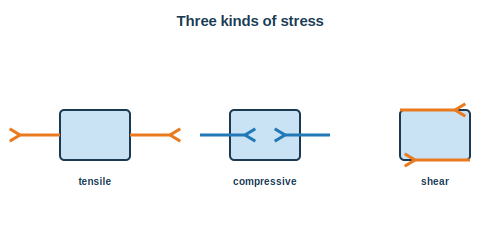
Stress is the internal restoring force per unit area set up in a body when it is deformed, equal to the applied force divided by the cross-sectional area, stress = F ÷ A. Its unit is the pascal (Pa). Stress may be tensile (stretching), compressive (squashing) or shear (sliding layers).
|
Diagram 1 – Three Kinds of Stress
Fig 1. Tensile stress stretches a body, compressive stress squashes it, and shear stress slides one face relative to the other. |
3. Strain |
Strain is the fractional deformation produced, a ratio with no units. Longitudinal strain is the change in length divided by the original length, ΔL ÷ L. There are also volume strain and shear strain. Because strain is a ratio, it simply expresses how much a body has deformed relative to its size.
4. Hooke’s Law |
Hooke’s law states that, within the elastic limit, the stress is directly proportional to the strain. The constant of proportionality is the modulus of elasticity. Beyond the elastic limit the law fails, the body no longer returns fully to its shape, and a permanent deformation remains.
5. Young’s Modulus |
Young’s modulus Y is the ratio of tensile stress to longitudinal strain, Y = stress ÷ strain = (F ÷ A) ÷ (ΔL ÷ L). A large Young’s modulus means a stiff material that stretches very little under load, such as steel. It is measured in pascals and is a property of the material, not the particular sample.
| Quantity | Definition | Unit |
| Stress | force ÷ area | pascal (Pa) |
| Strain | change in length ÷ length | none |
| Young’s modulus | stress ÷ strain | pascal (Pa) |
6. The Stress to Strain Curve |
A graph of stress against strain reveals a material’s behaviour. At first the line is straight, the proportional region where Hooke’s law holds, up to the elastic limit. Beyond it the material yields and deforms permanently, until finally it reaches its breaking point and fractures. The curve summarises strength, stiffness and ductility at a glance.
|
Diagram 2 – Stress to Strain Curve
Fig 2. The straight portion is the Hooke’s law region up to the elastic limit; beyond it the material yields and finally fractures. |

7. Key Reasoning (Principles) |
|
Principle 1: Stress is proportional to strain (small deformations) Within the elastic limit, Hooke’s law holds and the body returns fully to its shape when unloaded. Their constant ratio is an elastic modulus. |
|
Principle 2: A modulus measures stiffness A large Young’s modulus means a material strains very little for a given stress, that is, it is stiff. Steel has a far larger modulus than rubber. |
|
Principle 3: Beyond the elastic limit, deformation is permanent Once the elastic limit is passed, Hooke’s law fails and the body keeps some deformation even after the load is removed. |
8. Worked Examples |
| Example 1 |
|
Q: A force of 200 N acts on a wire of cross-section 0.0001 m². Find the stress. ▶ Show SolutionStress = F ÷ A = 200 ÷ 0.0001. = 2 × 10⁶ Pa. Answer: 2 × 10⁶ Pa. |
| Example 2 |
|
Q: A 2 m wire stretches by 0.001 m. Find the strain. ▶ Show SolutionStrain = ΔL ÷ L = 0.001 ÷ 2. = 5 × 10⁻⁴. Answer: 5 × 10⁻⁴. |
| Example 3 |
|
Q: A stress of 4 × 10⁷ Pa gives a strain of 2 × 10⁻⁴. Find Young’s modulus. ▶ Show SolutionY = stress ÷ strain = 4 × 10⁷ ÷ 2 × 10⁻⁴. = 2 × 10¹¹ Pa. Answer: 2 × 10¹¹ Pa. |
| Example 4 |
|
Q: Find the stress for a 500 N force on a 0.0005 m² bar. ▶ Show SolutionStress = 500 ÷ 0.0005. = 1 × 10⁶ Pa. Answer: 1 × 10⁶ Pa. |
| Example 5 |
|
Q: A 4 m rod stretches by 0.002 m. Find the strain. ▶ Show SolutionStrain = 0.002 ÷ 4. = 5 × 10⁻⁴. Answer: 5 × 10⁻⁴. |
| Example 6 |
|
Q: What does a large Young’s modulus tell you about a material? ▶ Show SolutionA large modulus means a small strain for a given stress. So the material is stiff. Answer: It is stiff (strains little). |
| Example 7 |
|
Q: Why is strain a dimensionless quantity? ▶ Show SolutionIt is the ratio of two lengths, so the units cancel. Answer: Because it is a ratio of lengths. |
| Example 8 |
|
Q: A wire of Y = 2 × 10¹¹ Pa carries a stress of 1 × 10⁸ Pa. Find the strain. ▶ Show SolutionStrain = stress ÷ Y = 1 × 10⁸ ÷ 2 × 10¹¹. = 5 × 10⁻⁴. Answer: 5 × 10⁻⁴. |
| Example 9 |
|
Q: Name the three kinds of stress. ▶ Show SolutionTensile, compressive and shear stress. Answer: Tensile, compressive and shear. |
| Example 10 |
|
Q: What happens beyond the elastic limit? ▶ Show SolutionHooke’s law fails and the material keeps a permanent deformation. Answer: Permanent deformation remains. |
9. Practice Sets A to D |
| Set A – Multiple Choice (Basic) |
|
1. Stress is: (a) force × area (b) force ÷ area (c) area ÷ force (d) force × length 2. Strain has the unit: (a) pascal (b) newton (c) none (d) metre 3. Hooke’s law holds within the: (a) fracture point (b) elastic limit (c) yield point (d) plastic region 4. Young’s modulus is the ratio of stress to: (a) force (b) strain (c) area (d) length 5. A stiff material has a Young’s modulus that is: (a) small (b) large (c) zero (d) negative ▶ Reveal Answers1. (b) force ÷ area. 2. (c) none. 3. (b) elastic limit. 4. (b) strain. 5. (b) large. |
| Set B – Short Answer (Understanding) |
|
1. Define stress and give its unit. 2. Define strain. 3. State Hooke’s law. 4. Define Young’s modulus. 5. What happens beyond the elastic limit? ▶ Reveal Answers1. Stress is the restoring force per unit area, F ÷ A, in pascals. 2. Strain is the fractional deformation, change in length divided by original length. 3. Within the elastic limit, stress is directly proportional to strain. 4. The ratio of tensile stress to longitudinal strain, a measure of stiffness. 5. Hooke’s law fails and the material keeps a permanent deformation. |
| Set C – Application and Reasoning |
|
1. Find the stress for 400 N on 0.0002 m². 2. A 5 m wire stretches 0.0025 m. Find the strain. 3. A stress of 6 × 10⁷ Pa gives strain 3 × 10⁻⁴. Find Y. 4. Find the strain for stress 1 × 10⁸ Pa, Y = 2 × 10¹¹ Pa. 5. Why does a thicker wire stretch less under the same load? ▶ Reveal Answers1. Stress = 400 ÷ 0.0002 = 2 × 10⁶ Pa. 2. Strain = 0.0025 ÷ 5 = 5 × 10⁻⁴. 3. Y = 6 × 10⁷ ÷ 3 × 10-4 = 2 × 10¹¹ Pa. 4. Strain = 1 × 10⁸ ÷ 2 × 1011 = 5 × 10⁻⁴. 5. A larger cross-sectional area gives a smaller stress for the same force, so less strain. |
| Set D – Higher Order (Challenge) |
|
1. Derive the elongation of a wire from Y = (F L) ÷ (A ΔL). 2. A steel wire (Y = 2 × 10¹¹ Pa), length 2 m, area 1 × 10⁻⁶ m², carries 100 N. Find the elongation. 3. Why is steel chosen over copper for load-bearing structures? 4. Explain why strain is the same in two wires of the same material under equal stress. 5. Sketch in words how the stress to strain curve shows ductility. ▶ Reveal Answers1. Rearranging Y = (F ÷ A) ÷ (ΔL ÷ L) gives ΔL = F L ÷ (A Y). 2. ΔL = (100 × 2) ÷ (1 × 10-6 × 2 × 1011) = 200 ÷ (2 × 10⁵) = 1 × 10⁻³ m. 3. Steel has a larger Young’s modulus, so it deforms less and is stiffer under load. 4. Because Y is the same for the same material, equal stress gives equal strain regardless of size. 5. A long region between yield and fracture shows the material stretches a lot before breaking, that is, high ductility. |
|
Chapter Summary
|
|||||||||||||||||||||||||||||||
| 8-Point Exam Quick-Check | ||||||||||||||||||||||||||||||||
|
||||||||||||||||||||||||||||||||
|
School Revise Virtual Lab Explore these ideas with interactive simulations and visual tools.
|
|
Class 11 Physics Chapter 8: Mechanical Properties of Solids, Complete Notes and Practice This revision guide follows the current NCERT Class 11 Physics syllabus and develops the elasticity of solids, covering stress and its three kinds, strain, Hooke’s law, Young’s modulus and material stiffness, and the stress to strain curve with its elastic limit, yield and fracture, with two diagrams, ten worked examples and graded practice. Visit SchoolRevise.com to revise, practise and excel. |
 Google