Curriculum
Science Grade XI Physics
Science Grade XI Physics
0/14
-
Chapter 1: Units and Measurements
 Preview
 -
Chapter 2: Motion in a Straight Line
Preview
-
Chapter 3: Motion in a Plane
Preview
-
Chapter 4: Laws of Motion
Preview
-
Chapter 5: Work, Energy and Power
Preview
-
Chapter 6: System of Particles and Rotational Motion
Preview
-
Chapter 7: Gravitation
Preview
-
Chapter 8: Mechanical Properties of Solids
Preview
-
Chapter 9: Mechanical Properties of Fluids
Preview
-
Chapter 10: Thermal Properties of Matter
Preview
-
Chapter 11: Thermodynamics
Preview
-
Chapter 12: Kinetic Theory
Preview
-
Chapter 13: Oscillations
Preview
-
Chapter 14: Waves
Preview
Work Sheets
0/14

Chapter 2: Motion in a Straight Line
|
Grade 11 Science | Chapter 2 Motion in a Straight LineMotion is the change of position with time. This chapter builds the kinematics of straight-line motion, reads it from graphs, and derives the three equations of motion.
|
|
Contents
|
1. Introduction: Describing Motion |
An object is in motion when its position changes with time relative to a chosen reference point. In this chapter we treat motion along a straight line, where direction reduces to a sign, plus or minus. We define the quantities that describe such motion, learn to read them from graphs, and derive the equations that link them for constant acceleration.
These ideas are the foundation of all of mechanics. Once we can describe how an object moves, the next chapters ask why it moves the way it does.
|
Core idea Straight-line motion is fully described by position, velocity and acceleration as functions of time, with direction shown by a sign. Graphs and the equations of motion summarise how they relate.
|
2. Position, Distance and Displacement |
Position is the location of an object measured from a reference point. Distance is the total path length covered, a scalar. Displacement is the change in position, a vector equal to final minus initial position. On a round trip the distance is non-zero but the displacement is zero, because the object returns to its start.
3. Speed, Velocity and Acceleration |
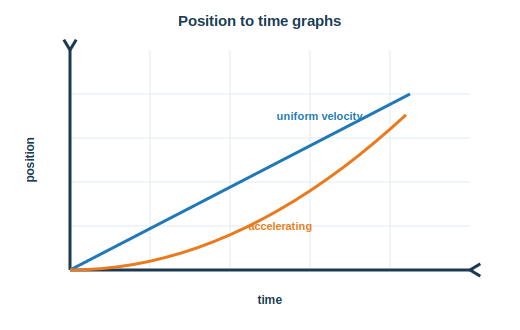
Average velocity is displacement divided by time taken; average speed is distance divided by time. Instantaneous velocity is the velocity at a single moment, the slope of the position to time graph at that point. Acceleration is the rate of change of velocity, the slope of the velocity to time graph, measured in metres per second squared.
|
Diagram 1 – Position to Time Graphs
Fig 1. A straight sloping line shows uniform velocity; its slope is the velocity. A curve shows changing velocity, that is acceleration. |
4. Motion Graphs |
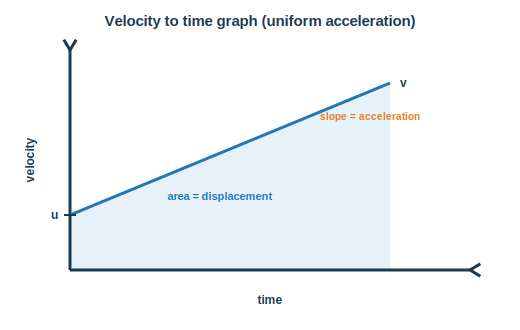
Graphs make motion easy to read. On a velocity to time graph, the slope of the line gives the acceleration, and the area between the line and the time axis gives the displacement. For uniform acceleration the line is straight, so the area is a trapezium, which leads directly to the equations of motion.
|
Diagram 2 – Velocity to Time Graph
Fig 2. For uniform acceleration the velocity line is straight. Its slope is the acceleration; the shaded area beneath it is the displacement. |
5. The Equations of Motion |
For motion with uniform acceleration a, with initial velocity u, final velocity v, time t and displacement s, three equations hold: v = u + at, s = ut + ½ a t², and v² = u² + 2 a s. They can be derived straight from the velocity to time graph: the first from the slope, the second from the area, and the third by eliminating t between the two. They apply only while the acceleration stays constant.
| Equation | Derived From | Use When |
| v = u + at | slope of the v to t line | time is known |
| s = ut + ½ a t² | area under the v to t line | time is known |
| v² = u² + 2as | eliminating t | time is not known |
6. Motion Under Gravity |
Near the Earth, a freely falling object has a constant downward acceleration g, about 9.8 m/s² (often taken as 10 m/s² for simple work). The same three equations apply, with a replaced by g and displacement measured as height. A body thrown up slows, stops momentarily at the top, and returns with the speed it was thrown.
7. Key Reasoning (Principles) |
|
Principle 1: Slope is a rate of change On a position to time graph the slope is velocity; on a velocity to time graph the slope is acceleration. Reading slopes turns a graph into the full story of the motion. |
|
Principle 2: Area is the accumulated change The area under a velocity to time graph equals the displacement, because it adds velocity multiplied by time over the whole motion. |
|
Principle 3: The equations need constant acceleration The three equations of motion were derived assuming a is constant, so they may not be used when the acceleration changes during the motion. |
8. Worked Examples |
| Example 1 |
|
Q: A body starts from rest and reaches 20 m/s in 4 s. Find its acceleration. ▶ Show Solutiona = (v minus u) ÷ t = (20 minus 0) ÷ 4. = 5 m/s². Answer: 5 m/s². |
| Example 2 |
|
Q: Using v = u + at, find v for u = 5 m/s, a = 2 m/s², t = 6 s. ▶ Show Solutionv = 5 + 2 × 6. = 17 m/s. Answer: 17 m/s. |
| Example 3 |
|
Q: A car starts from rest with a = 3 m/s². Find its displacement in 4 s. ▶ Show Solutions = ut + ½ a t² = 0 + ½ × 3 × 16. = 24 m. Answer: 24 m. |
| Example 4 |
|
Q: Using v² = u² + 2as, find v for u = 0, a = 2 m/s², s = 25 m. ▶ Show Solutionv² = 0 + 2 × 2 × 25 = 100. v = 10 m/s. Answer: 10 m/s. |
| Example 5 |
|
Q: A train moving at 30 m/s brakes to rest in 10 s. Find its acceleration. ▶ Show Solutiona = (0 minus 30) ÷ 10. = minus 3 m/s² (deceleration). Answer: minus 3 m/s². |
| Example 6 |
|
Q: Find the displacement of a body moving at a steady 12 m/s for 9 s. ▶ Show SolutionDisplacement = velocity × time = 12 × 9. = 108 m. Answer: 108 m. |
| Example 7 |
|
Q: A stone is dropped from rest. Find its speed after 3 s (take g = 10 m/s²). ▶ Show Solutionv = u + gt = 0 + 10 × 3. = 30 m/s. Answer: 30 m/s. |
| Example 8 |
|
Q: A ball is dropped from a height. Find the distance fallen in 2 s (g = 10 m/s²). ▶ Show Solutions = ut + ½ g t² = 0 + ½ × 10 × 4. = 20 m. Answer: 20 m. |
| Example 9 |
|
Q: A body covers 100 m in 20 s, then 60 m in 10 s. Find its average speed. ▶ Show SolutionAverage speed = total distance ÷ total time = 160 ÷ 30. = 5.33 m/s. Answer: About 5.33 m/s. |
| Example 10 |
|
Q: A ball is thrown up at 20 m/s. Find the time to reach its highest point (g = 10 m/s²). ▶ Show SolutionAt the top v = 0, so 0 = 20 minus 10 t, giving t = 2 s. Answer: 2 s. |
9. Practice Sets A to D |
| Set A – Multiple Choice (Basic) |
|
1. The slope of a position to time graph gives the: (a) distance (b) velocity (c) acceleration (d) time 2. The area under a velocity to time graph gives the: (a) speed (b) acceleration (c) displacement (d) force 3. The SI unit of acceleration is: (a) m/s (b) m/s² (c) m (d) s 4. A freely falling body has acceleration about: (a) 0 (b) 5 m/s² (c) 9.8 m/s² (d) 98 m/s² 5. The equations of motion apply only for: (a) any motion (b) uniform acceleration (c) rest (d) circular motion ▶ Reveal Answers1. (b) velocity. 2. (c) displacement. 3. (b) m/s². 4. (c) 9.8 m/s². 5. (b) uniform acceleration. |
| Set B – Short Answer (Understanding) |
|
1. State the difference between distance and displacement. 2. What does the slope of a velocity to time graph represent? 3. Define acceleration. 4. Why is the displacement zero for a round trip? 5. When can the equations of motion not be used? ▶ Reveal Answers1. Distance is total path length (scalar); displacement is the change in position with direction (vector). 2. It represents the acceleration of the object. 3. Acceleration is the rate of change of velocity with time. 4. Because the object returns to its starting point, so the change in position is zero. 5. When the acceleration is not constant during the motion. |
| Set C – Application and Reasoning |
|
1. A body accelerates from 4 m/s to 16 m/s in 6 s. Find its acceleration. 2. Find the displacement of a body with u = 0, a = 4 m/s² after 5 s. 3. A stone is dropped and hits the ground after 4 s. Find its final speed (g = 10 m/s²). 4. Using v² = u² + 2as, find the distance for u = 10 m/s, v = 0, a = minus 2 m/s². 5. A car travels 90 m in 6 s, then 90 m in 9 s. Find the average speed. ▶ Reveal Answers1. (16 minus 4) ÷ 6 = 2 m/s². 2. s = 0 + ½ × 4 × 25 = 50 m. 3. v = 0 + 10 × 4 = 40 m/s. 4. 0 = 100 + 2(minus 2)s, so 4s = 100, s = 25 m. 5. Total 180 m in 15 s, average speed = 12 m/s. |
| Set D – Higher Order (Challenge) |
|
1. A ball is thrown up at 30 m/s. Find the maximum height reached (g = 10 m/s²). 2. Derive v = u + at from the definition of acceleration. 3. A car starts from rest, accelerates at 2 m/s² for 5 s, then moves steadily for 5 s. Find the total distance. 4. Two stones are dropped 1 s apart. Explain how the gap between them changes as they fall. 5. Show, using the area under a v to t graph, that s = ut + ½ a t². ▶ Reveal Answers1. At the top v = 0; v² = u² minus 2gs gives 0 = 900 minus 20s, so s = 45 m. 2. Acceleration a = (v minus u) ÷ t; rearranging gives v = u + at. 3. Phase 1: s = ½ × 2 × 25 = 25 m, reaching v = 10 m/s; phase 2: 10 × 5 = 50 m; total = 75 m. 4. The gap increases with time, because the lower stone is always moving faster, so the distance between them grows. 5. The area is a rectangle ut plus a triangle ½ t (at), giving s = ut + ½ a t². |
|
Chapter Summary
|
|||||||||||||||||||||||||||||||
| 8-Point Exam Quick-Check | ||||||||||||||||||||||||||||||||
|
||||||||||||||||||||||||||||||||
|
School Revise Virtual Lab Explore these ideas with interactive simulations and visual tools.
|
|
Class 11 Physics Chapter 2: Motion in a Straight Line, Complete Notes and Practice This revision guide follows the current NCERT Class 11 Physics syllabus and builds the kinematics of straight-line motion, covering position, distance and displacement, speed, velocity and acceleration, position and velocity graphs, the three equations of motion and their derivation, and motion under gravity, with two graphs, ten worked examples and graded practice. Visit SchoolRevise.com to revise, practise and excel. |
 Google