Curriculum
Science Grade XI Physics
Science Grade XI Physics
0/14
-
Chapter 1: Units and Measurements
 Preview
 -
Chapter 2: Motion in a Straight Line
Preview
-
Chapter 3: Motion in a Plane
Preview
-
Chapter 4: Laws of Motion
Preview
-
Chapter 5: Work, Energy and Power
Preview
-
Chapter 6: System of Particles and Rotational Motion
Preview
-
Chapter 7: Gravitation
Preview
-
Chapter 8: Mechanical Properties of Solids
Preview
-
Chapter 9: Mechanical Properties of Fluids
Preview
-
Chapter 10: Thermal Properties of Matter
Preview
-
Chapter 11: Thermodynamics
Preview
-
Chapter 12: Kinetic Theory
Preview
-
Chapter 13: Oscillations
Preview
-
Chapter 14: Waves
Preview
Work Sheets
0/14

Chapter 11: Thermodynamics
|
Grade 11 Science | Chapter 11 ThermodynamicsThermodynamics is the physics of heat and work. This chapter builds the first law, the main processes, and how a heat engine turns heat into work with a limited efficiency.
|
|
Contents
|
1. Introduction: Heat and Work |
Thermodynamics studies how heat and work transfer energy and how that energy is conserved. A gas can take in heat and do work by expanding, or have work done on it and give out heat. This chapter states the law that links these, describes the standard processes, and shows why a heat engine can never be perfectly efficient.
|
Core idea The first law, ΔU = Q minus W, is the conservation of energy for heat and work. The second law sets a limit on how much heat can be turned into work.
|
2. Internal Energy |
The internal energy U of a system is the total energy of its molecules, their kinetic and potential energy. It depends only on the state of the system, not on how it got there. For an ideal gas the internal energy depends only on its temperature, so heating the gas raises its internal energy.
3. The First Law of Thermodynamics |
The first law states that the heat Q added to a system equals the increase in its internal energy ΔU plus the work W done by the system: Q = ΔU + W, often written ΔU = Q minus W. It is simply the conservation of energy applied to heat and work, and it holds for every process.
4. Thermodynamic Processes |
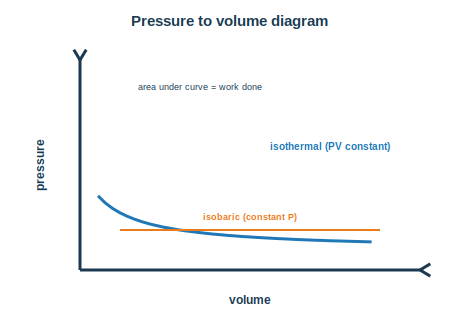
A gas can change in several standard ways. An isothermal process keeps the temperature constant; an adiabatic process exchanges no heat; an isobaric process keeps the pressure constant; and an isochoric process keeps the volume constant, so no work is done. On a pressure to volume diagram, the work done by the gas equals the area under the curve.
|
Diagram 1 – Pressure to Volume Diagram
Fig 1. On a pressure to volume diagram each process traces a different path, and the work done by the gas equals the area beneath the curve. |
5. Heat Engines and Efficiency |
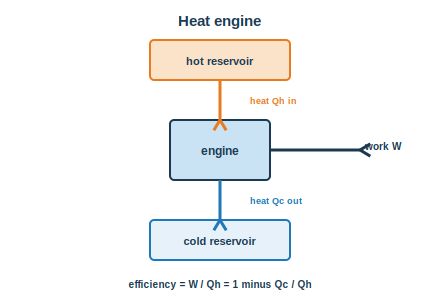
A heat engine takes in heat from a hot reservoir, converts part of it into work, and rejects the rest to a cold reservoir. Its efficiency is the work output divided by the heat input, η = W ÷ Qh = 1 minus Qc ÷ Qh. Because some heat is always rejected, the efficiency is always less than one.
|
Diagram 2 – Heat Engine
Fig 2. A heat engine takes heat Qh from a hot reservoir, does work W, and rejects heat Qc to a cold reservoir; its efficiency is W over Qh. |
6. The Second Law |
The second law of thermodynamics states that heat flows by itself only from hot to cold, never the reverse, and that no engine can convert heat entirely into work. There is always some heat rejected. This sets a maximum possible efficiency for any engine working between two temperatures, reached only by an ideal Carnot engine.
7. Key Reasoning (Principles) |
|
Principle 1: Energy is conserved (first law) Heat added either raises the internal energy or does work, ΔU = Q minus W. Energy is never created or destroyed, only transferred. |
|
Principle 2: Work is the area on a PV diagram The work done by a gas equals the area under its path on a pressure to volume diagram, which is why an isochoric process does no work. |
|
Principle 3: No engine is perfectly efficient (second law) Some heat is always rejected to the cold reservoir, so efficiency is always below one; heat will not flow from cold to hot on its own. |
8. Worked Examples |
| Example 1 |
|
Q: A gas absorbs 200 J of heat and does 50 J of work. Find the change in internal energy. ▶ Show SolutionΔU = Q minus W = 200 minus 50. = 150 J. Answer: 150 J. |
| Example 2 |
|
Q: A gas does 80 J of work while its internal energy stays constant. Find the heat absorbed. ▶ Show SolutionQ = ΔU + W = 0 + 80. = 80 J. Answer: 80 J. |
| Example 3 |
|
Q: An engine takes in 500 J and rejects 300 J. Find the work done. ▶ Show SolutionW = Qh minus Qc = 500 minus 300. = 200 J. Answer: 200 J. |
| Example 4 |
|
Q: For the same engine, find the efficiency. ▶ Show Solutionη = W ÷ Qh = 200 ÷ 500. = 0.4 or 40%. Answer: 40%. |
| Example 5 |
|
Q: How much work is done in an isochoric (constant volume) process? ▶ Show SolutionNo volume change means no work is done. W = 0. Answer: Zero. |
| Example 6 |
|
Q: A gas releases 120 J of heat and 120 J of work is done on it. Find ΔU. ▶ Show SolutionΔU = Q minus W = (minus 120) minus (minus 120). = 0 J. Answer: 0 J. |
| Example 7 |
|
Q: An engine has efficiency 0.25 and takes in 800 J. Find the work output. ▶ Show SolutionW = η Qh = 0.25 × 800. = 200 J. Answer: 200 J. |
| Example 8 |
|
Q: Which process exchanges no heat with the surroundings? ▶ Show SolutionAn adiabatic process exchanges no heat. Answer: Adiabatic. |
| Example 9 |
|
Q: An engine takes in 1000 J and does 350 J of work. Find the heat rejected. ▶ Show SolutionQc = Qh minus W = 1000 minus 350. = 650 J. Answer: 650 J. |
| Example 10 |
|
Q: Why can no engine be 100% efficient? ▶ Show SolutionBy the second law some heat is always rejected to the cold reservoir. Answer: Because heat is always rejected (second law). |
9. Practice Sets A to D |
| Set A – Multiple Choice (Basic) |
|
1. The first law is: (a) ΔU = Q + W (b) ΔU = Q minus W (c) Q = W (d) U = 0 2. An isothermal process keeps constant: (a) pressure (b) volume (c) temperature (d) heat 3. An adiabatic process has: (a) no work (b) no heat exchange (c) constant volume (d) constant pressure 4. Engine efficiency is: (a) Qc ÷ Qh (b) W ÷ Qh (c) Qh ÷ W (d) Qh minus Qc 5. No engine can be: (a) hot (b) 100% efficient (c) cold (d) reversible ▶ Reveal Answers1. (b) ΔU = Q minus W. 2. (c) temperature. 3. (b) no heat exchange. 4. (b) W ÷ Qh. 5. (b) 100% efficient. |
| Set B – Short Answer (Understanding) |
|
1. Define internal energy. 2. State the first law of thermodynamics. 3. Name the four standard thermodynamic processes. 4. Write the formula for the efficiency of a heat engine. 5. State the second law of thermodynamics. ▶ Reveal Answers1. The total kinetic and potential energy of the molecules of a system, depending only on its state. 2. The heat added equals the change in internal energy plus the work done, ΔU = Q minus W. 3. Isothermal, adiabatic, isobaric and isochoric. 4. η = W ÷ Qh = 1 minus Qc ÷ Qh. 5. Heat flows by itself only from hot to cold, and no engine converts heat entirely into work. |
| Set C – Application and Reasoning |
|
1. A gas absorbs 300 J and does 100 J of work. Find ΔU. 2. An engine takes 600 J and rejects 400 J. Find the work done. 3. Find the efficiency of an engine doing 150 J from 500 J input. 4. How much work is done in a constant-volume process? 5. Why does an isothermal process keep internal energy constant for an ideal gas? ▶ Reveal Answers1. ΔU = 300 minus 100 = 200 J. 2. W = 600 minus 400 = 200 J. 3. η = 150 ÷ 500 = 0.3 or 30%. 4. None, since there is no change in volume. 5. Because the internal energy of an ideal gas depends only on temperature, which is constant. |
| Set D – Higher Order (Challenge) |
|
1. An ideal Carnot engine works between 400 K and 300 K. Find its maximum efficiency. 2. A gas in an adiabatic process does 60 J of work. Find the change in internal energy. 3. Explain why the area under a PV curve equals the work done by the gas. 4. An engine takes 2000 J and has efficiency 0.35. Find the heat rejected. 5. Explain why a refrigerator does not violate the second law. ▶ Reveal Answers1. η = 1 minus (300 ÷ 400) = 1 minus 0.75 = 0.25 or 25%. 2. Adiabatic means Q = 0, so ΔU = minus W = minus 60 J. 3. Work = pressure times change in volume summed over the path, which is the area beneath the curve. 4. W = 0.35 × 2000 = 700 J; heat rejected = 2000 minus 700 = 1300 J. 5. Because work is supplied to move heat from cold to hot, so heat does not flow from cold to hot on its own. |
|
Chapter Summary
|
|||||||||||||||||||||||||||||||
| 8-Point Exam Quick-Check | ||||||||||||||||||||||||||||||||
|
||||||||||||||||||||||||||||||||
|
School Revise Virtual Lab Explore these ideas with interactive simulations and visual tools.
|
|
Class 11 Physics Chapter 11: Thermodynamics, Complete Notes and Practice This revision guide follows the current NCERT Class 11 Physics syllabus and develops thermodynamics, covering internal energy, the first law as the conservation of energy, the isothermal, adiabatic, isobaric and isochoric processes, heat engines and efficiency, and the second law, with two diagrams, ten worked examples and graded practice. Visit SchoolRevise.com to revise, practise and excel. |
 Google