Curriculum
Science Grade XI Physics
Science Grade XI Physics
0/14
-
Chapter 1: Units and Measurements
 Preview
 -
Chapter 2: Motion in a Straight Line
Preview
-
Chapter 3: Motion in a Plane
Preview
-
Chapter 4: Laws of Motion
Preview
-
Chapter 5: Work, Energy and Power
Preview
-
Chapter 6: System of Particles and Rotational Motion
Preview
-
Chapter 7: Gravitation
Preview
-
Chapter 8: Mechanical Properties of Solids
Preview
-
Chapter 9: Mechanical Properties of Fluids
Preview
-
Chapter 10: Thermal Properties of Matter
Preview
-
Chapter 11: Thermodynamics
Preview
-
Chapter 12: Kinetic Theory
Preview
-
Chapter 13: Oscillations
Preview
-
Chapter 14: Waves
Preview
Chapter 14: Waves
|
Grade 11 Science | Chapter 14 WavesWaves carry energy without carrying matter. This chapter covers transverse and longitudinal waves, the wave equation, superposition, standing waves and beats.
|
|
Contents
|
1. Introduction: What Is a Wave |
A wave is a disturbance that travels through a medium or space, carrying energy from one place to another without carrying the matter along with it. Sound, light and ripples on water are all waves. This chapter classifies waves, defines the quantities that describe them, and studies what happens when waves meet.
|
Core idea A wave transfers energy, not matter. Its speed, frequency and wavelength are linked by v = f λ, and when waves overlap they add by superposition, giving standing waves and beats.
|
2. Types of Waves |
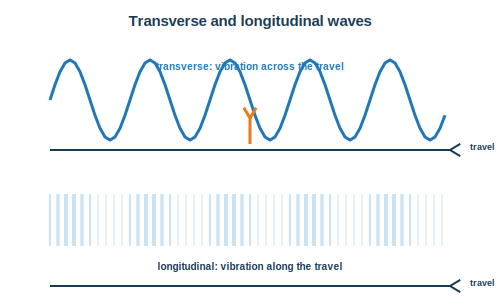
In a transverse wave the particles of the medium vibrate at right angles to the direction the wave travels, as on a string or with light. In a longitudinal wave they vibrate along the direction of travel, forming compressions and rarefactions, as with sound. Both transfer energy through the medium without moving it along permanently.
|
Diagram 1 – Transverse and Longitudinal Waves
Fig 1. In a transverse wave the medium vibrates across the direction of travel; in a longitudinal wave it vibrates along it, as compressions and rarefactions. |
3. Wave Quantities and the Wave Equation |
A wave is described by its wavelength λ, the distance between successive identical points; its frequency f, the number of waves per second; its period T = 1 ÷ f; and its amplitude. These are linked by the wave equation v = f λ: the speed equals the frequency times the wavelength.
4. Speed of a Wave |
The speed of a wave depends on the medium. On a stretched string the speed is the square root of (T ÷ μ), where T is the tension and μ the mass per unit length, so a tighter or lighter string carries waves faster. Sound travels faster in solids than in gases. In any one medium, the speed is fixed, so a higher frequency means a shorter wavelength.
5. Superposition and Standing Waves |
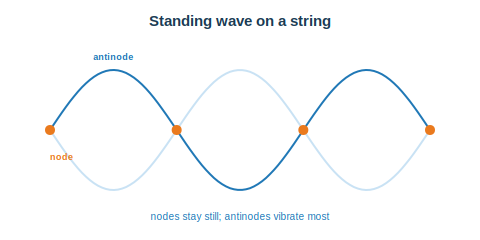
When two waves meet, the principle of superposition says the total displacement is the sum of the separate displacements. When two equal waves travel in opposite directions, they form a standing wave with fixed nodes that do not move and antinodes that vibrate most. Standing waves on strings and in air columns produce the notes of musical instruments.
|
Diagram 2 – Standing Wave on a String
Fig 2. A standing wave has nodes that stay still and antinodes that vibrate with the greatest amplitude, formed by two waves travelling in opposite directions. |
6. Beats |
When two sound waves of slightly different frequencies overlap, they alternately reinforce and cancel, producing a slow throbbing called beats. The beat frequency equals the difference between the two frequencies. Musicians use beats to tune instruments, listening for the throbbing to disappear when two notes match.
7. Key Reasoning (Principles) |
|
Principle 1: A wave carries energy, not matter The medium vibrates about fixed positions while the disturbance, and the energy it carries, moves on through it. |
|
Principle 2: Speed, frequency and wavelength are linked Through v = f λ, a fixed wave speed in a medium means a higher frequency must have a shorter wavelength. |
|
Principle 3: Overlapping waves add by superposition Where waves meet, their displacements add. This gives standing waves from opposing waves and beats from close frequencies. |
8. Worked Examples |
| Example 1 |
|
Q: A wave has frequency 50 Hz and wavelength 4 m. Find its speed. ▶ Show Solutionv = f λ = 50 × 4. = 200 m/s. Answer: 200 m/s. |
| Example 2 |
|
Q: A wave travels at 340 m/s with wavelength 2 m. Find its frequency. ▶ Show Solutionf = v ÷ λ = 340 ÷ 2. = 170 Hz. Answer: 170 Hz. |
| Example 3 |
|
Q: Find the wavelength of a 256 Hz sound in air (v = 340 m/s). ▶ Show Solutionλ = v ÷ f = 340 ÷ 256. ≈ 1.33 m. Answer: About 1.33 m. |
| Example 4 |
|
Q: Two tuning forks of 256 Hz and 260 Hz are sounded. Find the beat frequency. ▶ Show SolutionBeat frequency = difference = 260 minus 256. = 4 Hz. Answer: 4 Hz. |
| Example 5 |
|
Q: A wave has period 0.02 s. Find its frequency. ▶ Show Solutionf = 1 ÷ T = 1 ÷ 0.02. = 50 Hz. Answer: 50 Hz. |
| Example 6 |
|
Q: In a transverse wave, in what direction do the particles vibrate? ▶ Show SolutionAt right angles to the direction the wave travels. Answer: At right angles to the travel. |
| Example 7 |
|
Q: Find the speed of a wave on a string with tension 100 N and μ = 0.01 kg/m. ▶ Show Solutionv = √(T ÷ μ) = √(100 ÷ 0.01) = √10000. = 100 m/s. Answer: 100 m/s. |
| Example 8 |
|
Q: A point on a standing wave that never moves is called a: ▶ Show SolutionA point of zero displacement on a standing wave is a node. Answer: Node. |
| Example 9 |
|
Q: Find the wavelength of a 100 Hz wave travelling at 300 m/s. ▶ Show Solutionλ = v ÷ f = 300 ÷ 100. = 3 m. Answer: 3 m. |
| Example 10 |
|
Q: Two notes give 5 beats per second; one is 440 Hz. Find the possible other frequency. ▶ Show SolutionBeat frequency = difference = 5, so the other is 440 plus or minus 5. Answer: 435 Hz or 445 Hz. |
9. Practice Sets A to D |
| Set A – Multiple Choice (Basic) |
|
1. The wave equation is: (a) v = f ÷ λ (b) v = f λ (c) v = λ ÷ f (d) f = v λ 2. Sound is a wave that is: (a) transverse (b) longitudinal (c) standing (d) electromagnetic 3. A point of zero displacement on a standing wave is a: (a) crest (b) node (c) antinode (d) trough 4. Beat frequency equals the: (a) sum of frequencies (b) difference of frequencies (c) average (d) product 5. Wave speed on a string is: (a) √(T/μ) (b) Tμ (c) T + μ (d) μ/T ▶ Reveal Answers1. (b) v = f λ. 2. (b) longitudinal. 3. (b) node. 4. (b) difference of frequencies. 5. (a) √(T/μ). |
| Set B – Short Answer (Understanding) |
|
1. State what a wave transfers and what it does not. 2. State the difference between transverse and longitudinal waves. 3. Write the wave equation. 4. State the principle of superposition. 5. What are beats? ▶ Reveal Answers1. A wave transfers energy but not matter. 2. In a transverse wave the medium vibrates across the travel; in a longitudinal wave it vibrates along it. 3. v = f λ. 4. When waves overlap, the total displacement is the sum of the separate displacements. 5. The slow throbbing heard when two waves of slightly different frequencies overlap. |
| Set C – Application and Reasoning |
|
1. A wave has frequency 25 Hz and wavelength 8 m. Find its speed. 2. Find the frequency of a 300 m/s wave of wavelength 5 m. 3. Find the beat frequency of 200 Hz and 205 Hz. 4. Find the wave speed for tension 64 N and μ = 0.04 kg/m. 5. Why does a higher frequency mean a shorter wavelength in a given medium? ▶ Reveal Answers1. v = 25 × 8 = 200 m/s. 2. f = 300 ÷ 5 = 60 Hz. 3. 205 minus 200 = 5 Hz. 4. v = √(64 ÷ 0.04) = √1600 = 40 m/s. 5. Because v = f λ is fixed in a medium, so if f rises, λ must fall. |
| Set D – Higher Order (Challenge) |
|
1. A string of length 1 m vibrates in its fundamental mode. Find the wavelength. 2. A 500 Hz wave travels at 340 m/s. Find its wavelength and period. 3. Explain how a standing wave forms on a guitar string. 4. Two waves of 330 Hz and 334 Hz overlap. How many beats are heard each second? 5. Explain why sound travels faster in steel than in air. ▶ Reveal Answers1. In the fundamental mode the string is half a wavelength, so λ = 2 × 1 = 2 m. 2. λ = 340 ÷ 500 = 0.68 m; period = 1 ÷ 500 = 0.002 s. 3. Waves reflect from the fixed ends and overlap with the incoming waves, forming fixed nodes at the ends and a standing pattern. 4. Beat frequency = 334 minus 330 = 4 beats per second. 5. Because steel is far stiffer, the restoring forces are stronger, so the wave speed, which depends on the medium’s stiffness, is much greater. |
|
Chapter Summary
|
|||||||||||||||||||||||||||||||
| 8-Point Exam Quick-Check | ||||||||||||||||||||||||||||||||
|
||||||||||||||||||||||||||||||||
|
School Revise Virtual Lab Explore these ideas with interactive simulations and visual tools.
|
|
Class 11 Physics Chapter 14: Waves, Complete Notes and Practice This revision guide follows the current NCERT Class 11 Physics syllabus and develops wave motion, covering transverse and longitudinal waves, wavelength, frequency and the wave equation, the speed of a wave on a string, superposition and standing waves with nodes and antinodes, and beats, with two diagrams, ten worked examples and graded practice. Visit SchoolRevise.com to revise, practise and excel. |
 Google