Curriculum
Science Grade XI Physics
Science Grade XI Physics
0/14
-
Chapter 1: Units and Measurements
 Preview
 -
Chapter 2: Motion in a Straight Line
Preview
-
Chapter 3: Motion in a Plane
Preview
-
Chapter 4: Laws of Motion
Preview
-
Chapter 5: Work, Energy and Power
Preview
-
Chapter 6: System of Particles and Rotational Motion
Preview
-
Chapter 7: Gravitation
Preview
-
Chapter 8: Mechanical Properties of Solids
Preview
-
Chapter 9: Mechanical Properties of Fluids
Preview
-
Chapter 10: Thermal Properties of Matter
Preview
-
Chapter 11: Thermodynamics
Preview
-
Chapter 12: Kinetic Theory
Preview
-
Chapter 13: Oscillations
Preview
-
Chapter 14: Waves
Preview
Chapter 13: Oscillations
|
Grade 11 Science | Chapter 13 OscillationsMany systems swing back and forth in a regular way. This chapter develops simple harmonic motion, the pendulum and the spring, with the energy that flows between kinetic and potential forms.
|
|
Contents
|
1. Introduction: Repeating Motion |
Many motions repeat: a swinging pendulum, a vibrating string, a mass bobbing on a spring. Such oscillations are described by their period and frequency, and the most important kind, simple harmonic motion, occurs whenever the restoring force is proportional to the displacement. This chapter develops it and applies it to the pendulum and the spring.
|
Core idea Simple harmonic motion happens when the restoring force is proportional to and opposite the displacement. Its graph is a sine curve, and its period depends on the system, T = 2π√(m/k) for a spring.
|
2. Period, Frequency and Amplitude |
The period T is the time for one complete oscillation; the frequency f is the number of oscillations per second, so f = 1 ÷ T, measured in hertz. The amplitude is the greatest displacement from the central, or equilibrium, position. These three quantities describe any oscillation.
3. Simple Harmonic Motion |
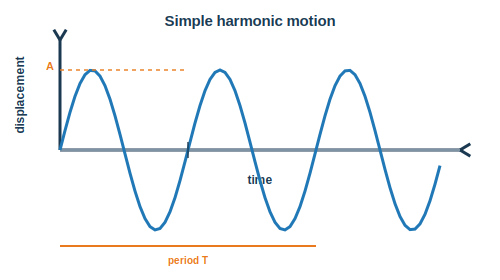
Simple harmonic motion (SHM) occurs when the restoring force is directly proportional to the displacement and directed toward the equilibrium position, F = minus k x. The displacement then varies with time as a sine or cosine, x = A cos(ωt), where A is the amplitude and ω the angular frequency. The motion is smooth and exactly repeating.
|
Diagram 1 – Simple Harmonic Motion
Fig 1. In simple harmonic motion the displacement varies as a sine curve in time, swinging between plus and minus the amplitude A with period T. |
4. The Simple Pendulum |
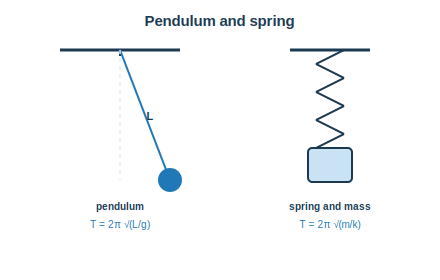
A simple pendulum of length L swings with simple harmonic motion for small angles, with period T = 2π√(L ÷ g). Remarkably, the period does not depend on the mass of the bob or, for small swings, on the amplitude. A longer pendulum has a longer period, which is the principle behind a pendulum clock.
5. The Spring and Mass System |
A mass m on a spring of stiffness k oscillates with simple harmonic motion of period T = 2π√(m ÷ k). A stiffer spring gives a shorter period, while a larger mass gives a longer one. The restoring force here is the spring force, F = minus k x, which is exactly the condition for SHM.
|
Diagram 2 – Pendulum and Spring
Fig 2. The pendulum and the spring and mass system are the two standard oscillators, with periods 2 pi root L over g and 2 pi root m over k. |
6. Energy in Oscillations |
In an oscillation, energy passes back and forth between kinetic and potential forms while the total stays constant, if there is no friction. At the extreme positions the energy is all potential and the speed is zero; at the centre it is all kinetic and the speed is greatest. Real oscillations slowly lose energy and damp out.
7. Key Reasoning (Principles) |
|
Principle 1: SHM needs a proportional restoring force Simple harmonic motion occurs exactly when the restoring force is proportional to the displacement and directed back toward equilibrium, F = minus k x. |
|
Principle 2: The period depends on the system, not the amplitude For SHM the period is fixed by the system, T = 2π√(m/k) for a spring or 2π√(L/g) for a pendulum, and does not depend on the amplitude. |
|
Principle 3: Energy trades between kinetic and potential Through each cycle the energy swings between kinetic and potential forms, with the total constant in the absence of friction. |
8. Worked Examples |
| Example 1 |
|
Q: An oscillation has period 0.5 s. Find its frequency. ▶ Show Solutionf = 1 ÷ T = 1 ÷ 0.5. = 2 Hz. Answer: 2 Hz. |
| Example 2 |
|
Q: A pendulum has frequency 4 Hz. Find its period. ▶ Show SolutionT = 1 ÷ f = 1 ÷ 4. = 0.25 s. Answer: 0.25 s. |
| Example 3 |
|
Q: Find the period of a 1 m pendulum (g = 10 m/s², take 2π = 6.28). ▶ Show SolutionT = 2π√(L/g) = 6.28 × √(1/10) = 6.28 × 0.316. ≈ 1.99 s, about 2 s. Answer: About 2 s. |
| Example 4 |
|
Q: A mass of 2 kg is on a spring of stiffness 8 N/m. Find the period (2π = 6.28). ▶ Show SolutionT = 2π√(m/k) = 6.28 × √(2/8) = 6.28 × 0.5. = 3.14 s. Answer: 3.14 s. |
| Example 5 |
|
Q: Where in an oscillation is the speed greatest? ▶ Show SolutionAt the equilibrium (central) position, where all the energy is kinetic. Answer: At the centre. |
| Example 6 |
|
Q: Where is the speed zero in an oscillation? ▶ Show SolutionAt the extreme positions, where all the energy is potential. Answer: At the extreme positions. |
| Example 7 |
|
Q: How does the period of a pendulum change if its length is quadrupled? ▶ Show SolutionT is proportional to √L; quadrupling L multiplies T by √4 = 2. So the period doubles. Answer: It doubles. |
| Example 8 |
|
Q: A spring’s stiffness is increased fourfold. How does the period change? ▶ Show SolutionT is proportional to one over √k; so it becomes half. Answer: It halves. |
| Example 9 |
|
Q: Find the frequency of a 0.2 s period oscillation. ▶ Show Solutionf = 1 ÷ 0.2. = 5 Hz. Answer: 5 Hz. |
| Example 10 |
|
Q: Why does a pendulum clock run on its length, not the bob’s mass? ▶ Show SolutionBecause T = 2π√(L/g) depends on length and g, not on the mass. Answer: Because the period depends on length, not mass. |
9. Practice Sets A to D |
| Set A – Multiple Choice (Basic) |
|
1. Frequency equals: (a) T (b) 1 ÷ T (c) T² (d) 2T 2. SHM requires a restoring force proportional to: (a) speed (b) displacement (c) time (d) mass 3. The period of a spring and mass is: (a) 2π√(L/g) (b) 2π√(m/k) (c) 1/f (d) fT 4. A pendulum’s period depends on its: (a) mass (b) amplitude (c) length (d) colour 5. At the centre of an oscillation the energy is mostly: (a) potential (b) kinetic (c) zero (d) heat ▶ Reveal Answers1. (b) 1 ÷ T. 2. (b) displacement. 3. (b) 2π√(m/k). 4. (c) length. 5. (b) kinetic. |
| Set B – Short Answer (Understanding) |
|
1. Define period and frequency. 2. State the condition for simple harmonic motion. 3. Write the period of a simple pendulum. 4. Write the period of a spring and mass system. 5. Describe the energy changes during an oscillation. ▶ Reveal Answers1. The period is the time for one oscillation; the frequency is the number per second, f = 1 ÷ T. 2. The restoring force must be proportional to the displacement and directed toward equilibrium. 3. T = 2π√(L ÷ g). 4. T = 2π√(m ÷ k). 5. Energy passes between kinetic and potential, with the total constant when there is no friction. |
| Set C – Application and Reasoning |
|
1. An oscillation has period 0.25 s. Find its frequency. 2. Find the period of a 0.4 m pendulum (g = 10, 2π = 6.28). 3. A 1 kg mass is on a 4 N/m spring. Find the period (2π = 6.28). 4. How does a pendulum’s period change if its length is doubled? 5. Why does amplitude not affect the period in SHM? ▶ Reveal Answers1. f = 1 ÷ 0.25 = 4 Hz. 2. T = 6.28 × √(0.4/10) = 6.28 × 0.2 = 1.256 s. 3. T = 6.28 × √(1/4) = 6.28 × 0.5 = 3.14 s. 4. T is proportional to √L, so it increases by √2, about 1.41 times. 5. Because the restoring force grows in proportion to the displacement, so larger swings move proportionally faster, keeping the period the same. |
| Set D – Higher Order (Challenge) |
|
1. A pendulum has period 2 s. Find its length (g = 10, 2π = 6.28). 2. Two springs of stiffness k and 4k carry equal masses. Compare their periods. 3. Explain why a child on a swing is an example of simple harmonic motion for small swings. 4. A 0.5 kg mass on a spring has period 1 s. Find the spring stiffness (2π = 6.28). 5. Explain why real oscillations eventually stop. ▶ Reveal Answers1. T = 2π√(L/g): 2 = 6.28√(L/10), so √(L/10) = 0.318, L/10 = 0.101, L ≈ 1.01 m. 2. T is proportional to one over √k, so the stiffer spring (4k) has half the period. 3. For small swings the restoring force from gravity is proportional to the displacement, the condition for SHM. 4. T = 2π√(m/k): 1 = 6.28√(0.5/k), so √(0.5/k) = 0.159, 0.5/k = 0.0253, k ≈ 19.7 N/m. 5. Because friction and air resistance gradually remove energy, so the amplitude decreases and the motion damps out. |
|
Chapter Summary
|
|||||||||||||||||||||||||||||||
| 8-Point Exam Quick-Check | ||||||||||||||||||||||||||||||||
|
||||||||||||||||||||||||||||||||
|
School Revise Virtual Lab Explore these ideas with interactive simulations and visual tools.
|
|
Class 11 Physics Chapter 13: Oscillations, Complete Notes and Practice This revision guide follows the current NCERT Class 11 Physics syllabus and develops oscillatory motion, covering period, frequency and amplitude, simple harmonic motion and its sine graph, the simple pendulum, the spring and mass system, and the exchange of energy between kinetic and potential forms, with two diagrams, ten worked examples and graded practice. Visit SchoolRevise.com to revise, practise and excel. |
 Google