Curriculum
Science Grade XI Physics
Science Grade XI Physics
0/14
-
Chapter 1: Units and Measurements
 Preview
 -
Chapter 2: Motion in a Straight Line
Preview
-
Chapter 3: Motion in a Plane
Preview
-
Chapter 4: Laws of Motion
Preview
-
Chapter 5: Work, Energy and Power
Preview
-
Chapter 6: System of Particles and Rotational Motion
Preview
-
Chapter 7: Gravitation
Preview
-
Chapter 8: Mechanical Properties of Solids
Preview
-
Chapter 9: Mechanical Properties of Fluids
Preview
-
Chapter 10: Thermal Properties of Matter
Preview
-
Chapter 11: Thermodynamics
Preview
-
Chapter 12: Kinetic Theory
Preview
-
Chapter 13: Oscillations
Preview
-
Chapter 14: Waves
Preview
Chapter 3: Motion in a Plane
|
Grade 11 Science | Chapter 3 Motion in a PlaneMotion in two dimensions needs vectors. This chapter covers vector addition, then applies it to projectile motion and uniform circular motion, deriving their key results.
|
|
Contents
|
1. Introduction: Why Vectors |
Motion along a line needed only a sign for direction. Motion in a plane needs vectors, quantities with both magnitude and direction, such as displacement, velocity, acceleration and force. This chapter develops the rules for handling vectors and then uses them on two important cases: a projectile and an object moving in a circle.
|
Core idea A vector has both magnitude and direction and follows special rules of addition. Resolving a vector into perpendicular components turns two-dimensional motion into two independent one-dimensional problems.
|
2. Scalars and Vectors |
A scalar has magnitude only, such as mass, time or speed. A vector has both magnitude and direction, such as displacement or velocity, and is drawn as an arrow whose length shows the magnitude. Vectors cannot simply be added like numbers; their directions must be taken into account.
3. Adding Vectors |
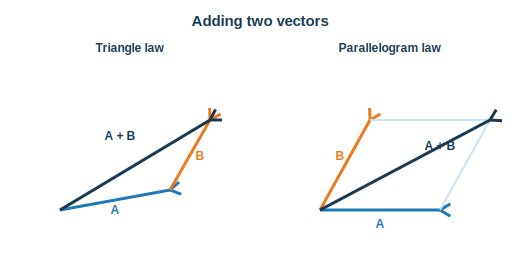
Two vectors are added by the triangle law, placing the tail of the second at the head of the first, the resultant joining the start to the finish. The parallelogram law gives the same result when the vectors start from a common point. For two perpendicular vectors of sizes A and B, the resultant has magnitude the square root of (A² + B²).
|
Diagram 1 – Adding Two Vectors
Fig 1. The triangle law joins vectors head to tail; the parallelogram law adds them from a common point. Both give the same resultant. |
4. Resolving Vectors into Components |
Any vector can be split into two perpendicular components, usually along the horizontal and vertical. A vector of magnitude A at angle θ has horizontal component A cosθ and vertical component A sinθ. Resolving lets us treat the two directions separately, which is the key to solving projectile motion.
5. Projectile Motion |
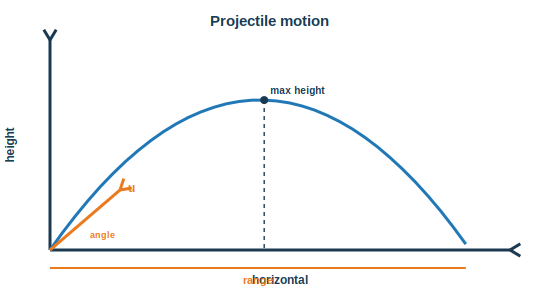
A projectile moves under gravity alone after launch. Its horizontal motion is at constant velocity, while its vertical motion is free fall, and the two are independent. For a launch speed u at angle θ, the time of flight is 2 u sinθ ÷ g, the maximum height is u² sin²θ ÷ 2g, and the horizontal range is u² sin 2θ ÷ g. The path traced is a parabola, and the range is greatest at a launch angle of 45 degrees.
|
Diagram 2 – Projectile Motion
Fig 2. A projectile follows a parabolic path. Its horizontal velocity is constant while its vertical motion is free fall, giving a maximum height and a horizontal range. |
6. Uniform Circular Motion |
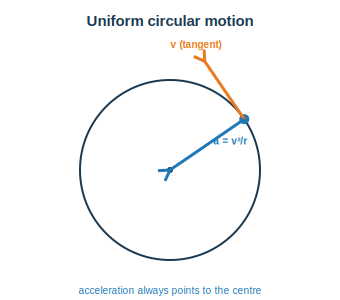
In uniform circular motion an object moves around a circle at constant speed. Its velocity is always tangent to the circle, but because the direction keeps changing, the object is accelerating. This centripetal acceleration points toward the centre and has magnitude v² ÷ r, where v is the speed and r the radius. A force directed to the centre is needed to produce it.
|
Diagram 3 – Uniform Circular Motion
Fig 3. The velocity is tangent to the circle while the centripetal acceleration, of size v squared over r, always points toward the centre. |
7. Key Reasoning (Principles) |
|
Principle 1: Components act independently The horizontal and vertical motions of a projectile do not affect each other. Gravity changes only the vertical motion, while the horizontal velocity stays constant. |
|
Principle 2: Resolve, then recombine A two-dimensional problem becomes two one-dimensional problems by resolving vectors into perpendicular components and treating each direction on its own. |
|
Principle 3: Changing direction is acceleration Even at constant speed, an object moving in a circle is accelerating, because its direction, and hence its velocity vector, is always changing toward the centre. |
8. Worked Examples |
| Example 1 |
|
Q: Find the resultant of two perpendicular vectors of 3 and 4 units. ▶ Show SolutionResultant = √(3² + 4²) = √25. = 5 units. Answer: 5 units. |
| Example 2 |
|
Q: Resolve a 10 N force at 30 degrees into horizontal and vertical components. (cos30 = 0.866, sin30 = 0.5) ▶ Show SolutionHorizontal = 10 × 0.866 = 8.66 N; vertical = 10 × 0.5 = 5 N. Answer: 8.66 N horizontal, 5 N vertical. |
| Example 3 |
|
Q: A ball is projected at 20 m/s at 30 degrees. Find its time of flight (g = 10 m/s², sin30 = 0.5). ▶ Show SolutionTime = 2 u sinθ ÷ g = 2 × 20 × 0.5 ÷ 10. = 2 s. Answer: 2 s. |
| Example 4 |
|
Q: For the same projectile, find the maximum height. (sin30 = 0.5) ▶ Show SolutionHeight = u² sin²θ ÷ 2g = 400 × 0.25 ÷ 20. = 5 m. Answer: 5 m. |
| Example 5 |
|
Q: A projectile is launched at 20 m/s at 45 degrees. Find its range (g = 10 m/s², sin90 = 1). ▶ Show SolutionRange = u² sin2θ ÷ g = 400 × 1 ÷ 10. = 40 m. Answer: 40 m. |
| Example 6 |
|
Q: Find the centripetal acceleration of a body moving at 10 m/s in a circle of radius 5 m. ▶ Show Solutiona = v² ÷ r = 100 ÷ 5. = 20 m/s². Answer: 20 m/s². |
| Example 7 |
|
Q: A horizontal velocity of 6 m/s and a vertical velocity of 8 m/s combine. Find the speed. ▶ Show SolutionSpeed = √(6² + 8²) = √100. = 10 m/s. Answer: 10 m/s. |
| Example 8 |
|
Q: At what angle is the range of a projectile greatest? ▶ Show SolutionRange is greatest when sin2θ = 1, that is 2θ = 90 degrees. So θ = 45 degrees. Answer: 45 degrees. |
| Example 9 |
|
Q: A stone moves in a circle of radius 2 m at 4 m/s. Find the centripetal acceleration. ▶ Show Solutiona = v² ÷ r = 16 ÷ 2. = 8 m/s². Answer: 8 m/s². |
| Example 10 |
|
Q: A projectile is launched horizontally at 15 m/s from a height and lands after 2 s. Find the horizontal distance (g = 10 m/s²). ▶ Show SolutionHorizontal velocity is constant: distance = 15 × 2. = 30 m. Answer: 30 m. |
9. Practice Sets A to D |
| Set A – Multiple Choice (Basic) |
|
1. Which is a vector? (a) mass (b) time (c) velocity (d) speed 2. The resultant of perpendicular vectors A and B has magnitude: (a) A + B (b) A minus B (c) √(A² + B²) (d) AB 3. A projectile’s path is a: (a) circle (b) straight line (c) parabola (d) spiral 4. Centripetal acceleration points: (a) along the velocity (b) to the centre (c) outward (d) downward 5. The range of a projectile is greatest at a launch angle of: (a) 30 (b) 45 (c) 60 (d) 90 degrees ▶ Reveal Answers1. (c) velocity. 2. (c) √(A² + B²). 3. (c) parabola. 4. (b) to the centre. 5. (b) 45 degrees. |
| Set B – Short Answer (Understanding) |
|
1. State the difference between a scalar and a vector. 2. State the triangle law of vector addition. 3. Why is the horizontal velocity of a projectile constant? 4. Why is an object in uniform circular motion accelerating? 5. Write the formula for centripetal acceleration. ▶ Reveal Answers1. A scalar has magnitude only; a vector has both magnitude and direction. 2. Place the second vector’s tail at the first’s head; the resultant joins the start to the finish. 3. Because gravity acts only vertically, leaving the horizontal velocity unchanged. 4. Because its direction, and so its velocity vector, is always changing toward the centre. 5. a = v² ÷ r. |
| Set C – Application and Reasoning |
|
1. Find the resultant of perpendicular vectors of 5 and 12 units. 2. Resolve a 20 N force at 60 degrees vertically. (sin60 = 0.866) 3. A ball is projected at 10 m/s at 30 degrees. Find its time of flight (g = 10, sin30 = 0.5). 4. Find the centripetal acceleration for v = 6 m/s, r = 3 m. 5. Why does a projectile launched at 30 and at 60 degrees have the same range? ▶ Reveal Answers1. √(25 + 144) = √169 = 13 units. 2. Vertical = 20 × 0.866 = 17.32 N. 3. Time = 2 × 10 × 0.5 ÷ 10 = 1 s. 4. a = 36 ÷ 3 = 12 m/s². 5. Because sin(2 × 30) = sin60 = sin120 = sin(2 × 60), so the range u² sin2θ ÷ g is the same. |
| Set D – Higher Order (Challenge) |
|
1. Derive the time of flight of a projectile launched at speed u and angle θ. 2. A projectile has range 40 m and is launched at 45 degrees with g = 10 m/s². Find its launch speed. 3. Explain why the maximum height depends on the vertical component of velocity only. 4. A car of mass 1000 kg turns a circle of radius 50 m at 10 m/s. Find the centripetal force needed. 5. Show that horizontal and vertical motions of a projectile are independent. ▶ Reveal Answers1. Vertical velocity is u sinθ; it reaches zero at the top after u sinθ ÷ g, so the full flight is 2 u sinθ ÷ g. 2. Range = u² sin90 ÷ g, so 40 = u² ÷ 10, giving u² = 400, u = 20 m/s. 3. Because only the vertical motion is slowed by gravity, the height reached depends on the upward velocity u sinθ alone. 4. Force = m v² ÷ r = 1000 × 100 ÷ 50 = 2000 N. 5. Gravity acts only vertically, so it changes the vertical velocity but never the horizontal one; the two motions proceed without affecting each other. |
|
Chapter Summary
|
|||||||||||||||||||||||||||||||
| 8-Point Exam Quick-Check | ||||||||||||||||||||||||||||||||
|
||||||||||||||||||||||||||||||||
|
School Revise Virtual Lab Explore these ideas with interactive simulations and visual tools.
|
|
Class 11 Physics Chapter 3: Motion in a Plane, Complete Notes and Practice This revision guide follows the current NCERT Class 11 Physics syllabus and develops two-dimensional motion, covering scalars and vectors, the triangle and parallelogram laws, resolving vectors into components, projectile motion with its time of flight, height and range, and uniform circular motion with centripetal acceleration, with three diagrams, ten worked examples and graded practice. Visit SchoolRevise.com to revise, practise and excel. |