Curriculum
Science Grade XI Physics
Science Grade XI Physics
0/14
-
Chapter 1: Units and Measurements
 Preview
 -
Chapter 2: Motion in a Straight Line
Preview
-
Chapter 3: Motion in a Plane
Preview
-
Chapter 4: Laws of Motion
Preview
-
Chapter 5: Work, Energy and Power
Preview
-
Chapter 6: System of Particles and Rotational Motion
Preview
-
Chapter 7: Gravitation
Preview
-
Chapter 8: Mechanical Properties of Solids
Preview
-
Chapter 9: Mechanical Properties of Fluids
Preview
-
Chapter 10: Thermal Properties of Matter
Preview
-
Chapter 11: Thermodynamics
Preview
-
Chapter 12: Kinetic Theory
Preview
-
Chapter 13: Oscillations
Preview
-
Chapter 14: Waves
Preview
Work Sheets
0/14

Chapter 7: Gravitation
|
Grade 11 Science | Chapter 7 GravitationOne law governs falling apples and orbiting planets. This chapter develops Newton’s law of gravitation, the field strength g, Kepler’s laws, and escape and orbital velocity.
|
|
Contents
|
1. Introduction: A Universal Force |
Newton’s great insight was that the same force pulling an apple to the ground holds the Moon in its orbit. Gravitation is a universal attraction between all masses. This chapter states the law quantitatively, links it to the everyday acceleration g, and uses it to explain the orbits of planets and satellites.
|
Core idea Every mass attracts every other with a force F = G m1 m2 ÷ r². The same law gives the surface value of g and, with circular motion, the orbits of satellites and planets.
|
2. Newton’s Law of Gravitation |
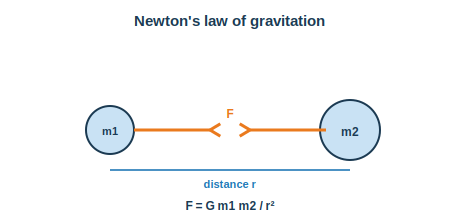
Newton’s law of gravitation states that two point masses attract each other with a force proportional to the product of their masses and inversely proportional to the square of the distance between them: F = G m1 m2 ÷ r². Here G is the universal gravitational constant. The force acts along the line joining the masses and is always attractive.
|
Diagram 1 – Newton’s Law of Gravitation
Fig 1. Two masses attract each other equally along the line joining them, with a force that falls off as the square of the distance. |
3. Acceleration Due to Gravity |
The acceleration due to gravity g at the Earth’s surface follows from the law: g = G M ÷ R², where M and R are the Earth’s mass and radius. This is why all objects fall with the same acceleration regardless of their mass. The value of g decreases with height above the surface and varies slightly over the Earth.
4. Gravitational Potential Energy |
Near the surface, lifting a mass m through a small height h increases its gravitational potential energy by mgh. More generally, the potential energy of two masses a distance r apart is minus G m1 m2 ÷ r, taken as zero at infinite separation. The negative sign shows that the masses are bound together and energy must be supplied to separate them.
5. Kepler’s Laws |
Kepler’s three laws describe planetary motion. First, each planet moves in an ellipse with the Sun at one focus. Second, the line from the Sun to a planet sweeps equal areas in equal times, so a planet moves faster when nearer the Sun. Third, the square of the orbital period is proportional to the cube of the average distance, T² proportional to r³. Newton’s law of gravitation explains all three.
|
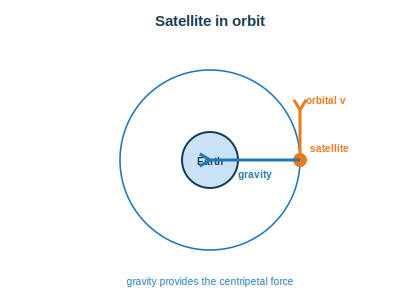
Diagram 2 – A Satellite in Orbit
Fig 2. Gravity provides the centripetal force that keeps a satellite in orbit; the orbital velocity is directed along the path while gravity pulls toward the Earth. |
6. Escape and Orbital Velocity |
The orbital velocity of a satellite close to the Earth is the speed at which gravity exactly supplies the needed centripetal force, v = the square root of (G M ÷ r). The escape velocity is the minimum speed to leave the Earth’s gravity altogether, v = the square root of (2 g R), about 11.2 km/s at the surface. The escape velocity is the square root of two times the orbital velocity at the surface.
7. Key Reasoning (Principles) |
|
Principle 1: Gravity follows an inverse-square law The force falls off as the square of the distance, so doubling the separation quarters the force. This single rule governs both falling bodies and orbits. |
|
Principle 2: g comes from the same law The surface acceleration g = G M ÷ R² is just Newton’s law applied at the Earth’s surface, which is why all bodies fall at the same rate. |
|
Principle 3: Gravity supplies the centripetal force in orbit A satellite stays in orbit because gravity provides exactly the centripetal force needed, which fixes the orbital velocity for a given radius. |
8. Worked Examples |
| Example 1 |
|
Q: If the distance between two masses doubles, how does the gravitational force change? ▶ Show SolutionForce varies as 1 ÷ r²; doubling r gives a factor 1 ÷ 4. So the force becomes one quarter. Answer: It becomes one quarter. |
| Example 2 |
|
Q: Write the formula for g at the Earth’s surface. ▶ Show SolutionFrom Newton’s law at the surface, g = G M ÷ R². Answer: g = G M ÷ R². |
| Example 3 |
|
Q: Find the gravitational potential energy gained by a 2 kg mass raised 5 m (g = 10 m/s²). ▶ Show SolutionPE = m g h = 2 × 10 × 5. = 100 J. Answer: 100 J. |
| Example 4 |
|
Q: State Kepler’s third law. ▶ Show SolutionThe square of the orbital period is proportional to the cube of the average distance, T² proportional to r³. Answer: T² is proportional to r³. |
| Example 5 |
|
Q: Find the escape velocity at the surface where g = 10 m/s² and R = 6.4 × 10⁶ m. ▶ Show Solutionv = √(2 g R) = √(2 × 10 × 6.4 × 106). = √(1.28 × 10⁸) ≈ 1.13 × 10⁴ m/s, about 11.3 km/s. Answer: About 11.3 km/s. |
| Example 6 |
|
Q: Why do all objects fall with the same acceleration? ▶ Show SolutionBecause g = G M ÷ R² does not depend on the falling body’s mass. Answer: Because g does not depend on the falling mass. |
| Example 7 |
|
Q: A planet’s orbital radius is increased fourfold. By what factor does the force change? ▶ Show SolutionForce varies as 1 ÷ r²; with r × 4, force changes by 1 ÷ 16. Answer: It becomes one sixteenth. |
| Example 8 |
|
Q: If a planet has the same density but twice the radius of Earth, how does its surface g compare? (g proportional to R for fixed density) ▶ Show SolutionWith g = G M ÷ R² and M proportional to R³, g is proportional to R. So g doubles. Answer: It doubles. |
| Example 9 |
|
Q: Find the gravitational potential energy gained lifting 10 kg by 3 m (g = 10 m/s²). ▶ Show SolutionPE = m g h = 10 × 10 × 3. = 300 J. Answer: 300 J. |
| Example 10 |
|
Q: The escape velocity is how many times the surface orbital velocity? ▶ Show SolutionEscape velocity = √2 times the orbital velocity at the surface. Answer: √2 times. |
9. Practice Sets A to D |
| Set A – Multiple Choice (Basic) |
|
1. Gravitational force varies with distance as: (a) r (b) 1/r (c) 1/r² (d) r² 2. The acceleration due to gravity at the surface is: (a) GM (b) G M ÷ R (c) G M ÷ R² (d) G M R 3. Kepler’s first law says planets move in: (a) circles (b) ellipses (c) lines (d) spirals 4. Escape velocity from the Earth is about: (a) 3 km/s (b) 8 km/s (c) 11.2 km/s (d) 30 km/s 5. In orbit, the centripetal force is provided by: (a) friction (b) the engine (c) gravity (d) air ▶ Reveal Answers1. (c) 1/r². 2. (c) G M ÷ R². 3. (b) ellipses. 4. (c) 11.2 km/s. 5. (c) gravity. |
| Set B – Short Answer (Understanding) |
|
1. State Newton’s law of gravitation. 2. Why is the gravitational potential energy of two masses negative? 3. State Kepler’s second law. 4. Define escape velocity. 5. Why does g decrease with height? ▶ Reveal Answers1. Two masses attract with a force proportional to the product of their masses and inversely proportional to the square of the distance. 2. Because zero is taken at infinite separation, and the masses are bound, so energy must be added to separate them. 3. The line from the Sun to a planet sweeps equal areas in equal times. 4. The minimum speed needed for an object to escape a body’s gravity altogether. 5. Because g = G M ÷ r² and r increases with height, reducing g. |
| Set C – Application and Reasoning |
|
1. If the distance between two masses is halved, how does the force change? 2. Find the potential energy gained lifting 4 kg by 5 m (g = 10 m/s²). 3. A planet is twice as far from its star. By what factor does the force fall? 4. Why do astronauts feel weightless in orbit? 5. State and explain Kepler’s third law. ▶ Reveal Answers1. Force varies as 1 ÷ r²; halving r gives a factor 4, so the force quadruples. 2. PE = 4 × 10 × 5 = 200 J. 3. By 1 ÷ 4, since force varies as the inverse square of distance. 4. Because they and their craft fall together under gravity, so there is no normal force, giving the feeling of weightlessness. 5. The square of the period is proportional to the cube of the mean orbital radius; larger orbits take much longer. |
| Set D – Higher Order (Challenge) |
|
1. Show that g = G M ÷ R² from Newton’s law of gravitation. 2. Find the escape velocity where g = 10 m/s² and R = 6.4 × 10⁶ m. 3. Explain why a satellite’s orbital velocity depends only on the orbit radius, not the satellite’s mass. 4. Two planets have orbital radii in the ratio 1 to 4. Find the ratio of their periods. 5. Explain how Newton’s law accounts for Kepler’s second law. ▶ Reveal Answers1. A mass m at the surface feels F = G M m ÷ R²; since F = mg, dividing by m gives g = G M ÷ R². 2. v = √(2 × 10 × 6.4 × 106) = √(1.28 × 10⁸) ≈ 1.13 × 10⁴ m/s. 3. Because gravity provides the centripetal force, m cancels from both sides, leaving v dependent only on G, M and r. 4. By T² proportional to r³, periods are in the ratio √(1³) to √(4³) = 1 to 8. 5. Gravity is a central force toward the Sun, so it exerts no torque about the Sun; angular momentum is conserved, which means equal areas are swept in equal times. |
|
Chapter Summary
|
|||||||||||||||||||||||||||||||
| 8-Point Exam Quick-Check | ||||||||||||||||||||||||||||||||
|
||||||||||||||||||||||||||||||||
|
School Revise Virtual Lab Explore these ideas with interactive simulations and visual tools.
|
|
Class 11 Physics Chapter 7: Gravitation, Complete Notes and Practice This revision guide follows the current NCERT Class 11 Physics syllabus and develops gravitation, covering Newton’s universal law, the acceleration due to gravity, gravitational potential energy, Kepler’s three laws of planetary motion, and escape and orbital velocity, with two diagrams, ten worked examples and graded practice. Visit SchoolRevise.com to revise, practise and excel. |
 Google