Curriculum
Science Grade XI Physics
Science Grade XI Physics
0/14
-
Chapter 1: Units and Measurements
 Preview
 -
Chapter 2: Motion in a Straight Line
Preview
-
Chapter 3: Motion in a Plane
Preview
-
Chapter 4: Laws of Motion
Preview
-
Chapter 5: Work, Energy and Power
Preview
-
Chapter 6: System of Particles and Rotational Motion
Preview
-
Chapter 7: Gravitation
Preview
-
Chapter 8: Mechanical Properties of Solids
Preview
-
Chapter 9: Mechanical Properties of Fluids
Preview
-
Chapter 10: Thermal Properties of Matter
Preview
-
Chapter 11: Thermodynamics
Preview
-
Chapter 12: Kinetic Theory
Preview
-
Chapter 13: Oscillations
Preview
-
Chapter 14: Waves
Preview
Chapter 12: Kinetic Theory
|
Grade 11 Science | Chapter 12 Kinetic TheoryGases are countless molecules in ceaseless motion. This chapter explains pressure and temperature from molecular motion, and derives the ideal gas law and the root mean square speed.
|
|
Contents
|
1. Introduction: The Molecular Picture |
Kinetic theory explains the behaviour of gases by treating them as enormous numbers of tiny molecules in rapid, random motion. From this simple picture it derives the pressure of a gas, the meaning of temperature, and the ideal gas law, connecting the unseen molecular world to measurable quantities.
|
Core idea A gas is molecules in random motion. Their collisions with the walls cause pressure, and their average kinetic energy sets the temperature, giving P = one third ρ v² and the ideal gas law.
|
2. Assumptions of Kinetic Theory |
The theory assumes that a gas consists of a very large number of identical molecules in constant random motion, that their size is negligible compared with the gas volume, that they exert no force on one another except during collisions, and that all collisions are perfectly elastic. These assumptions describe an ideal gas, which real gases approach at low pressure and high temperature.
3. Pressure from Molecular Motion |
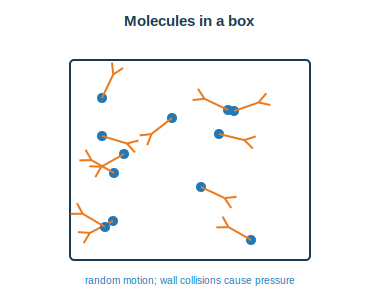
Each time a molecule strikes a wall it rebounds, exerting a tiny force. The countless collisions per second average out to a steady pressure. Kinetic theory gives P = one third ρ v², where ρ is the density and v² is the mean of the squared speeds. So pressure rises if the molecules move faster or are more closely packed.
|
Diagram 1 – Molecules in a Box
Fig 1. Gas molecules move randomly and collide with the walls; these collisions, averaged over countless molecules, produce the pressure. |
4. The Ideal Gas Equation |
Combining the gas laws gives the ideal gas equation PV = nRT, where P is pressure, V volume, n the number of moles, R the universal gas constant and T the temperature in kelvin. It contains Boyle’s law (P inversely proportional to V at fixed T) and Charles’s law (V proportional to T at fixed P) as special cases.
5. Temperature and Molecular Energy |
Kinetic theory shows that the average translational kinetic energy of a gas molecule is proportional to the absolute temperature: it equals three halves k T, where k is the Boltzmann constant. So temperature is a measure of the average molecular kinetic energy. At absolute zero the molecular motion would, in this picture, cease.
6. Root Mean Square Speed |
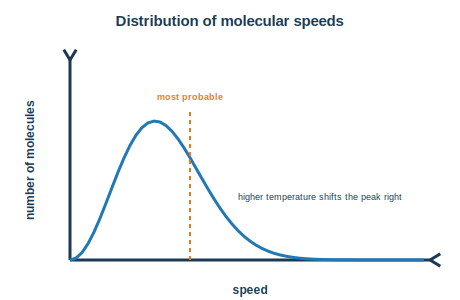
Because molecules move at many different speeds, we use the root mean square speed, the square root of the mean of the squared speeds. It is given by the square root of (3RT ÷ M), where M is the molar mass. Lighter molecules and higher temperatures give larger speeds, which is why hydrogen molecules move faster than oxygen at the same temperature.
|
Diagram 2 – Distribution of Molecular Speeds
Fig 2. Molecules have a spread of speeds with a most probable value; raising the temperature shifts the whole distribution to higher speeds. |
7. Key Reasoning (Principles) |
|
Principle 1: Pressure comes from collisions The steady pressure of a gas is the averaged effect of countless molecular collisions with the walls, giving P = one third ρ v². |
|
Principle 2: Temperature measures molecular energy The average translational kinetic energy of a molecule is three halves k T, so temperature is a direct measure of molecular motion. |
|
Principle 3: Lighter and hotter means faster The root mean square speed is the square root of (3RT ÷ M), so molecules move faster at higher temperature and when lighter. |
8. Worked Examples |
| Example 1 |
|
Q: A gas at constant temperature has its volume halved. What happens to the pressure? ▶ Show SolutionBy Boyle’s law P is inversely proportional to V. Halving V doubles the pressure. Answer: It doubles. |
| Example 2 |
|
Q: A gas at constant pressure has its temperature (in kelvin) doubled. What happens to the volume? ▶ Show SolutionBy Charles’s law V is proportional to T. Doubling T doubles the volume. Answer: It doubles. |
| Example 3 |
|
Q: Find the pressure from kinetic theory for ρ = 1.2 kg/m³ and v² = 250000 m²/s². ▶ Show SolutionP = one third ρ v² = (1.2 × 250000) ÷ 3. = 100000 Pa. Answer: 100000 Pa. |
| Example 4 |
|
Q: Using PV = nRT, find P for n = 1, R = 8.314, T = 300 K, V = 0.025 m³. ▶ Show SolutionP = nRT ÷ V = (1 × 8.314 × 300) ÷ 0.025. ≈ 99768 Pa, about 1 × 10⁵ Pa. Answer: About 1 × 10⁵ Pa. |
| Example 5 |
|
Q: If the absolute temperature of a gas doubles, how does the average molecular kinetic energy change? ▶ Show SolutionAverage KE is three halves k T, proportional to T. So it doubles. Answer: It doubles. |
| Example 6 |
|
Q: Why do hydrogen molecules move faster than oxygen at the same temperature? ▶ Show SolutionRMS speed is the square root of (3RT ÷ M); hydrogen has a smaller M, so a larger speed. Answer: Because hydrogen has a smaller molar mass. |
| Example 7 |
|
Q: A gas has its volume tripled at constant temperature. Find the new pressure relative to the old. ▶ Show SolutionP is inversely proportional to V; tripling V gives one third the pressure. Answer: One third. |
| Example 8 |
|
Q: State the relationship between temperature and average molecular kinetic energy. ▶ Show SolutionThe average translational kinetic energy is three halves k T, proportional to absolute temperature. Answer: KE is proportional to absolute temperature. |
| Example 9 |
|
Q: Find the pressure for ρ = 1.5 kg/m³ and v² = 200000 m²/s². ▶ Show SolutionP = (1.5 × 200000) ÷ 3. = 100000 Pa. Answer: 100000 Pa. |
| Example 10 |
|
Q: What happens to molecular motion as temperature approaches absolute zero? ▶ Show SolutionIn the kinetic picture the molecular motion would cease. Answer: It would cease. |
9. Practice Sets A to D |
| Set A – Multiple Choice (Basic) |
|
1. Gas pressure arises from molecular: (a) size (b) collisions with walls (c) colour (d) charge 2. The ideal gas equation is: (a) PV = nRT (b) P = mgh (c) F = ma (d) Q = mcΔT 3. Temperature measures the average molecular: (a) size (b) kinetic energy (c) charge (d) mass 4. RMS speed is the square root of: (a) 3RT/M (b) RT (c) M/RT (d) PV 5. Kinetic theory pressure is P equals: (a) ρv² (b) one third ρv² (c) 3ρv² (d) ρ/v² ▶ Reveal Answers1. (b) collisions with walls. 2. (a) PV = nRT. 3. (b) kinetic energy. 4. (a) 3RT/M. 5. (b) one third ρv². |
| Set B – Short Answer (Understanding) |
|
1. State two assumptions of kinetic theory. 2. Write the kinetic theory expression for pressure. 3. Write the ideal gas equation and name the terms. 4. What does temperature measure at the molecular level? 5. Write the formula for the root mean square speed. ▶ Reveal Answers1. Molecules are in constant random motion; collisions are perfectly elastic (any two). 2. P = one third ρ v². 3. PV = nRT, with P pressure, V volume, n moles, R the gas constant, T temperature in kelvin. 4. The average translational kinetic energy of the molecules. 5. The square root of (3RT ÷ M). |
| Set C – Application and Reasoning |
|
1. A gas at constant T has its volume reduced to one quarter. Find the new pressure. 2. Find the pressure for ρ = 0.9 kg/m³ and v² = 300000 m²/s². 3. Using PV = nRT, find V for n = 2, R = 8.314, T = 300, P = 1 × 10⁵. 4. How does the average kinetic energy change if T (in kelvin) triples? 5. Why does a real gas behave most ideally at low pressure and high temperature? ▶ Reveal Answers1. P inversely proportional to V; one quarter the volume gives four times the pressure. 2. P = (0.9 × 300000) ÷ 3 = 90000 Pa. 3. V = nRT ÷ P = (2 × 8.314 × 300) ÷ 1 × 10⁵ ≈ 0.0499 m³. 4. It triples, since average KE is proportional to absolute temperature. 5. Because the molecules are then far apart and fast, so their size and mutual forces become negligible. |
| Set D – Higher Order (Challenge) |
|
1. Show how Boyle’s law follows from PV = nRT at constant temperature. 2. Two gases are at the same temperature. Compare their average molecular kinetic energies. 3. Explain why pressure increases when a gas is heated at constant volume. 4. If the molar mass of oxygen is 16 times that of hydrogen, compare their RMS speeds at the same temperature. 5. Explain why temperature cannot fall below absolute zero in this model. ▶ Reveal Answers1. At constant T, nRT is constant, so PV is constant, which is Boyle’s law. 2. They are equal, since average kinetic energy depends only on temperature, not on the type of gas. 3. Heating raises the molecular speeds, so the molecules strike the walls harder and more often, raising the pressure. 4. RMS speed is proportional to one over the square root of M, so hydrogen is the square root of 16 = 4 times faster. 5. Because the average molecular kinetic energy is three halves k T, which cannot be negative, so T has a lowest value of zero. |
|
Chapter Summary
|
|||||||||||||||||||||||||||||||
| 8-Point Exam Quick-Check | ||||||||||||||||||||||||||||||||
|
||||||||||||||||||||||||||||||||
|
School Revise Virtual Lab Explore these ideas with interactive simulations and visual tools.
|
|
Class 11 Physics Chapter 12: Kinetic Theory, Complete Notes and Practice This revision guide follows the current NCERT Class 11 Physics syllabus and develops the kinetic theory of gases, covering its assumptions, the origin of pressure from molecular collisions, the ideal gas equation, the link between temperature and average molecular kinetic energy, and the root mean square speed, with two diagrams, ten worked examples and graded practice. Visit SchoolRevise.com to revise, practise and excel. |