Curriculum
Science Grade XI Biology
Science Grade XI Biology
0/19
-
Chapter 1: The Living World
 Preview
 -
Chapter 2: Biological Classification
Preview
-
Chapter 3: Plant Kingdom
Preview
-
Chapter 4: Animal Kingdom
Preview
-
Chapter 5: Morphology of Flowering Plants
Preview
-
Chapter 6: Anatomy of Flowering Plants
Preview
-
Chapter 7: Structural Organisation in Animals
Preview
-
Chapter 8: Cell: The Unit of Life
Preview
-
Chapter 9: Biomolecules
Preview
-
Chapter 10: Cell Cycle and Cell Division
Preview
-
Chapter 11: Photosynthesis in Higher Plants
Preview
-
Chapter 12: Respiration in Plants
Preview
-
Chapter 13: Plant Growth and Development
Preview
-
Chapter 14: Breathing and Exchange of Gases
Preview
-
Chapter 15: Body Fluids and Circulation
Preview
-
Chapter 16: Excretory Products and their Elimination
Preview
-
Chapter 17: Locomotion and Movement
Preview
-
Chapter 18: Neural Control and Coordination
Preview
-
Chapter 19: Chemical Coordination and Integration
Preview
Work Sheets
0/19

Chapter 1: The Living World
|
Grade 11 Science | Chapter 1 The Living WorldWhat makes something alive, and how do we make sense of millions of life forms? This chapter defines living things and sets out how biologists name and classify the diversity of life.
|
|
Contents
|
1. Introduction: What Is Living? |
Before we study life, we must say what counts as living. Living organisms share defining features: growth from within, reproduction to make more of their kind, metabolism (the chemical reactions of life), cellular organisation, and the ability to sense and respond to their surroundings. Of these, metabolism and the organised response to the environment are regarded as the surest signs of life.
With life defined, the next challenge is its sheer variety. Millions of kinds of organisms exist, so biologists need an orderly way to name and group them, which is the work of taxonomy that this chapter introduces.
|
Core idea Living things share features such as growth, reproduction, metabolism, cellular organisation and response to stimuli. To study their huge diversity, biologists name and classify them systematically.
|
2. The Diversity of Life and the Need to Classify |
The number and variety of living organisms is enormous, and new ones are still being discovered. Studying each separately would be impossible, so organisms are sorted into groups based on shared features, a process called classification. Classification brings order, makes organisms easier to study and identify, and reveals how different kinds may be related.
3. Taxonomy and Systematics |
Taxonomy is the science of naming, describing and classifying organisms. It rests on characterisation, identification, classification and nomenclature. Systematics is the wider study of the diversity of organisms and the evolutionary relationships among them, so it includes taxonomy but also asks how organisms are related through descent.
4. Taxonomic Categories |
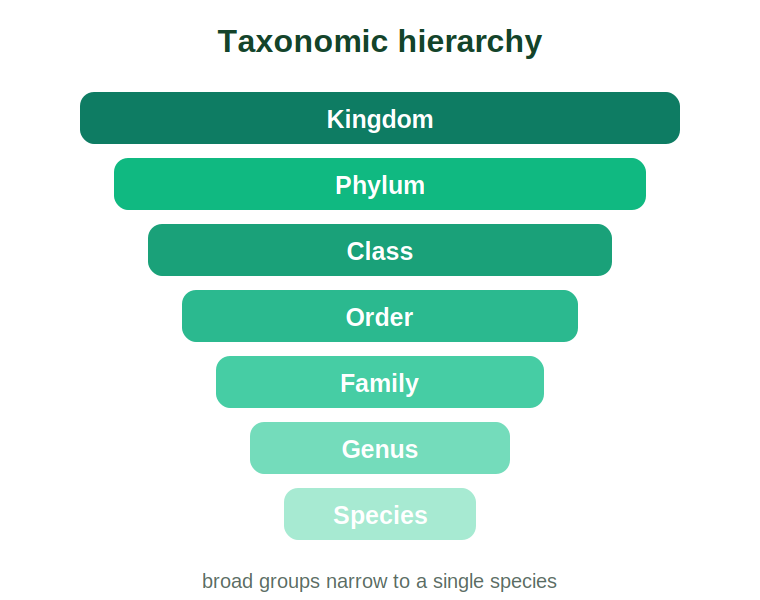
Organisms are arranged in a ladder of ranks called taxonomic categories. From the largest, most general group to the smallest, most specific, these are kingdom, phylum (or division for plants), class, order, family, genus and species. Each category is a taxon. As we move down the ladder the number of organisms falls while the features they share increase, and the species is the basic unit.
|
Diagram 1 – The Taxonomic Hierarchy
Fig 1. The ladder of taxonomic categories from kingdom down to species, shown for the human; lower categories hold fewer kinds that share more features. |
5. Binomial Nomenclature |
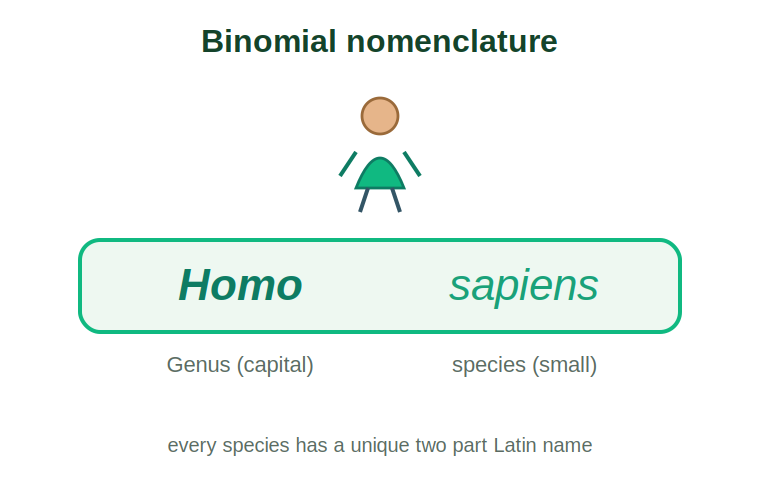
Common names differ from place to place, so scientists use a universal system called binomial nomenclature, devised by Carolus Linnaeus. Each organism gets a two-word Latinised name: the first word is the genus and the second is the species. The genus begins with a capital letter and the species with a small letter; in print the name is in italics, and when handwritten it is underlined.
|
Diagram 2 – A Two-Part Scientific Name
Fig 2. A scientific name has two parts: the genus, written with a capital letter, and the species, written with a small letter, both in italics. |
6. Taxonomic Aids |
Classifying and identifying organisms needs collections and reference tools called taxonomic aids. A herbarium stores dried, pressed and labelled plant specimens; a botanical garden grows living plants for study; a museum keeps preserved animal and plant specimens; a zoological park keeps living animals; and a key uses paired contrasting statements to identify organisms step by step. Floras, manuals, monographs and catalogues record this knowledge.
|
Watch out Systematics is broader than taxonomy. Taxonomy names and classifies; systematics also studies the evolutionary relationships, asking how organisms are related, not just how they are grouped.
|
7. Key Reasoning (Principles) |
|
Principle 1: Living things share defining features Growth, reproduction, metabolism, cellular organisation and response to stimuli together mark something as living, with metabolism and organised response the surest signs. |
|
Principle 2: Classification is hierarchical Taxonomic categories nest inside one another from species up to kingdom, so each group sits within a larger one and members share more features lower down. |
|
Principle 3: Scientific names are universal A two-part Latinised name gives every organism a unique identity understood worldwide, removing the confusion caused by varied common names. |
8. Worked Examples |
| Example 1 |
|
Q: Name any three features common to all living organisms. ▶ Show SolutionLiving things grow, reproduce, carry out metabolism, are made of cells and respond to stimuli. Answer: Growth, reproduction and metabolism (also cellular organisation and response). |
| Example 2 |
|
Q: Which feature is regarded as the surest sign of life? ▶ Show SolutionMetabolism, the chemical reactions of life, together with an organised response, best mark a thing as living. Answer: Metabolism (with organised response to the environment). |
| Example 3 |
|
Q: Define taxonomy. ▶ Show SolutionTaxonomy is the science of naming, describing and classifying organisms. Answer: The science of naming, describing and classifying organisms. |
| Example 4 |
|
Q: List the taxonomic categories from largest to smallest. ▶ Show SolutionKingdom, phylum or division, class, order, family, genus, species. Answer: Kingdom, phylum, class, order, family, genus, species. |
| Example 5 |
|
Q: What is the basic unit of classification? ▶ Show SolutionThe species is the smallest and basic unit. Answer: The species. |
| Example 6 |
|
Q: What is the two-word naming system called, and who devised it? ▶ Show SolutionThe two-word system is binomial nomenclature, devised by Carolus Linnaeus. Answer: Binomial nomenclature, devised by Linnaeus. |
| Example 7 |
|
Q: In the name Homo sapiens, which word is the genus and which is the species? ▶ Show SolutionThe first word, Homo, is the genus; the second, sapiens, is the species. Answer: Homo is the genus; sapiens is the species. |
| Example 8 |
|
Q: How is a scientific name written in print and when handwritten? ▶ Show SolutionIn print it is in italics; when handwritten it is underlined. Answer: Italics in print; underlined when handwritten. |
| Example 9 |
|
Q: Name the taxonomic aid that stores dried, pressed plant specimens. ▶ Show SolutionDried and pressed plant specimens are kept in a herbarium. Answer: A herbarium. |
| Example 10 |
|
Q: State one difference between taxonomy and systematics. ▶ Show SolutionTaxonomy names and classifies; systematics also studies evolutionary relationships. Answer: Systematics also studies evolutionary relationships, not just grouping. |
9. Practice Sets A to D |
| Set A – Multiple Choice (Basic) |
|
1. The basic unit of classification is the: (a) kingdom (b) genus (c) species (d) family 2. The two-word naming system is called: (a) taxonomy (b) binomial nomenclature (c) systematics (d) a key 3. Dried and pressed plant specimens are stored in a: (a) zoo (b) museum (c) herbarium (d) garden 4. Which is the surest sign of a living thing? (a) size (b) colour (c) metabolism (d) weight 5. In Mangifera indica, the word indica is the: (a) genus (b) species (c) family (d) order ▶ Reveal Answers1. (c) species. 2. (b) binomial nomenclature. 3. (c) herbarium. 4. (c) metabolism. 5. (b) species. |
| Set B – Short Answer (Understanding) |
|
1. List four features common to all living organisms. 2. Define a taxon. 3. Why do scientists prefer scientific names to common names? 4. What is a key, as a taxonomic aid? 5. State the difference between a herbarium and a botanical garden. ▶ Reveal Answers1. Growth, reproduction, metabolism, cellular organisation and response to stimuli (any four). 2. A taxon is a group of organisms at any rank of classification, such as a family or a genus. 3. Because scientific names are unique and the same everywhere, while common names vary by place. 4. A tool of paired contrasting statements used to identify organisms step by step. 5. A herbarium stores dried, pressed specimens; a botanical garden grows living plants. |
| Set C – Application and Reasoning |
|
1. Arrange these from largest to smallest: family, species, kingdom, genus. 2. Why does the number of shared features increase as we move down the hierarchy? 3. Rewrite the name homo Sapiens correctly and explain the corrections. 4. Which taxonomic aid would a scientist use to study living animals? 5. Explain why systematics is said to be broader than taxonomy. ▶ Reveal Answers1. Kingdom, family, genus, species. 2. Because lower categories contain fewer, more closely related kinds, so they have more features in common. 3. Homo sapiens: the genus takes a capital H, the species a small s, and the whole name is in italics. 4. A zoological park (zoo), which keeps living animals. 5. Systematics studies not only naming and grouping but also the evolutionary relationships among organisms. |
| Set D – Higher Order (Challenge) |
|
1. Explain why a single agreed naming system is essential for biologists worldwide. 2. Two organisms are placed in the same genus. What does this tell you compared with sharing only a kingdom? 3. Discuss why metabolism is taken as a defining feature even though some non-living things can grow in size. 4. Describe how a herbarium, a museum and a zoological park together support the study of biodiversity. 5. Using the hierarchy, explain how an unknown insect would be placed from kingdom down to species. ▶ Reveal Answers1. Because organisms have many varied common names; one Latinised system gives each a single unique identity understood everywhere. 2. Sharing a genus means they are very closely related and share many features, far more than organisms that share only the broad kingdom. 3. Non-living things may grow by adding material from outside, but only living things grow from within through metabolism, the organised chemical reactions of life. 4. A herbarium preserves plant specimens, a museum preserves other preserved specimens, and a zoological park keeps living animals, so together they cover plants, preserved and living animals for reference and study. 5. It would be placed in Animalia, then the phylum Arthropoda, then the insect class, and so on down through order, family and genus to its species, using shared features at each step. |
|
Chapter Summary
|
|||||||||||||||||||||||||||||||
| 8-Point Exam Quick-Check | ||||||||||||||||||||||||||||||||
|
||||||||||||||||||||||||||||||||
|
School Revise Virtual Lab Explore these ideas with interactive simulations and visual tools.
|
|
Class 11 Biology Chapter 1: The Living World, Complete Notes and Practice This revision guide follows the current NCERT Class 11 Biology syllabus and covers the defining features of living organisms, the diversity of life and the need for classification, taxonomy and systematics, the taxonomic categories from kingdom to species, binomial nomenclature and taxonomic aids, with two diagrams, ten worked examples and graded practice. Visit SchoolRevise.com to revise, practise and excel. |
 Google