Curriculum
Science Grade XI Biology
Science Grade XI Biology
0/19
-
Chapter 1: The Living World
 Preview
 -
Chapter 2: Biological Classification
Preview
-
Chapter 3: Plant Kingdom
Preview
-
Chapter 4: Animal Kingdom
Preview
-
Chapter 5: Morphology of Flowering Plants
Preview
-
Chapter 6: Anatomy of Flowering Plants
Preview
-
Chapter 7: Structural Organisation in Animals
Preview
-
Chapter 8: Cell: The Unit of Life
Preview
-
Chapter 9: Biomolecules
Preview
-
Chapter 10: Cell Cycle and Cell Division
Preview
-
Chapter 11: Photosynthesis in Higher Plants
Preview
-
Chapter 12: Respiration in Plants
Preview
-
Chapter 13: Plant Growth and Development
Preview
-
Chapter 14: Breathing and Exchange of Gases
Preview
-
Chapter 15: Body Fluids and Circulation
Preview
-
Chapter 16: Excretory Products and their Elimination
Preview
-
Chapter 17: Locomotion and Movement
Preview
-
Chapter 18: Neural Control and Coordination
Preview
-
Chapter 19: Chemical Coordination and Integration
Preview
Work Sheets
0/19

Chapter 16: Excretory Products and their Elimination
|
Grade 11 Science | Chapter 16 Excretory Products and their EliminationThe body must remove the wastes made by its cells. This chapter develops excretion, the urinary system, the nephron, and how urine is formed.
|
|
Contents
|
1. Introduction: Removing Waste |
As cells work, they make wastes that would be harmful if they built up. Excretion is the removal of these wastes from the body. The main waste from breaking down proteins is removed by the kidneys, which filter the blood and make urine. This chapter follows how the body cleans its blood and keeps its fluids in balance.
|
Core idea Excretion removes harmful wastes. The kidneys filter the blood and make urine, which passes through the ureters to the bladder and out through the urethra.
|
2. The Urinary System |
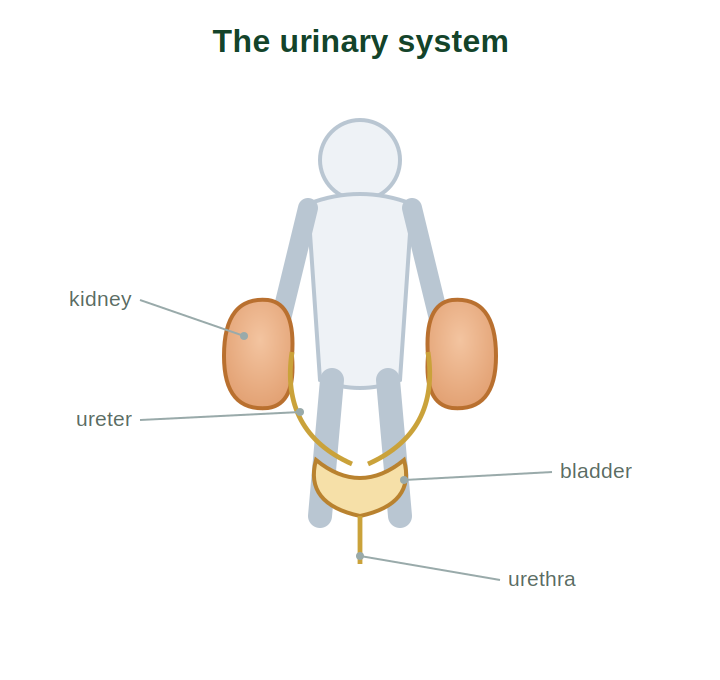
The urinary system does most of the body’s excretion. Two bean shaped kidneys filter the blood and make urine. The urine drains down two tubes, the ureters, into a stretchy bag, the bladder, where it is stored. When the bladder is full, urine leaves the body through a tube called the urethra.
|
Diagram 1 – The Urinary System
Fig 1. The kidneys make urine, which drains through the ureters to the bladder and out by the urethra. |
3. The Nephron |
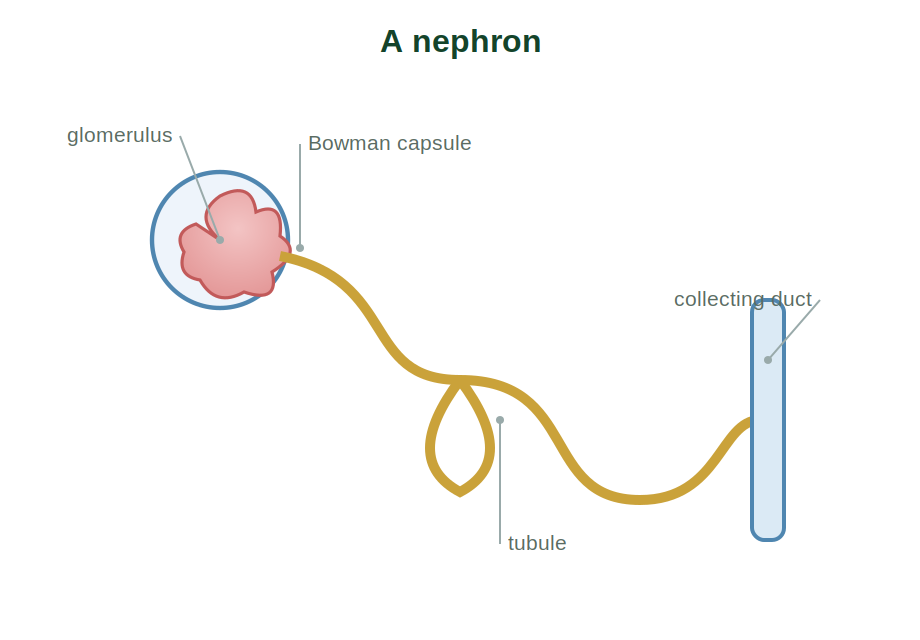
Each kidney contains about a million tiny filtering units called nephrons. Blood enters a tight knot of capillaries, the glomerulus, sitting in a cup called the Bowman capsule, where the blood is filtered. The filtered liquid then flows along a long, looping tubule and into a collecting duct. The nephron is where urine is actually made.
|
Diagram 2 – A Nephron
Fig 2. Blood is filtered at the glomerulus into the Bowman capsule, then processed along the tubule. |
4. How Urine Is Formed |
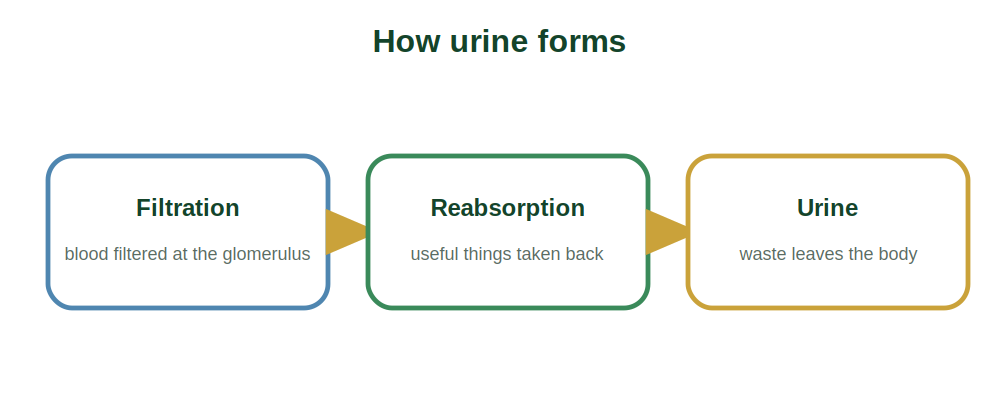
Urine is made in three steps. First, in filtration, the blood is filtered at the glomerulus, and water, salts, glucose and wastes pass into the tubule. Next, in reabsorption, the useful materials such as glucose, much of the water and needed salts are taken back into the blood. What remains, mostly water with dissolved wastes, becomes urine and is removed.
|
Diagram 3 – How Urine Is Formed
Fig 3. Blood is filtered, useful materials are reabsorbed, and the remaining waste leaves as urine. |
5. Other Excretory Organs |
The kidneys are not the only organs that excrete. The lungs remove carbon dioxide and some water as we breathe out. The skin removes water, salts and a little waste in sweat, which also cools the body. The liver processes wastes and turns harmful substances into safer ones for the kidneys to remove. Together these share the work of excretion.
6. Keeping Water in Balance |
Besides removing waste, the kidneys keep the body’s water and salts in balance, a job called osmoregulation. If the body has too much water, the kidneys make more dilute urine; if it is short of water, they make less, more concentrated urine to save water. In this way the kidneys keep the internal conditions of the body steady.
7. Key Reasoning (Principles) |
|
Principle 1: Wastes must be removed Cell activity makes wastes that would harm the body if they built up, so excretion removes them and keeps the blood clean. |
|
Principle 2: Filter, then reclaim the useful The kidney first filters out a large amount of liquid, then reabsorbs the useful materials, so only true waste is lost as urine. |
|
Principle 3: The kidney keeps the body steady By adjusting how much water and salt it removes, the kidney keeps the body’s fluids in balance whatever a person drinks. |
8. Worked Examples |
| Example 1 |
|
Q: What is excretion? ▶ Show SolutionThe removal of harmful wastes from the body. Answer: Removing harmful wastes. |
| Example 2 |
|
Q: Which organs make urine? ▶ Show SolutionThe kidneys. Answer: The kidneys. |
| Example 3 |
|
Q: Name the tube that carries urine from a kidney to the bladder. ▶ Show SolutionThe ureter. Answer: The ureter. |
| Example 4 |
|
Q: Where is urine stored? ▶ Show SolutionIn the bladder. Answer: In the bladder. |
| Example 5 |
|
Q: What is the filtering unit of the kidney called? ▶ Show SolutionThe nephron. Answer: The nephron. |
| Example 6 |
|
Q: Where is the blood filtered in a nephron? ▶ Show SolutionAt the glomerulus, into the Bowman capsule. Answer: At the glomerulus. |
| Example 7 |
|
Q: Name the three steps of urine formation. ▶ Show SolutionFiltration, reabsorption and the removal of urine. Answer: Filtration, reabsorption, urine. |
| Example 8 |
|
Q: What is taken back into the blood during reabsorption? ▶ Show SolutionUseful materials such as glucose, water and needed salts. Answer: Useful materials. |
| Example 9 |
|
Q: Name two organs other than the kidneys that excrete. ▶ Show SolutionThe lungs and the skin (also the liver). Answer: Lungs and skin. |
| Example 10 |
|
Q: What do the kidneys do when the body has too little water? ▶ Show SolutionThey make less, more concentrated urine to save water. Answer: Make concentrated urine. |
9. Practice Sets A to D |
| Set A – Multiple Choice (Basic) |
|
1. Urine is made by the: (a) liver (b) kidneys (c) lungs (d) skin 2. Urine is stored in the: (a) ureter (b) bladder (c) urethra (d) kidney 3. The filtering unit of the kidney is the: (a) alveolus (b) nephron (c) neuron (d) villus 4. Blood is filtered at the: (a) tubule (b) glomerulus (c) bladder (d) urethra 5. Useful materials are returned during: (a) filtration (b) reabsorption (c) breathing (d) clotting ▶ Reveal Answers1. (b) kidneys. 2. (b) bladder. 3. (b) nephron. 4. (b) glomerulus. 5. (b) reabsorption. |
| Set B – Short Answer (Understanding) |
|
1. Define excretion. 2. Trace the path of urine out of the body. 3. Name the parts of a nephron. 4. Describe the three steps of urine formation. 5. Name three other excretory organs and what each removes. ▶ Reveal Answers1. The removal of harmful wastes from the body. 2. From the kidneys through the ureters to the bladder and out by the urethra. 3. Glomerulus, Bowman capsule, tubule and collecting duct. 4. Filtration of the blood, reabsorption of useful materials, and removal of the remaining urine. 5. Lungs remove carbon dioxide, skin removes sweat, and the liver processes wastes. |
| Set C – Application and Reasoning |
|
1. Why must the body remove wastes? 2. Why is glucose reabsorbed rather than lost in urine? 3. On a hot day with much sweating, what kind of urine forms? 4. Why does each kidney have about a million nephrons? 5. Why is the bladder stretchy? ▶ Reveal Answers1. Because wastes would build up and harm the body if not removed. 2. Because glucose is a useful fuel, so the body reclaims it instead of wasting it. 3. Less, more concentrated urine, to save water lost in sweat. 4. So a large volume of blood can be filtered and processed. 5. So it can store urine until it is convenient to remove it. |
| Set D – Higher Order (Challenge) |
|
1. Explain why the kidney filters first and then reabsorbs, rather than picking out only the waste. 2. Explain how the kidneys keep the body’s water in balance. 3. Explain why a person drinking a lot of water passes more urine. 4. Explain how the liver and kidneys work together in excretion. 5. Explain why excretion is essential to keeping the internal conditions steady. ▶ Reveal Answers1. Filtering everything and then reclaiming the useful materials is simpler and surer than trying to select only the wastes from the blood. 2. By adjusting how much water they remove, making dilute urine when water is plentiful and concentrated urine when it is scarce. 3. Because the kidneys remove the extra water as more, dilute urine to keep the balance. 4. The liver turns harmful substances into safer wastes, and the kidneys then filter those wastes out of the blood. 5. Because removing wastes and balancing water and salts keeps the blood and body fluids within the limits the cells need. |
|
Chapter Summary
|
|||||||||||||||||||||||||||||||
| 8-Point Exam Quick-Check | ||||||||||||||||||||||||||||||||
|
||||||||||||||||||||||||||||||||
|
School Revise Virtual Lab Explore these ideas with interactive simulations and visual tools.
|
|
Class 11 Biology Chapter 16: Excretory Products and their Elimination, Complete Notes and Practice This revision guide follows the current NCERT Class 11 Biology syllabus and develops excretion, covering the need to remove wastes, the urinary system of kidneys, ureters, bladder and urethra, the nephron with its glomerulus, Bowman capsule and tubule, the formation of urine by filtration and reabsorption, the role of the lungs, skin and liver, and how the kidneys keep water in balance, with three diagrams, ten worked examples and graded practice. Visit SchoolRevise.com to revise, practise and excel. |
 Google