Curriculum
Science Grade XI Biology
Science Grade XI Biology
0/19
-
Chapter 1: The Living World
 Preview
 -
Chapter 2: Biological Classification
Preview
-
Chapter 3: Plant Kingdom
Preview
-
Chapter 4: Animal Kingdom
Preview
-
Chapter 5: Morphology of Flowering Plants
Preview
-
Chapter 6: Anatomy of Flowering Plants
Preview
-
Chapter 7: Structural Organisation in Animals
Preview
-
Chapter 8: Cell: The Unit of Life
Preview
-
Chapter 9: Biomolecules
Preview
-
Chapter 10: Cell Cycle and Cell Division
Preview
-
Chapter 11: Photosynthesis in Higher Plants
Preview
-
Chapter 12: Respiration in Plants
Preview
-
Chapter 13: Plant Growth and Development
Preview
-
Chapter 14: Breathing and Exchange of Gases
Preview
-
Chapter 15: Body Fluids and Circulation
Preview
-
Chapter 16: Excretory Products and their Elimination
Preview
-
Chapter 17: Locomotion and Movement
Preview
-
Chapter 18: Neural Control and Coordination
Preview
-
Chapter 19: Chemical Coordination and Integration
Preview
Work Sheets
0/19

Chapter 15: Body Fluids and Circulation
|
Grade 11 Science | Chapter 15 Body Fluids and CirculationThe blood carries materials all around the body. This chapter develops the parts of blood, the structure of the heart, double circulation, and the blood vessels.
|
|
Contents
|
1. Introduction: The Body’s Transport |
A large body cannot rely on materials simply spreading from cell to cell, so it needs a transport system. In humans this is the blood, pumped by the heart through a network of vessels. The blood carries oxygen, food, wastes and much more, reaching every cell. This chapter looks at the blood, the pump and the route it follows.
|
Core idea The blood carries materials around the body. The heart pumps it through arteries, capillaries and veins, in a double loop through the lungs and the body.
|
2. The Parts of Blood |
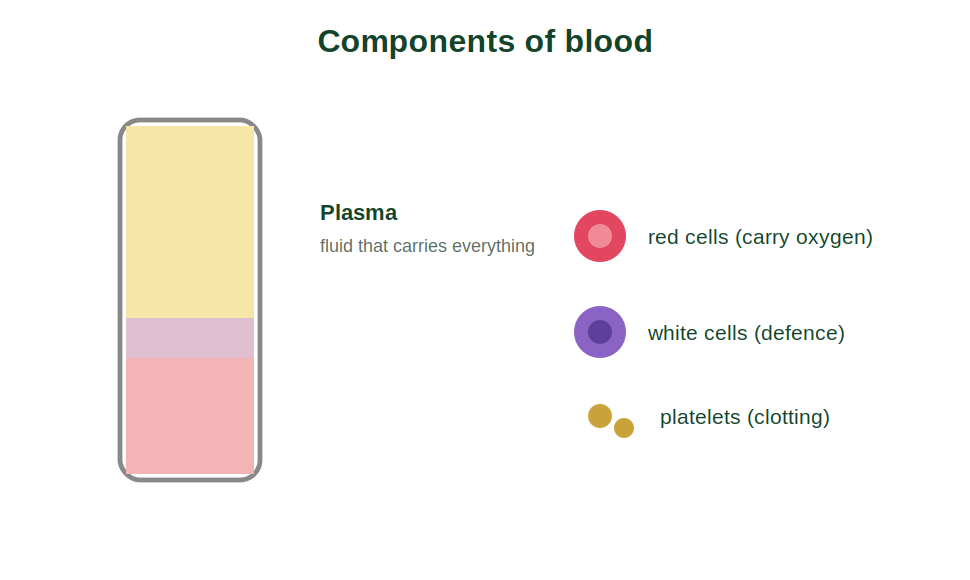
Blood is part fluid and part cells. The fluid, plasma, carries dissolved food, wastes and other materials. Floating in it are the red blood cells that carry oxygen, the white blood cells that defend against disease, and the tiny platelets that help the blood to clot and seal a wound. Together these let the blood do many jobs at once.
|
Diagram 1 – The Components of Blood
Fig 1. Blood is made of plasma carrying red cells, white cells and platelets. |
3. The Heart |
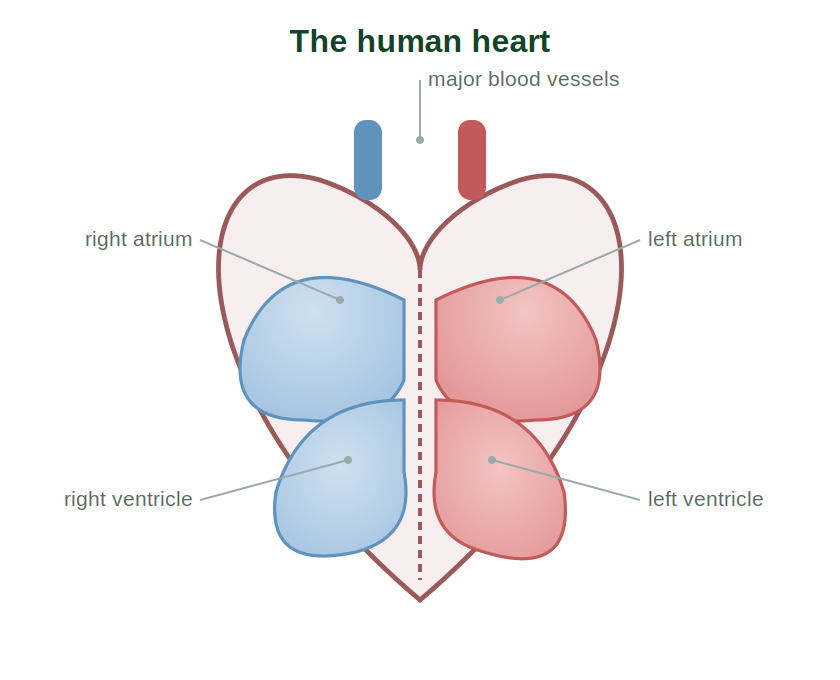
The heart is a muscular pump with four chambers. The two upper chambers are the atria, which receive blood, and the two lower are the ventricles, which pump it out. The right side handles oxygen poor blood and the left side oxygen rich blood, kept apart by a wall so the two never mix. Its steady beat keeps the blood moving.
|
Diagram 2 – The Human Heart
Fig 2. The heart has four chambers, with the right side handling oxygen poor blood and the left oxygen rich. |
4. Double Circulation |
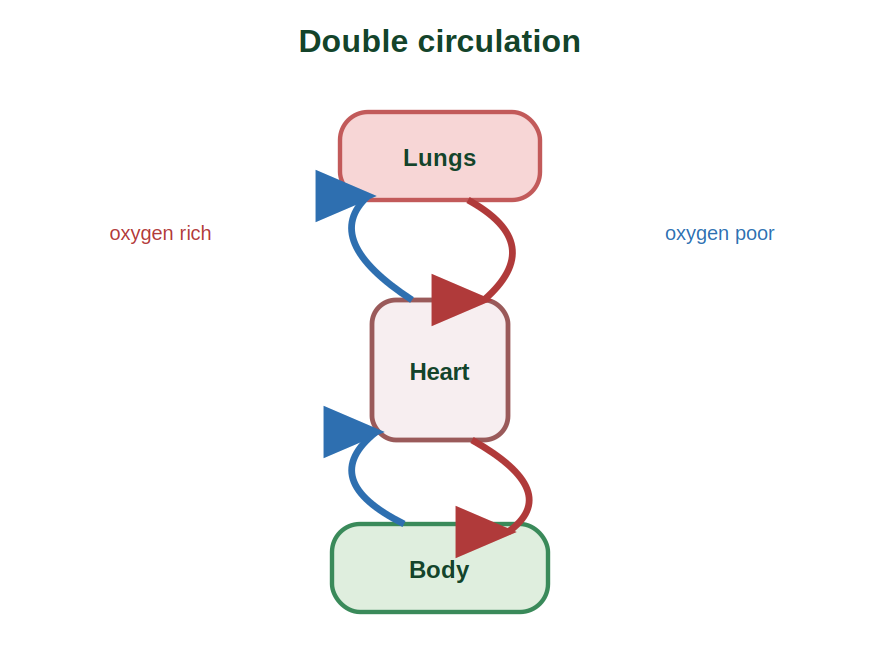
Human blood passes through the heart twice in each full circuit, called double circulation. In the first loop the heart pumps oxygen poor blood to the lungs to pick up oxygen and return. In the second loop it pumps that oxygen rich blood to the body and receives it back. So the heart sends blood out under strong pressure to the whole body.
|
Diagram 3 – Double Circulation
Fig 3. Blood travels heart to lungs and back, then heart to body and back, passing through the heart twice. |
5. Blood Vessels |
Three kinds of vessel carry the blood. Arteries carry blood away from the heart under high pressure and have thick walls. Veins return blood to the heart at lower pressure and have valves to stop it flowing backward. Between them lie the capillaries, vessels so thin that materials pass easily between the blood and the cells.
6. Why a Double Circulation |
A double circulation is efficient because the blood is given a fresh, strong push by the heart before it travels to the body. If blood went round only once, it would lose pressure passing through the lungs and reach the body slowly. By returning to the heart for a second push, the blood is delivered quickly and at full pressure to active organs.
7. Key Reasoning (Principles) |
|
Principle 1: A big body needs a transport system Materials cannot simply spread far enough in a large body, so the blood, pumped by the heart, carries them to every cell. |
|
Principle 2: The heart keeps oxygen rich and poor blood apart A dividing wall keeps the right side, with oxygen poor blood, separate from the left side, with oxygen rich blood, so the two never mix. |
|
Principle 3: Double circulation delivers blood at full pressure Because the blood returns to the heart for a second push after the lungs, it reaches the body quickly and under strong pressure. |
8. Worked Examples |
| Example 1 |
|
Q: Why does a large body need a transport system? ▶ Show SolutionBecause materials cannot spread far enough on their own to reach every cell. Answer: To reach every cell. |
| Example 2 |
|
Q: What is the fluid part of blood called? ▶ Show SolutionPlasma. Answer: Plasma. |
| Example 3 |
|
Q: Which blood cells carry oxygen? ▶ Show SolutionThe red blood cells. Answer: Red blood cells. |
| Example 4 |
|
Q: Which blood cells defend against disease? ▶ Show SolutionThe white blood cells. Answer: White blood cells. |
| Example 5 |
|
Q: What do platelets do? ▶ Show SolutionThey help the blood to clot and seal a wound. Answer: Help clotting. |
| Example 6 |
|
Q: How many chambers does the heart have? ▶ Show SolutionFour. Answer: Four. |
| Example 7 |
|
Q: Which chambers pump blood out of the heart? ▶ Show SolutionThe ventricles. Answer: The ventricles. |
| Example 8 |
|
Q: What does double circulation mean? ▶ Show SolutionThe blood passes through the heart twice in each full circuit. Answer: Blood passes the heart twice. |
| Example 9 |
|
Q: Which vessels carry blood away from the heart? ▶ Show SolutionArteries. Answer: Arteries. |
| Example 10 |
|
Q: Why do veins have valves? ▶ Show SolutionTo stop the blood flowing backward. Answer: To prevent backflow. |
9. Practice Sets A to D |
| Set A – Multiple Choice (Basic) |
|
1. The fluid part of blood is: (a) plasma (b) platelets (c) haemoglobin (d) serum only 2. Oxygen is carried by: (a) white cells (b) red cells (c) platelets (d) plasma only 3. The heart has: (a) two chambers (b) three (c) four (d) five 4. Arteries carry blood: (a) to the heart (b) away from the heart (c) nowhere (d) backward 5. Double circulation passes the heart: (a) once (b) twice (c) thrice (d) never ▶ Reveal Answers1. (a) plasma. 2. (b) red cells. 3. (c) four. 4. (b) away from the heart. 5. (b) twice. |
| Set B – Short Answer (Understanding) |
|
1. Name the four parts of blood and a role of each. 2. Name the four chambers of the heart. 3. Explain double circulation. 4. Compare arteries and veins. 5. What happens in the capillaries? ▶ Reveal Answers1. Plasma (carries materials), red cells (carry oxygen), white cells (defence), platelets (clotting). 2. Right atrium, right ventricle, left atrium, left ventricle. 3. The blood passes through the heart twice, once for the loop to the lungs and once for the loop to the body. 4. Arteries carry blood away from the heart under high pressure with thick walls; veins return blood at low pressure with valves. 5. Materials pass between the blood and the cells through their very thin walls. |
| Set C – Application and Reasoning |
|
1. Why must oxygen rich and oxygen poor blood not mix? 2. Why do arteries have thick walls? 3. Why are capillary walls so thin? 4. Why does the heart pump blood to the lungs first? 5. Why does a cut bleed but then stop? ▶ Reveal Answers1. So the body always receives blood that is rich in oxygen. 2. To withstand the high pressure of blood pumped from the heart. 3. So materials can pass easily between the blood and the cells. 4. To pick up oxygen before that blood is sent to the body. 5. Platelets help the blood to clot and seal the wound. |
| Set D – Higher Order (Challenge) |
|
1. Explain why double circulation is more efficient than a single one. 2. Explain how the structure of the heart keeps the two kinds of blood apart. 3. Explain why veins, but not arteries, need valves. 4. Explain how each component of blood suits its job. 5. Explain how the blood links breathing, digestion and the cells. ▶ Reveal Answers1. Because the blood returns to the heart for a second push after the lungs, so it reaches the body quickly and at full pressure. 2. A dividing wall separates the right side, with oxygen poor blood, from the left side, with oxygen rich blood. 3. Because veins carry blood at low pressure, so valves are needed to stop it flowing backward, while the high pressure in arteries keeps blood moving forward. 4. Red cells carry oxygen, white cells defend, platelets clot, and plasma carries dissolved materials, so the blood does many jobs at once. 5. The blood collects oxygen from the lungs and food from the gut and carries them to the cells, returning their wastes. |
|
Chapter Summary
|
|||||||||||||||||||||||||||||||
| 8-Point Exam Quick-Check | ||||||||||||||||||||||||||||||||
|
||||||||||||||||||||||||||||||||
|
School Revise Virtual Lab Explore these ideas with interactive simulations and visual tools.
|
|
Class 11 Biology Chapter 15: Body Fluids and Circulation, Complete Notes and Practice This revision guide follows the current NCERT Class 11 Biology syllabus and develops circulation, covering the need for a transport system, the parts of blood including plasma, red cells, white cells and platelets, the four chambered heart, double circulation through the lungs and body, the arteries, veins and capillaries, and why a double circulation is efficient, with three diagrams, ten worked examples and graded practice. Visit SchoolRevise.com to revise, practise and excel. |
 Google