Curriculum
Science Grade XI Biology
Science Grade XI Biology
0/19
-
Chapter 1: The Living World
 Preview
 -
Chapter 2: Biological Classification
Preview
-
Chapter 3: Plant Kingdom
Preview
-
Chapter 4: Animal Kingdom
Preview
-
Chapter 5: Morphology of Flowering Plants
Preview
-
Chapter 6: Anatomy of Flowering Plants
Preview
-
Chapter 7: Structural Organisation in Animals
Preview
-
Chapter 8: Cell: The Unit of Life
Preview
-
Chapter 9: Biomolecules
Preview
-
Chapter 10: Cell Cycle and Cell Division
Preview
-
Chapter 11: Photosynthesis in Higher Plants
Preview
-
Chapter 12: Respiration in Plants
Preview
-
Chapter 13: Plant Growth and Development
Preview
-
Chapter 14: Breathing and Exchange of Gases
Preview
-
Chapter 15: Body Fluids and Circulation
Preview
-
Chapter 16: Excretory Products and their Elimination
Preview
-
Chapter 17: Locomotion and Movement
Preview
-
Chapter 18: Neural Control and Coordination
Preview
-
Chapter 19: Chemical Coordination and Integration
Preview
Work Sheets
0/19

Chapter 10: Cell Cycle and Cell Division
|
Grade 11 Science | Chapter 10 Cell Cycle and Cell DivisionCells grow and divide in an orderly cycle. This chapter develops the cell cycle, the stages of mitosis, its role in growth and repair, and meiosis, which makes gametes and adds variation.
|
|
Contents
|
1. Introduction: Why Cells Divide |
Living things grow, repair damage and reproduce, and all of this depends on cells dividing to make new cells. Division happens in an orderly sequence called the cell cycle. This chapter follows that cycle, examines the two kinds of division, mitosis and meiosis, and explains what each is for.
|
Core idea Cells divide through the cell cycle. Mitosis makes two identical cells for growth and repair, while meiosis makes four cells with half the chromosomes, for reproduction.
|
2. The Cell Cycle |
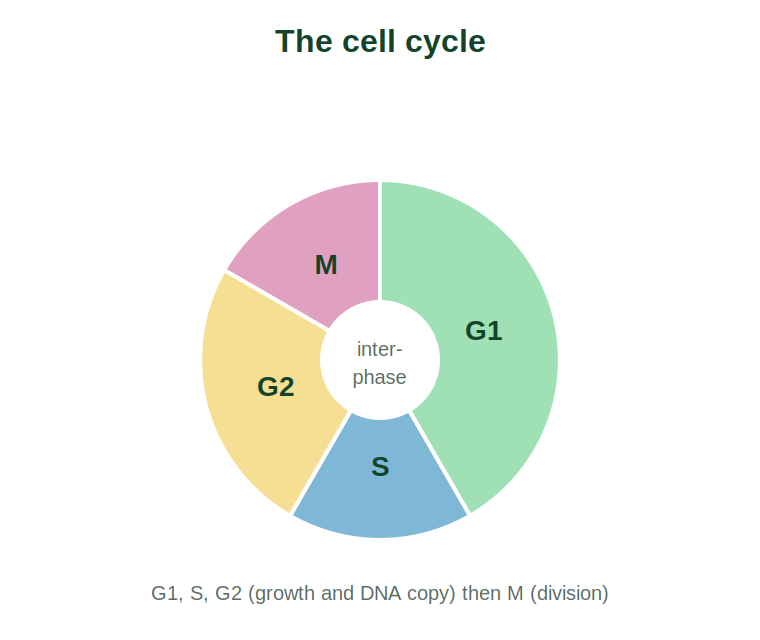
The cell cycle is the orderly series of events by which a cell grows and divides. Most of the time the cell is in interphase, which has three parts: G1, when the cell grows; S, when the DNA is copied so each chromosome is doubled; and G2, when it prepares to divide. Then comes the M phase, the actual division.
|
Diagram 1 – The Cell Cycle
Fig 1. The cell cycle: the long interphase (G1, S, G2) of growth and DNA copying, then the M phase of division. |
3. Mitosis |
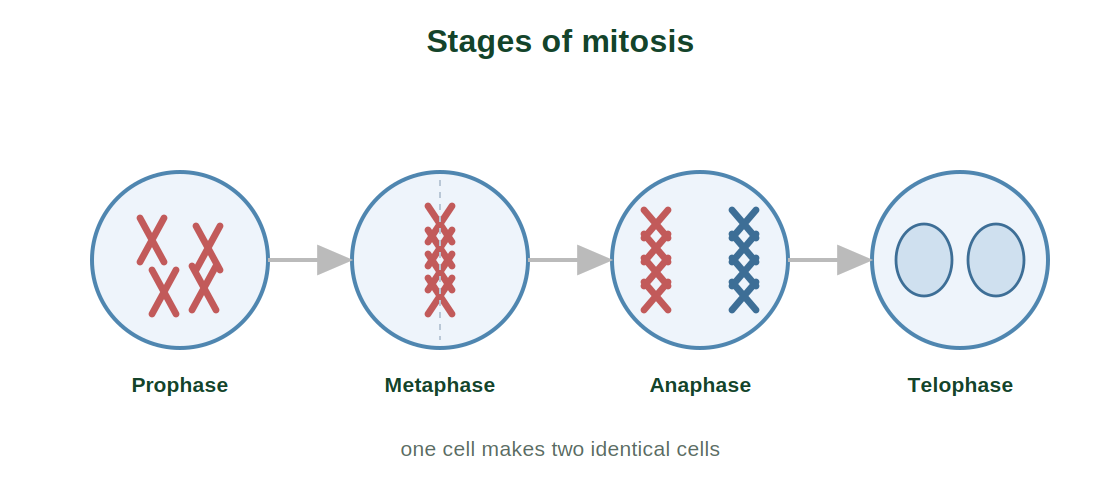
Mitosis is the division that produces two identical cells. It passes through four stages. In prophase the chromosomes condense and become visible. In metaphase they line up across the middle of the cell. In anaphase the copies are pulled apart to opposite ends. In telophase two new nuclei form, and the cell then splits in two.
|
Diagram 2 – The Stages of Mitosis
Fig 2. In mitosis the chromosomes condense, line up, separate and re-form as two identical nuclei. |
4. The Importance of Mitosis |
Mitosis matters because it produces cells that are genetically identical to the parent cell, each with the full set of chromosomes. This is exactly what is needed for growth, as an organism builds more cells, for repair, as wounds heal, and for replacement of worn out cells. It also lets simple organisms reproduce by simply dividing.
5. Meiosis |
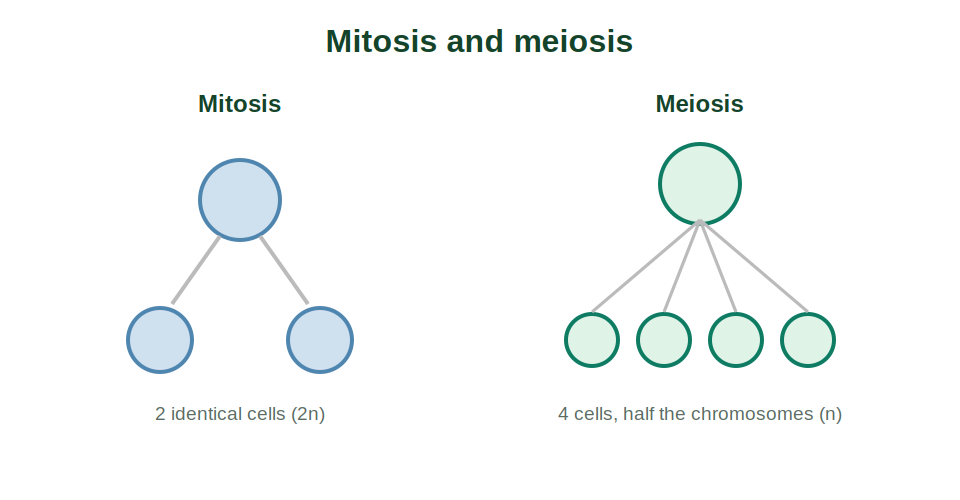
Meiosis is a special division that makes gametes, the sex cells. From one cell it produces four cells, each with half the number of chromosomes, called haploid. This halving is vital: when two gametes join at fertilisation, the full number is restored. Meiosis also shuffles the genetic material, so the offspring differ from their parents, the source of variation.
|
Diagram 3 – Mitosis and Meiosis
Fig 3. Mitosis makes two identical cells with the full chromosome number; meiosis makes four cells with half. |
6. Mitosis Compared with Meiosis |
The two divisions serve different ends. Mitosis happens once, gives two cells, keeps the chromosome number the same, and produces identical cells for growth and repair. Meiosis happens twice in a row, gives four cells, halves the chromosome number, and produces varied cells for reproduction. Both begin only after the DNA has been copied in the S phase.
7. Key Reasoning (Principles) |
|
Principle 1: DNA is copied before division In the S phase the DNA is copied so that each chromosome is doubled, ensuring there is a full set to share out when the cell divides. |
|
Principle 2: Mitosis conserves the chromosome number Because the doubled chromosomes are shared equally, each new cell receives the full set, identical to the parent, suiting growth and repair. |
|
Principle 3: Meiosis halves the number and adds variation Meiosis divides twice to give four haploid cells and shuffles the genes, so fertilisation restores the number while the offspring vary. |
8. Worked Examples |
| Example 1 |
|
Q: Name the two main phases of the cell cycle. ▶ Show SolutionInterphase (growth and DNA copying) and the M phase (division). Answer: Interphase and M phase. |
| Example 2 |
|
Q: In which phase is the DNA copied? ▶ Show SolutionThe DNA is copied in the S phase of interphase. Answer: The S phase. |
| Example 3 |
|
Q: Name the four stages of mitosis in order. ▶ Show SolutionProphase, metaphase, anaphase, telophase. Answer: Prophase, metaphase, anaphase, telophase. |
| Example 4 |
|
Q: How many cells does mitosis produce? ▶ Show SolutionMitosis produces two cells. Answer: Two. |
| Example 5 |
|
Q: Are the cells from mitosis identical or different? ▶ Show SolutionThey are genetically identical to the parent cell. Answer: Identical. |
| Example 6 |
|
Q: How many cells does meiosis produce? ▶ Show SolutionMeiosis produces four cells. Answer: Four. |
| Example 7 |
|
Q: What happens to the chromosome number in meiosis? ▶ Show SolutionIt is halved, giving haploid cells. Answer: It is halved. |
| Example 8 |
|
Q: What is mitosis used for? ▶ Show SolutionFor growth, repair and replacement of cells. Answer: Growth and repair. |
| Example 9 |
|
Q: A cell has 8 chromosomes. How many will each cell have after mitosis? ▶ Show SolutionMitosis keeps the number the same. So 8 chromosomes each. Answer: 8. |
| Example 10 |
|
Q: A cell has 8 chromosomes. How many will each cell have after meiosis? ▶ Show SolutionMeiosis halves the number. So 4 chromosomes each. Answer: 4. |
9. Practice Sets A to D |
| Set A – Multiple Choice (Basic) |
|
1. DNA is copied during the: (a) G1 phase (b) S phase (c) G2 phase (d) M phase 2. Mitosis produces: (a) 2 identical cells (b) 4 cells (c) 2 different cells (d) 1 cell 3. Chromosomes line up across the middle in: (a) prophase (b) metaphase (c) anaphase (d) telophase 4. Meiosis produces cells that are: (a) diploid (b) haploid (c) identical (d) larger 5. Mitosis is used mainly for: (a) gametes (b) growth and repair (c) variation (d) digestion ▶ Reveal Answers1. (b) S phase. 2. (a) 2 identical cells. 3. (b) metaphase. 4. (b) haploid. 5. (b) growth and repair. |
| Set B – Short Answer (Understanding) |
|
1. List the parts of interphase. 2. Name the four stages of mitosis. 3. State two uses of mitosis. 4. What is special about the cells made by meiosis? 5. Why must the chromosome number be halved in gametes? ▶ Reveal Answers1. G1 (growth), S (DNA copied) and G2 (preparation). 2. Prophase, metaphase, anaphase and telophase. 3. Growth and the repair or replacement of cells. 4. There are four of them, each with half the chromosome number (haploid) and varied. 5. So that when two gametes join at fertilisation, the full number is restored. |
| Set C – Application and Reasoning |
|
1. A wound is healing. Which division is at work? 2. Sex cells are being made. Which division is at work? 3. A cell has 10 chromosomes. How many after mitosis? 4. A cell has 10 chromosomes. How many after meiosis? 5. Why are the cells made by mitosis identical? ▶ Reveal Answers1. Mitosis. 2. Meiosis. 3. 10 chromosomes in each cell. 4. 5 chromosomes in each cell. 5. Because the copied chromosomes are shared equally, so each cell gets the same full set. |
| Set D – Higher Order (Challenge) |
|
1. Explain why the DNA must be copied before either kind of division. 2. Explain how meiosis keeps the chromosome number steady across generations. 3. A species has 24 chromosomes. State the number in its gametes and explain. 4. Explain why meiosis is a source of variation. 5. Compare the number of cells and chromosome number produced by mitosis and meiosis. ▶ Reveal Answers1. So that there is a complete doubled set of chromosomes to share out, giving each new cell a full set. 2. Meiosis halves the number in the gametes, and fertilisation joins two gametes to restore the full number, so it stays steady. 3. 12, because meiosis halves the 24 chromosomes to give haploid gametes. 4. Because it shuffles the genetic material, so the gametes, and the offspring they form, differ from the parents. 5. Mitosis gives 2 cells with the full number; meiosis gives 4 cells with half the number. |
|
Chapter Summary
|
|||||||||||||||||||||||||||||||
| 8-Point Exam Quick-Check | ||||||||||||||||||||||||||||||||
|
||||||||||||||||||||||||||||||||
|
School Revise Virtual Lab Explore these ideas with interactive simulations and visual tools.
|
|
Class 11 Biology Chapter 10: Cell Cycle and Cell Division, Complete Notes and Practice This revision guide follows the current NCERT Class 11 Biology syllabus and develops cell division, covering the cell cycle with its interphase phases G1, S and G2 and the M phase, the four stages of mitosis and its role in growth and repair, and meiosis, which makes four haploid gametes and brings variation, with three diagrams, ten worked examples and graded practice. Visit SchoolRevise.com to revise, practise and excel. |
 Google