Curriculum
Science Grade XI Biology
Science Grade XI Biology
0/19
-
Chapter 1: The Living World
 Preview
 -
Chapter 2: Biological Classification
Preview
-
Chapter 3: Plant Kingdom
Preview
-
Chapter 4: Animal Kingdom
Preview
-
Chapter 5: Morphology of Flowering Plants
Preview
-
Chapter 6: Anatomy of Flowering Plants
Preview
-
Chapter 7: Structural Organisation in Animals
Preview
-
Chapter 8: Cell: The Unit of Life
Preview
-
Chapter 9: Biomolecules
Preview
-
Chapter 10: Cell Cycle and Cell Division
Preview
-
Chapter 11: Photosynthesis in Higher Plants
Preview
-
Chapter 12: Respiration in Plants
Preview
-
Chapter 13: Plant Growth and Development
Preview
-
Chapter 14: Breathing and Exchange of Gases
Preview
-
Chapter 15: Body Fluids and Circulation
Preview
-
Chapter 16: Excretory Products and their Elimination
Preview
-
Chapter 17: Locomotion and Movement
Preview
-
Chapter 18: Neural Control and Coordination
Preview
-
Chapter 19: Chemical Coordination and Integration
Preview
Work Sheets
0/19

Chapter 8: Cell: The Unit of Life
|
Grade 11 Science | Chapter 8 Cell: The Unit of LifeThe cell is the basic unit of every living thing. This chapter develops the cell theory, the membrane and wall, the nucleus, the organelles, and how plant and animal cells differ.
|
|
Contents
|
1. Introduction: The Cell Theory |
Every living thing, from a single bacterium to a blue whale, is made of cells. The cell theory states three things: all living organisms are made of cells, the cell is the basic unit of life, and all cells arise from existing cells. This chapter looks inside the cell to see the parts that carry out the work of life.
|
Core idea The cell is the basic unit of life. It is bounded by a membrane, controlled by a nucleus, and filled with organelles that each carry out a special task.
|
2. The Cell Membrane and Wall |
Every cell is surrounded by a thin cell membrane that controls what enters and leaves, keeping the cell separate from its surroundings while letting needed materials pass. Plant cells, fungi and bacteria have an extra cell wall outside the membrane that gives shape and support. Animal cells have no cell wall, which lets them take many shapes.
3. The Nucleus |
The nucleus is the control centre of the cell. It holds the genetic material, DNA, which carries the instructions for building and running the cell, and it directs the cell’s activities. The nucleus is wrapped in its own membrane, the nuclear envelope, and contains a dense spot, the nucleolus. A cell with a true nucleus is a eukaryote.
4. The Cytoplasm and Its Organelles |
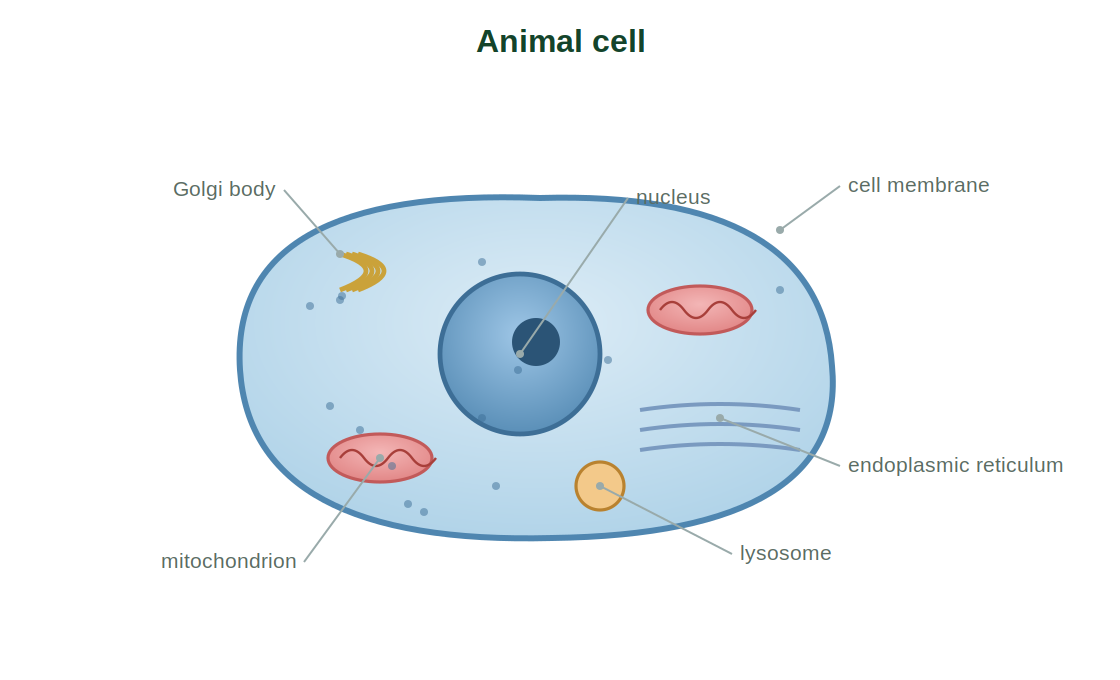
Inside the membrane is the cytoplasm, a jelly like fluid holding the organelles, the little organs of the cell. The mitochondria release energy from food, the endoplasmic reticulum and ribosomes build and transport proteins, the Golgi body packages materials, and lysosomes break down waste. Each organelle has a structure suited to its job.
|
Diagram 1 – The Animal Cell
Fig 1. An animal cell, showing the membrane, nucleus, mitochondria, endoplasmic reticulum, Golgi body and lysosome. |
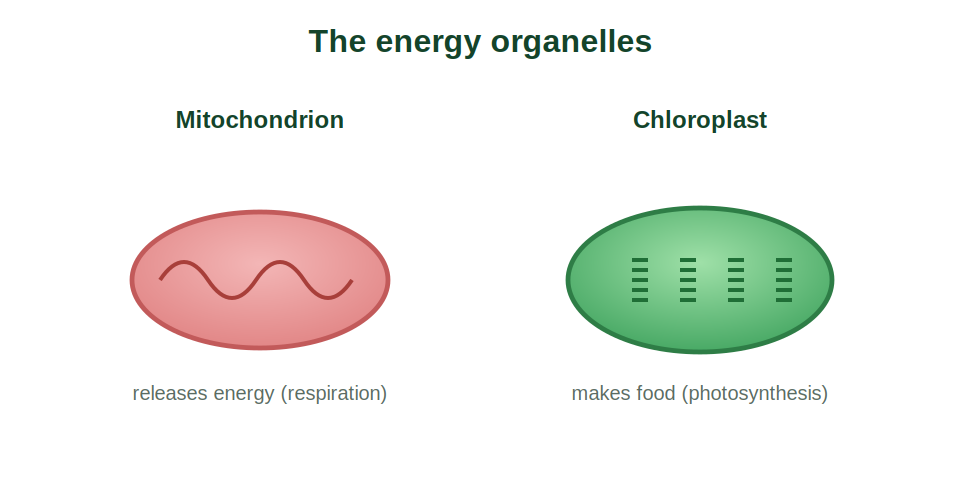
Two organelles handle the cell’s energy. The mitochondrion releases energy by respiration, supplying power to the whole cell, which is why it is called the powerhouse. In plant cells, the chloroplast captures light to make food by photosynthesis. Both have folded inner membranes that increase the area for these reactions.
|
Diagram 2 – The Energy Organelles
Fig 2. The mitochondrion releases energy by respiration; the chloroplast makes food by photosynthesis. |
5. Plant and Animal Cells |
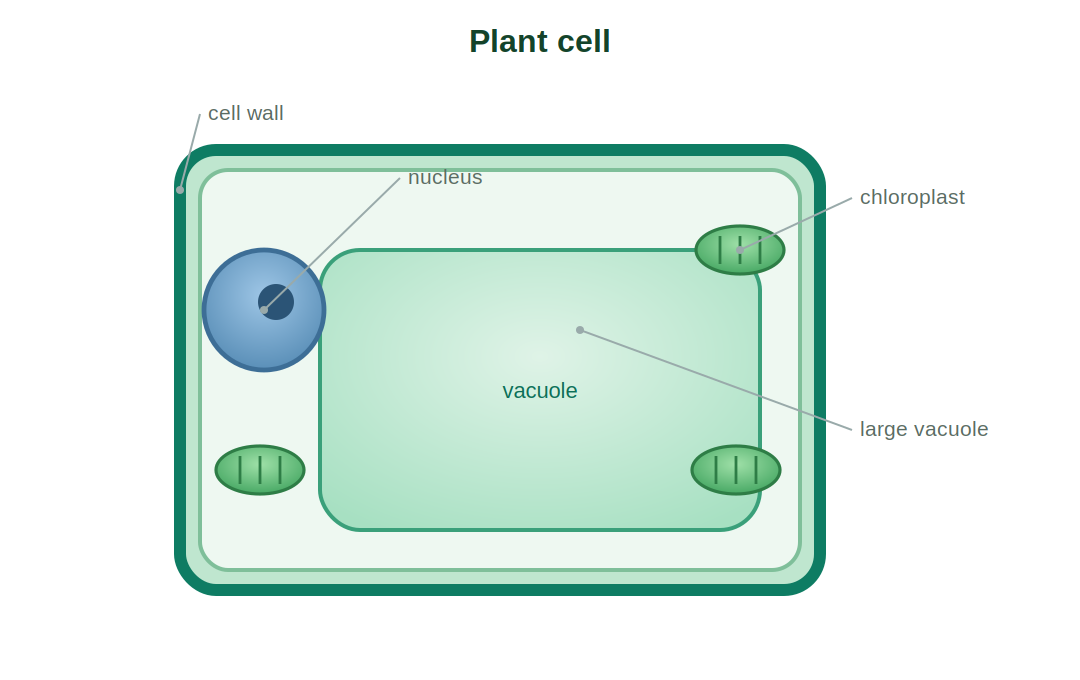
Plant and animal cells share most organelles but differ in three clear ways. A plant cell has a rigid cell wall, green chloroplasts for photosynthesis, and a large central vacuole filled with sap that keeps the cell firm. An animal cell has none of these, so it is more flexible and gets its food ready made.
|
Diagram 3 – The Plant Cell
Fig 3. A plant cell, with its cell wall, chloroplasts and large central vacuole, features an animal cell lacks. |
6. Prokaryotic and Eukaryotic Cells |
Cells fall into two great kinds. A prokaryotic cell, found only in bacteria, has no true nucleus and few organelles, carrying its DNA loose in the cytoplasm. A eukaryotic cell, found in protists, fungi, plants and animals, has a true nucleus and many membrane bound organelles. The eukaryotic cell is larger and far more complex.
7. Key Reasoning (Principles) |
|
Principle 1: The cell is the unit of life All organisms are made of cells, the cell is the basic unit of life, and every cell comes from a pre-existing cell, the three points of the cell theory. |
|
Principle 2: Structure fits function in organelles Each organelle has a shape suited to its task, such as the folded inner membrane of a mitochondrion that increases the area for releasing energy. |
|
Principle 3: Plant and animal cells differ in three features A plant cell has a cell wall, chloroplasts and a large vacuole, which an animal cell lacks, reflecting how each kind of cell lives. |
8. Worked Examples |
| Example 1 |
|
Q: State the three points of the cell theory. ▶ Show SolutionAll organisms are made of cells, the cell is the basic unit of life, and all cells come from existing cells. Answer: The three points of the cell theory. |
| Example 2 |
|
Q: What controls what enters and leaves a cell? ▶ Show SolutionThe cell membrane controls what passes in and out. Answer: The cell membrane. |
| Example 3 |
|
Q: Which organelle is the control centre of the cell? ▶ Show SolutionThe nucleus holds the DNA and directs the cell. Answer: The nucleus. |
| Example 4 |
|
Q: Which organelle releases energy from food? ▶ Show SolutionThe mitochondrion releases energy by respiration. Answer: The mitochondrion. |
| Example 5 |
|
Q: Which organelle in a plant cell makes food? ▶ Show SolutionThe chloroplast makes food by photosynthesis. Answer: The chloroplast. |
| Example 6 |
|
Q: Name three features a plant cell has that an animal cell lacks. ▶ Show SolutionA cell wall, chloroplasts and a large central vacuole. Answer: Cell wall, chloroplasts, large vacuole. |
| Example 7 |
|
Q: What is the jelly like fluid inside the cell called? ▶ Show SolutionThe fluid holding the organelles is the cytoplasm. Answer: The cytoplasm. |
| Example 8 |
|
Q: What is the main difference between a prokaryotic and a eukaryotic cell? ▶ Show SolutionA prokaryote has no true nucleus; a eukaryote has one. Answer: The presence of a true nucleus. |
| Example 9 |
|
Q: Which organelle packages materials for transport? ▶ Show SolutionThe Golgi body packages materials. Answer: The Golgi body. |
| Example 10 |
|
Q: Why is the mitochondrion called the powerhouse of the cell? ▶ Show SolutionBecause it releases the energy that powers the cell’s activities. Answer: It releases the cell’s energy. |
9. Practice Sets A to D |
| Set A – Multiple Choice (Basic) |
|
1. The basic unit of life is the: (a) atom (b) cell (c) organ (d) tissue 2. The control centre of the cell is the: (a) membrane (b) nucleus (c) vacuole (d) wall 3. Energy is released in the: (a) nucleus (b) mitochondrion (c) ribosome (d) wall 4. Chloroplasts are found in: (a) animal cells (b) plant cells (c) bacteria only (d) no cells 5. A prokaryote lacks a: (a) membrane (b) true nucleus (c) cytoplasm (d) DNA ▶ Reveal Answers1. (b) cell. 2. (b) nucleus. 3. (b) mitochondrion. 4. (b) plant cells. 5. (b) true nucleus. |
| Set B – Short Answer (Understanding) |
|
1. State the cell theory. 2. What is the role of the cell membrane? 3. What does the nucleus contain and do? 4. Name three energy related or organelle functions. 5. List the three features unique to plant cells. ▶ Reveal Answers1. All organisms are made of cells, the cell is the basic unit of life, and cells come from existing cells. 2. It controls what enters and leaves the cell. 3. It contains the DNA and directs the cell’s activities. 4. Mitochondria release energy, ribosomes build proteins, and the Golgi body packages materials. 5. A cell wall, chloroplasts and a large central vacuole. |
| Set C – Application and Reasoning |
|
1. A cell has a wall, chloroplasts and a big vacuole. Plant or animal? 2. Why can animal cells take many shapes? 3. Which organelle would be plentiful in a very active muscle cell? 4. Why is a cell with no nucleus called a prokaryote? 5. What links the structure of a mitochondrion to its function? ▶ Reveal Answers1. A plant cell. 2. Because they have no rigid cell wall. 3. Mitochondria, because the cell needs much energy. 4. Because prokaryote means before a nucleus, and it has no true nucleus. 5. Its folded inner membrane gives a large area for the reactions that release energy. |
| Set D – Higher Order (Challenge) |
|
1. Explain why the cell is called the structural and functional unit of life. 2. Compare how a plant and an animal cell obtain their energy supply. 3. Explain why a large vacuole helps keep a plant firm. 4. A cell is large, with a true nucleus and many organelles. Classify it. 5. Explain how the cell theory implies that life is continuous. ▶ Reveal Answers1. Because every living structure is built from cells, and every life process is carried out within them. 2. An animal cell takes in ready made food and releases energy in mitochondria; a plant cell also makes its own food in chloroplasts first. 3. The vacuole fills with sap and presses outward on the wall, keeping the cell and the plant rigid. 4. It is a eukaryotic cell. 5. Because every cell arises from a pre-existing cell, so life passes unbroken from one generation to the next. |
|
Chapter Summary
|
|||||||||||||||||||||||||||||||
| 8-Point Exam Quick-Check | ||||||||||||||||||||||||||||||||
|
||||||||||||||||||||||||||||||||
|
School Revise Virtual Lab Explore these ideas with interactive simulations and visual tools.
|
|
Class 11 Biology Chapter 8: Cell The Unit of Life, Complete Notes and Practice This revision guide follows the current NCERT Class 11 Biology syllabus and develops the cell, covering the cell theory, the cell membrane and wall, the nucleus, the cytoplasm and its organelles such as mitochondria, endoplasmic reticulum, ribosomes, Golgi body and lysosomes, the differences between plant and animal cells, and the prokaryotic and eukaryotic types, with three diagrams, ten worked examples and graded practice. Visit SchoolRevise.com to revise, practise and excel. |
 Google