Curriculum
Science Grade XI Biology
Science Grade XI Biology
0/19
-
Chapter 1: The Living World
 Preview
 -
Chapter 2: Biological Classification
Preview
-
Chapter 3: Plant Kingdom
Preview
-
Chapter 4: Animal Kingdom
Preview
-
Chapter 5: Morphology of Flowering Plants
Preview
-
Chapter 6: Anatomy of Flowering Plants
Preview
-
Chapter 7: Structural Organisation in Animals
Preview
-
Chapter 8: Cell: The Unit of Life
Preview
-
Chapter 9: Biomolecules
Preview
-
Chapter 10: Cell Cycle and Cell Division
Preview
-
Chapter 11: Photosynthesis in Higher Plants
Preview
-
Chapter 12: Respiration in Plants
Preview
-
Chapter 13: Plant Growth and Development
Preview
-
Chapter 14: Breathing and Exchange of Gases
Preview
-
Chapter 15: Body Fluids and Circulation
Preview
-
Chapter 16: Excretory Products and their Elimination
Preview
-
Chapter 17: Locomotion and Movement
Preview
-
Chapter 18: Neural Control and Coordination
Preview
-
Chapter 19: Chemical Coordination and Integration
Preview
Work Sheets
0/19

Chapter 5: Morphology of Flowering Plants
|
Grade 11 Science | Chapter 5 Morphology of Flowering PlantsMorphology is the study of plant form. This chapter examines the root, stem, leaf and flower, the two root systems, leaf venation, and the structure of the flower that drives reproduction.
|
|
Contents
|
1. Introduction: The Form of a Plant |
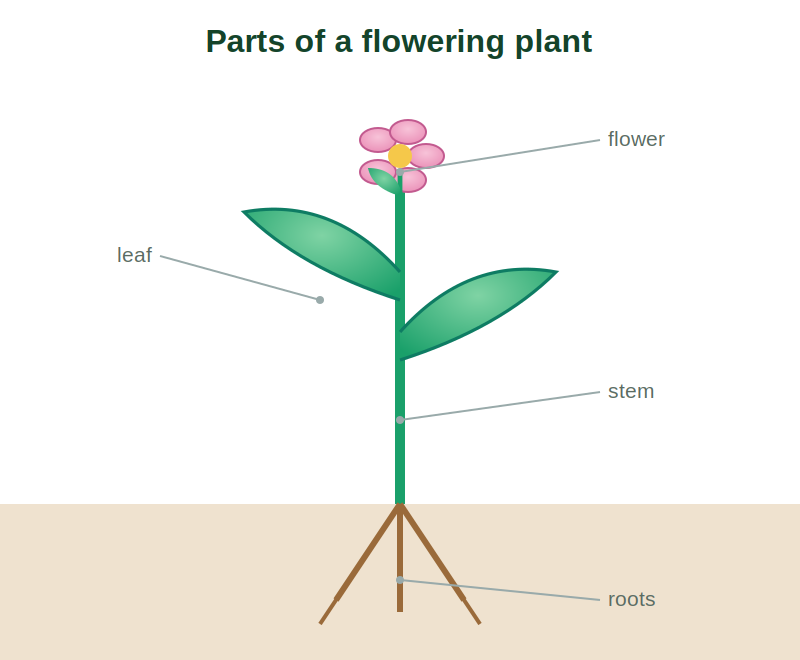
Morphology is the study of the external form and structure of an organism. A flowering plant has a clear body plan: an underground root system that anchors and absorbs, and an above ground shoot system of stem, leaves and flowers. This chapter examines each part in turn and shows how its form fits its function.
|
Core idea A flowering plant has a root system and a shoot system. The root anchors and absorbs; the stem supports and conducts; the leaf makes food; and the flower is the organ of reproduction.
|
|
Diagram 1 – Parts of a Flowering Plant
Fig 1. A flowering plant has a root system below ground and a shoot system of stem, leaves and flowers above. |
2. The Root System |
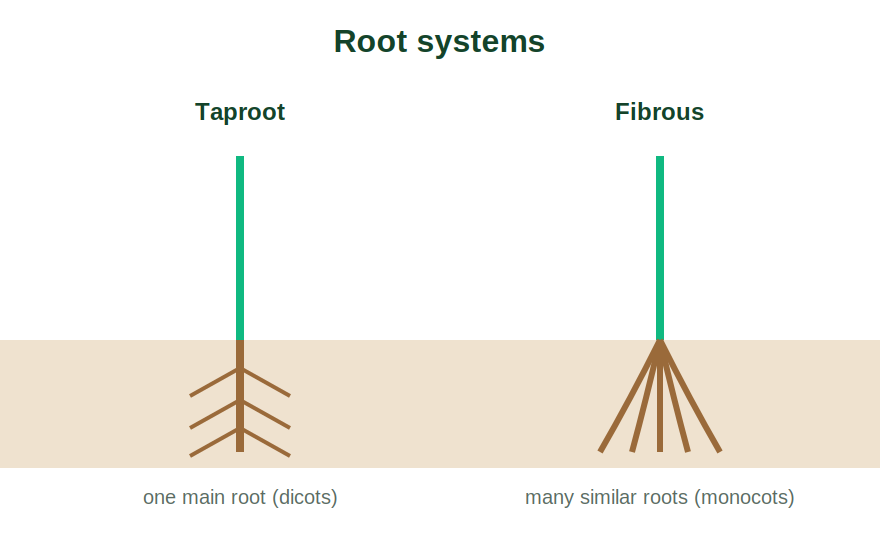
The root anchors the plant and absorbs water and minerals from the soil. There are two main systems. A taproot has one main root growing down with smaller side roots, typical of dicots. A fibrous root system has many roots of similar size spreading out, typical of monocots such as grasses. Roots may also store food, as in a carrot.
|
Diagram 2 – Root Systems
Fig 2. A taproot has one main root (dicots); a fibrous system has many similar roots (monocots). |
3. The Stem |
The stem is the central axis of the shoot. It supports the leaves and flowers, holds the leaves up to the light, and conducts water and food between the roots and the leaves through its vascular tissue. The points where leaves arise are called nodes, and the lengths between them are internodes. Some stems are modified to store food or to climb.
4. The Leaf |
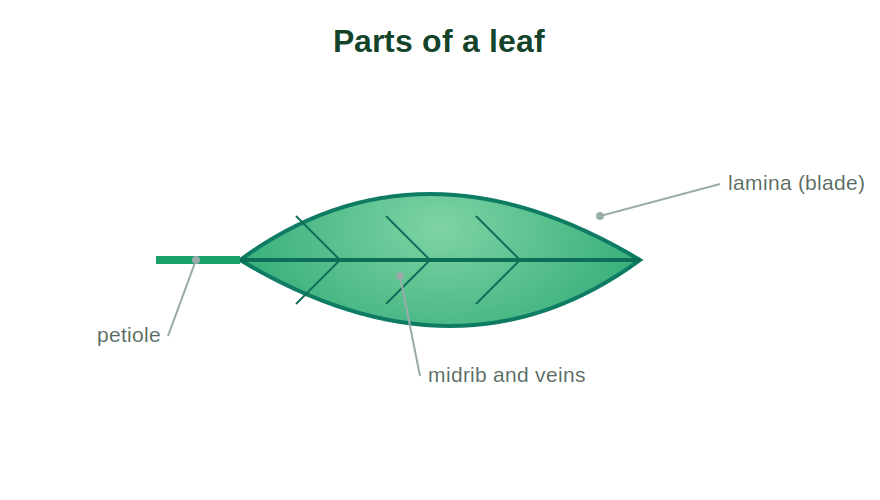
The leaf is the main organ of photosynthesis. A typical leaf has a flat blade, the lamina, joined to the stem by a stalk, the petiole, and carries veins that supply it. The pattern of veins, or venation, is parallel in monocots and net like in dicots, matching the difference seen in their seeds and flowers.
|
Diagram 3 – Parts of a Leaf
Fig 3. A leaf has a flat lamina, a petiole joining it to the stem, and a midrib with branching veins. |
5. The Flower |
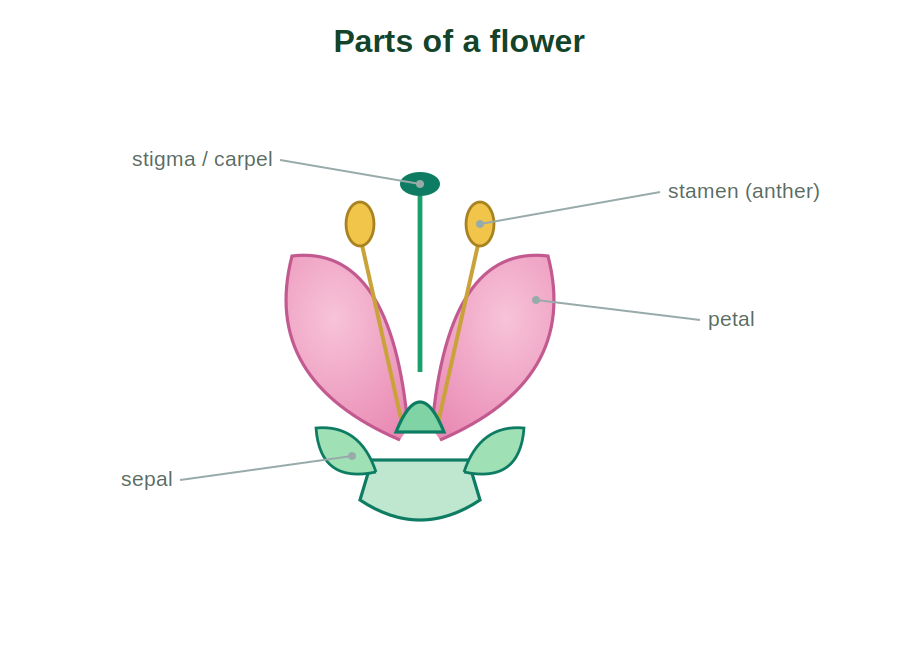
The flower is the reproductive organ of the plant, built from four whorls. The outer green sepals protect the bud; the coloured petals attract pollinators; the stamens are the male parts that make pollen; and the carpels are the female parts that contain the ovules. After fertilisation the ovary grows into a fruit and the ovules into seeds.
|
Diagram 4 – Parts of a Flower
Fig 4. A flower has sepals, petals, stamens (male) and carpels (female) arranged in whorls. |
6. Fruit and Seed |
After fertilisation, the parts of the flower develop further. The ovary ripens into a fruit, which protects the seeds and helps to spread them, while each fertilised ovule becomes a seed containing the embryo of the next plant. The seed stores food in one cotyledon in monocots or two in dicots, ready to support the young seedling.
7. Key Reasoning (Principles) |
|
Principle 1: Form fits function in each organ Each part of the plant has a shape suited to its task: roots branch to absorb, leaves flatten to catch light, and flowers display to attract pollinators. |
|
Principle 2: Root and venation patterns match the class A taproot with net veins marks a dicot, while a fibrous root with parallel veins marks a monocot, so the form is consistent throughout the plant. |
|
Principle 3: The flower carries out reproduction The four whorls of the flower bring together protection, attraction, and the male and female parts, so that fertilisation can lead to fruit and seed. |
8. Worked Examples |
| Example 1 |
|
Q: Name the two main systems of a flowering plant. ▶ Show SolutionThe root system below ground and the shoot system above. Answer: Root and shoot systems. |
| Example 2 |
|
Q: What are the two functions of a root? ▶ Show SolutionA root anchors the plant and absorbs water and minerals. Answer: Anchorage and absorption. |
| Example 3 |
|
Q: Which root system is typical of dicots? ▶ Show SolutionDicots usually have a taproot, one main root. Answer: Taproot. |
| Example 4 |
|
Q: Which root system is typical of monocots? ▶ Show SolutionMonocots usually have a fibrous system of many similar roots. Answer: Fibrous. |
| Example 5 |
|
Q: Name the flat blade of a leaf. ▶ Show SolutionThe flat blade of a leaf is the lamina. Answer: The lamina. |
| Example 6 |
|
Q: What kind of venation do monocot leaves show? ▶ Show SolutionMonocot leaves have parallel venation. Answer: Parallel. |
| Example 7 |
|
Q: Name the four whorls of a flower from outside in. ▶ Show SolutionSepals, petals, stamens and carpels. Answer: Sepals, petals, stamens, carpels. |
| Example 8 |
|
Q: Which whorl is the male part of the flower? ▶ Show SolutionThe stamens are the male part, making pollen. Answer: The stamens. |
| Example 9 |
|
Q: What does the ovary become after fertilisation? ▶ Show SolutionThe ovary ripens into a fruit. Answer: A fruit. |
| Example 10 |
|
Q: What does a fertilised ovule become? ▶ Show SolutionEach fertilised ovule becomes a seed. Answer: A seed. |
9. Practice Sets A to D |
| Set A – Multiple Choice (Basic) |
|
1. The part that anchors the plant is the: (a) leaf (b) stem (c) root (d) flower 2. A taproot is typical of: (a) monocots (b) dicots (c) algae (d) ferns 3. The flat blade of a leaf is the: (a) petiole (b) lamina (c) node (d) sepal 4. The male part of a flower is the: (a) sepal (b) petal (c) stamen (d) carpel 5. After fertilisation the ovary becomes the: (a) seed (b) fruit (c) petal (d) root ▶ Reveal Answers1. (c) root. 2. (b) dicots. 3. (b) lamina. 4. (c) stamen. 5. (b) fruit. |
| Set B – Short Answer (Understanding) |
|
1. Name the two systems of a flowering plant and their regions. 2. Distinguish a taproot from a fibrous root system. 3. Name the parts of a typical leaf. 4. List the four whorls of a flower. 5. What becomes of the ovary and the ovules after fertilisation? ▶ Reveal Answers1. The root system below ground and the shoot system (stem, leaves, flowers) above. 2. A taproot has one main root with side roots; a fibrous system has many roots of similar size. 3. The lamina (blade), the petiole (stalk) and the veins with a midrib. 4. Sepals, petals, stamens and carpels. 5. The ovary becomes a fruit and each ovule becomes a seed. |
| Set C – Application and Reasoning |
|
1. A plant has parallel leaf veins and a fibrous root. Monocot or dicot? 2. Why are petals usually brightly coloured? 3. What is the role of the sepals? 4. Why does the stem hold leaves up high? 5. Where in the leaf does most photosynthesis occur? ▶ Reveal Answers1. Monocot. 2. To attract pollinators such as insects. 3. To protect the flower while it is in bud. 4. To expose the leaves to sunlight for photosynthesis. 5. In the lamina, the flat blade. |
| Set D – Higher Order (Challenge) |
|
1. Explain how the form of a root suits its function of absorption. 2. A carrot is a swollen root. What extra function does it serve? 3. Explain why the flower is described as the reproductive organ of the plant. 4. Predict the root and venation of a plant whose seed has two cotyledons. 5. Explain how form is consistent across the organs of a monocot. ▶ Reveal Answers1. A root branches into many fine tips with a large surface area, maximising contact with soil water and minerals. 2. It stores food for the plant. 3. Because it brings together the male stamens and female carpels, allowing fertilisation that leads to fruit and seed. 4. A taproot and net (reticulate) venation, since two cotyledons mark a dicot. 5. A monocot has one cotyledon, parallel leaf veins, a fibrous root and flower parts in threes, all matching. |
|
Chapter Summary
|
|||||||||||||||||||||||||||||||
| 8-Point Exam Quick-Check | ||||||||||||||||||||||||||||||||
|
||||||||||||||||||||||||||||||||
|
School Revise Virtual Lab Explore these ideas with interactive simulations and visual tools.
|
|
Class 11 Biology Chapter 5: Morphology of Flowering Plants, Complete Notes and Practice This revision guide follows the current NCERT Class 11 Biology syllabus and develops plant morphology, covering the root and shoot systems, the taproot and fibrous root types, the stem with its nodes and internodes, the leaf with its lamina, petiole and venation, the flower with its four whorls of sepals, petals, stamens and carpels, and the development of fruit and seed, with four diagrams, ten worked examples and graded practice. Visit SchoolRevise.com to revise, practise and excel. |
 Google