Curriculum
Science Grade XI Biology
Science Grade XI Biology
0/19
-
Chapter 1: The Living World
 Preview
 -
Chapter 2: Biological Classification
Preview
-
Chapter 3: Plant Kingdom
Preview
-
Chapter 4: Animal Kingdom
Preview
-
Chapter 5: Morphology of Flowering Plants
Preview
-
Chapter 6: Anatomy of Flowering Plants
Preview
-
Chapter 7: Structural Organisation in Animals
Preview
-
Chapter 8: Cell: The Unit of Life
Preview
-
Chapter 9: Biomolecules
Preview
-
Chapter 10: Cell Cycle and Cell Division
Preview
-
Chapter 11: Photosynthesis in Higher Plants
Preview
-
Chapter 12: Respiration in Plants
Preview
-
Chapter 13: Plant Growth and Development
Preview
-
Chapter 14: Breathing and Exchange of Gases
Preview
-
Chapter 15: Body Fluids and Circulation
Preview
-
Chapter 16: Excretory Products and their Elimination
Preview
-
Chapter 17: Locomotion and Movement
Preview
-
Chapter 18: Neural Control and Coordination
Preview
-
Chapter 19: Chemical Coordination and Integration
Preview
Work Sheets
0/19

Chapter 17: Locomotion and Movement
|
Grade 11 Science | Chapter 17 Locomotion and MovementBones and muscles work together to move the body. This chapter develops the skeleton, joints, and the muscles that pull on bones in antagonistic pairs.
|
|
Contents
|
1. Introduction: Why We Move |
Movement lets an animal find food, escape danger and respond to its world. Locomotion is movement from place to place, while movement also includes the smaller actions within the body. In humans, movement comes from the muscles pulling on the bones of the skeleton, working at the joints. This chapter looks at how the three work together.
|
Core idea The skeleton supports the body and protects organs. Muscles pull on bones at the joints, working in antagonistic pairs so that one bends a joint and the other straightens it.
|
2. The Skeleton |
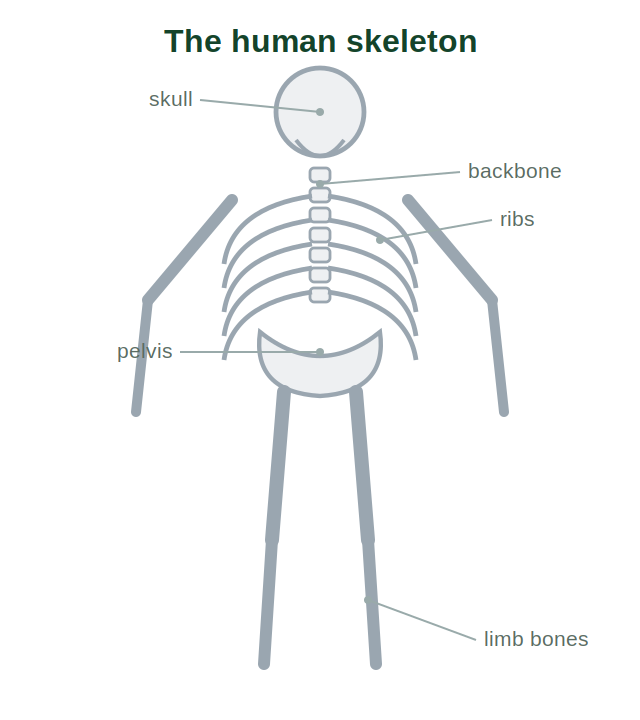
The skeleton is the body’s framework of bones. It gives the body its shape and support, lets it stand upright, and protects soft organs, as the skull guards the brain and the ribs guard the heart and lungs. The backbone holds the body up and protects the spinal cord, and the pelvis and limb bones bear weight and allow movement.
|
Diagram 1 – The Human Skeleton
Fig 1. The skeleton supports the body and protects organs, from the skull to the limb bones. |
3. Joints |
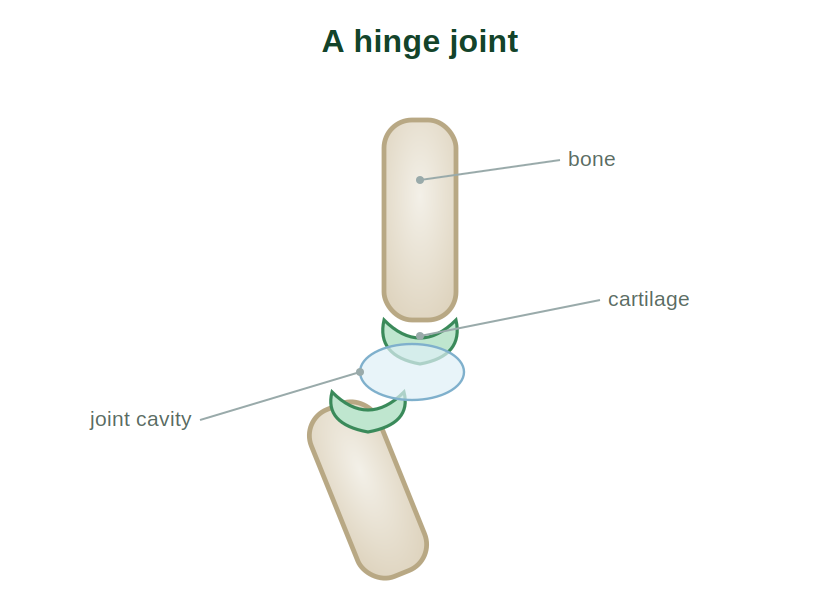
A joint is where two bones meet, and it is what allows the skeleton to bend and move. At a joint the ends of the bones are capped with smooth cartilage and bathed in a fluid that lets them slide without rubbing. A hinge joint, like the elbow or knee, lets a limb bend and straighten in one direction, while other joints allow a wider range of movement.
|
Diagram 2 – A Hinge Joint
Fig 2. At a joint, smooth cartilage caps the bone ends so they move without rubbing. |
4. Muscles |
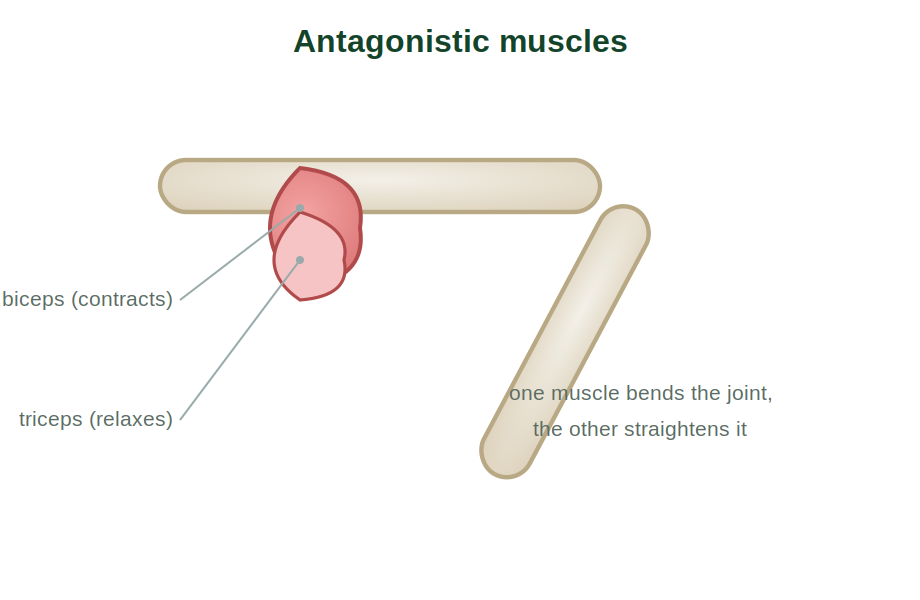
Muscles are the tissues that produce movement. A muscle can only pull, not push, by getting shorter, an action called contracting. Because of this, muscles are arranged in antagonistic pairs that pull in opposite directions. In the arm, the biceps bends the elbow when it contracts, and the triceps straightens it when it contracts, each undoing the other’s work.
|
Diagram 3 – Antagonistic Muscles
Fig 3. The biceps and triceps form an antagonistic pair: one bends the elbow, the other straightens it. |
5. How Muscles Move Bones |
A muscle is joined to bones across a joint. When the muscle contracts, it shortens and pulls the bone, so the joint bends. The muscle cannot push the bone back, so a second muscle on the other side must contract to straighten the joint, while the first relaxes. This pulling in turns by an antagonistic pair is how every movement at a joint is produced.
6. The Importance of Movement |
Movement is vital to an animal’s life. It lets it search for and catch food, escape from danger, find shelter and a mate, and respond to changes around it. Inside the body, muscle movement also drives the heartbeat and pushes food through the gut. So the skeleton and muscles together support nearly everything the body does.
7. Key Reasoning (Principles) |
|
Principle 1: The skeleton supports and protects The bones give the body shape and hold it upright, and they shield soft organs such as the brain, heart and lungs. |
|
Principle 2: Muscles can only pull A muscle produces force only by shortening, so it can pull a bone but cannot push it back, which shapes how muscles are arranged. |
|
Principle 3: Antagonistic pairs allow movement both ways Because a muscle cannot push, muscles work in opposing pairs, one bending the joint and the other straightening it. |
8. Worked Examples |
| Example 1 |
|
Q: What is locomotion? ▶ Show SolutionMovement of the body from place to place. Answer: Moving from place to place. |
| Example 2 |
|
Q: What gives the body its shape and support? ▶ Show SolutionThe skeleton of bones. Answer: The skeleton. |
| Example 3 |
|
Q: Which bones protect the brain? ▶ Show SolutionThe skull. Answer: The skull. |
| Example 4 |
|
Q: What is a joint? ▶ Show SolutionA place where two bones meet, allowing movement. Answer: Where two bones meet. |
| Example 5 |
|
Q: What caps the bone ends at a joint? ▶ Show SolutionSmooth cartilage. Answer: Cartilage. |
| Example 6 |
|
Q: In which direction can a muscle act? ▶ Show SolutionA muscle can only pull, by getting shorter. Answer: It can only pull. |
| Example 7 |
|
Q: What is an antagonistic pair of muscles? ▶ Show SolutionTwo muscles that pull a joint in opposite directions. Answer: Two muscles pulling oppositely. |
| Example 8 |
|
Q: Which muscle bends the elbow? ▶ Show SolutionThe biceps. Answer: The biceps. |
| Example 9 |
|
Q: Which muscle straightens the elbow? ▶ Show SolutionThe triceps. Answer: The triceps. |
| Example 10 |
|
Q: Why must muscles work in pairs? ▶ Show SolutionBecause a muscle can only pull, so another is needed to pull the bone back. Answer: Because a muscle cannot push. |
9. Practice Sets A to D |
| Set A – Multiple Choice (Basic) |
|
1. The body’s framework is the: (a) muscle (b) skeleton (c) skin (d) blood 2. The brain is protected by the: (a) ribs (b) skull (c) pelvis (d) spine 3. Bones meet at a: (a) muscle (b) joint (c) nerve (d) vessel 4. A muscle produces force by: (a) pushing (b) pulling (c) bending (d) twisting 5. The biceps and triceps are an example of: (a) bones (b) an antagonistic pair (c) joints (d) nerves ▶ Reveal Answers1. (b) skeleton. 2. (b) skull. 3. (b) joint. 4. (b) pulling. 5. (b) an antagonistic pair. |
| Set B – Short Answer (Understanding) |
|
1. State two functions of the skeleton. 2. What is found at the ends of bones in a joint? 3. Why can a muscle not push a bone? 4. What is an antagonistic muscle pair? 5. Describe how the elbow bends and straightens. ▶ Reveal Answers1. Support and shape, and protection of organs. 2. Smooth cartilage, with a fluid that lets the bones slide. 3. Because it produces force only by shortening, so it can only pull. 4. Two muscles that pull a joint in opposite directions. 5. The biceps contracts to bend it; the triceps contracts to straighten it, each relaxing as the other works. |
| Set C – Application and Reasoning |
|
1. Why are the ribs curved into a cage? 2. Why is cartilage important at a joint? 3. If the biceps contracts, what does the triceps do? 4. Why does a hinge joint move in only one direction? 5. Why does an animal need to move? ▶ Reveal Answers1. To protect the heart and lungs inside while allowing the chest to move for breathing. 2. It is smooth and cushions the bone ends so they move without rubbing or wearing. 3. It relaxes, so the elbow can bend. 4. Because its shape allows bending and straightening but not side to side movement. 5. To find food, escape danger, find shelter and a mate, and respond to its world. |
| Set D – Higher Order (Challenge) |
|
1. Explain why the fact that muscles only pull leads to antagonistic pairs. 2. Explain how the skeleton both supports and protects at the same time. 3. Explain why a stiff, fused skeleton with no joints could not move. 4. Explain the roles of bone, cartilage and muscle in one movement. 5. Explain why muscle movement matters inside the body, not just for walking. ▶ Reveal Answers1. Because a muscle cannot push a bone back, a second muscle is needed to pull it the other way, so they must be arranged in opposing pairs. 2. The strong bones hold the body up and give it shape, while their arrangement, such as the skull and ribs, also encloses and shields soft organs. 3. Without joints the bones could not bend against one another, so the body could not change its position. 4. The bones provide the levers, the cartilage lets them move smoothly at the joint, and the muscles pull the bones to produce the movement. 5. Because muscle movement also drives the heartbeat and pushes food along the gut, so it keeps vital processes going. |
|
Chapter Summary
|
|||||||||||||||||||||||||||||||
| 8-Point Exam Quick-Check | ||||||||||||||||||||||||||||||||
|
||||||||||||||||||||||||||||||||
|
School Revise Virtual Lab Explore these ideas with interactive simulations and visual tools.
|
|
Class 11 Biology Chapter 17: Locomotion and Movement, Complete Notes and Practice This revision guide follows the current NCERT Class 11 Biology syllabus and develops locomotion, covering why animals move, the skeleton that supports and protects, the joints where bones meet, the muscles that move bones by contracting, the antagonistic pairs such as the biceps and triceps, and the importance of movement, with three diagrams, ten worked examples and graded practice. Visit SchoolRevise.com to revise, practise and excel. |
 Google