Curriculum
Science Grade XI Biology
Science Grade XI Biology
0/19
-
Chapter 1: The Living World
 Preview
 -
Chapter 2: Biological Classification
Preview
-
Chapter 3: Plant Kingdom
Preview
-
Chapter 4: Animal Kingdom
Preview
-
Chapter 5: Morphology of Flowering Plants
Preview
-
Chapter 6: Anatomy of Flowering Plants
Preview
-
Chapter 7: Structural Organisation in Animals
Preview
-
Chapter 8: Cell: The Unit of Life
Preview
-
Chapter 9: Biomolecules
Preview
-
Chapter 10: Cell Cycle and Cell Division
Preview
-
Chapter 11: Photosynthesis in Higher Plants
Preview
-
Chapter 12: Respiration in Plants
Preview
-
Chapter 13: Plant Growth and Development
Preview
-
Chapter 14: Breathing and Exchange of Gases
Preview
-
Chapter 15: Body Fluids and Circulation
Preview
-
Chapter 16: Excretory Products and their Elimination
Preview
-
Chapter 17: Locomotion and Movement
Preview
-
Chapter 18: Neural Control and Coordination
Preview
-
Chapter 19: Chemical Coordination and Integration
Preview
Work Sheets
0/19

Chapter 9: Biomolecules
|
Grade 11 Science | Chapter 9 BiomoleculesLiving things are built from a few kinds of molecule. This chapter develops the four biomolecules, carbohydrates, proteins, lipids and nucleic acids, and the enzymes that drive life’s reactions.
|
|
Contents
|
1. Introduction: The Molecules of Life |
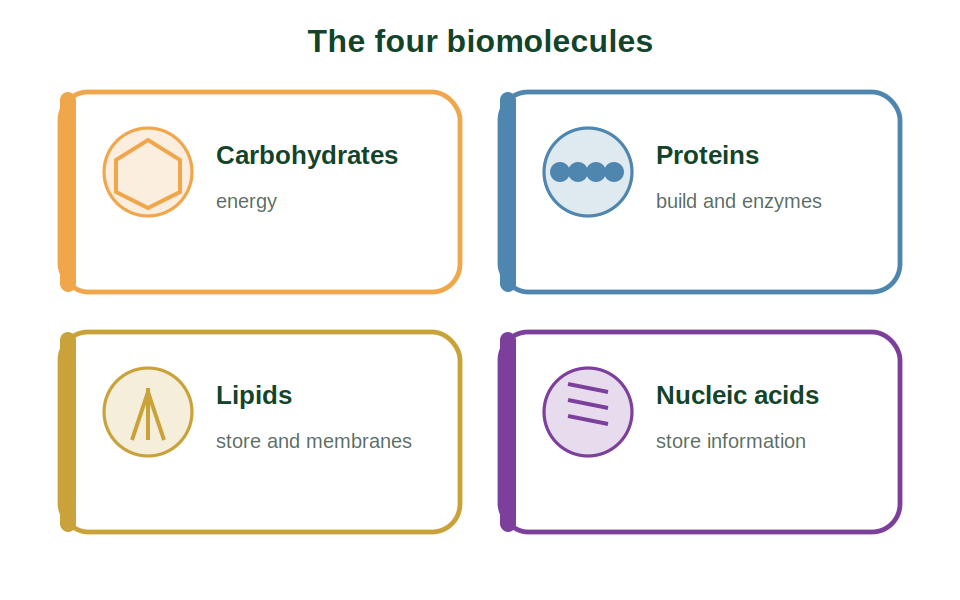
Although life is varied, it is built from just four main kinds of large molecule, the biomolecules: carbohydrates, proteins, lipids and nucleic acids. Most are polymers, long chains built from small repeating units called monomers. This chapter looks at each class, what it is made of and what it does, and ends with the enzymes that control the chemistry of the cell.
|
Core idea The four biomolecules are carbohydrates (energy), proteins (building and enzymes), lipids (storage and membranes) and nucleic acids (information). Most are polymers of small monomers.
|
|
Diagram 1 – The Four Biomolecules
Fig 1. The four classes of biomolecule and their main roles in the body. |
2. Carbohydrates |
Carbohydrates are the body’s main source of quick energy. Their monomers are simple sugars such as glucose, which join into chains. Single sugars and short chains taste sweet and dissolve easily, while long chains such as starch store energy in plants and cellulose builds the plant cell wall. Carbohydrates are made of carbon, hydrogen and oxygen.
3. Proteins |
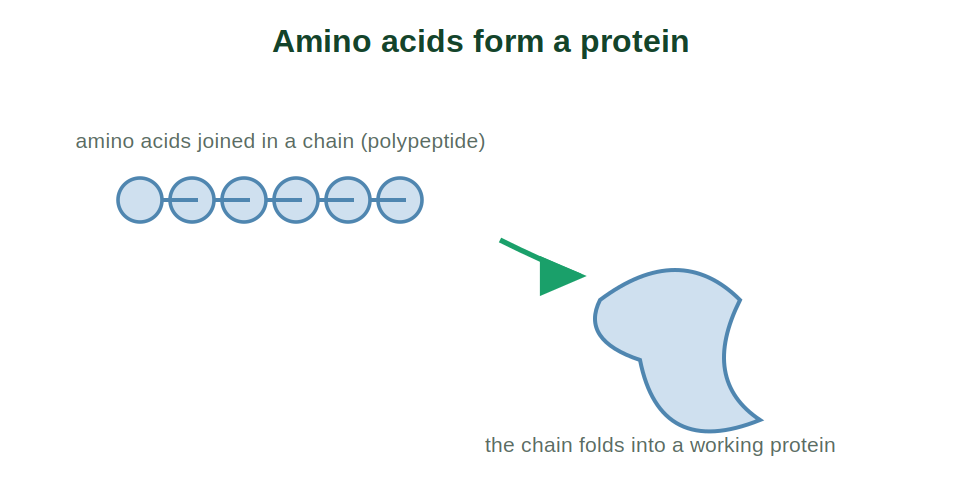
Proteins are the body’s builders and workers. Their monomers are amino acids, which join in a chain that folds into a particular shape, and that shape decides the protein’s job. Proteins build muscle and skin, carry oxygen, defend against disease, and act as enzymes that speed up reactions. There are twenty amino acids, combined in countless ways.
|
Diagram 2 – From Amino Acids to a Protein
Fig 2. Amino acids join in a chain that folds into a working protein, whose shape decides its function. |
4. Lipids |
Lipids, the fats and oils, store energy and build membranes. A typical fat is made of a glycerol joined to fatty acid chains. Lipids do not dissolve in water, which makes them ideal for the cell membrane that separates the watery inside of a cell from its surroundings, and for storing energy in a compact form under the skin.
5. Nucleic Acids |
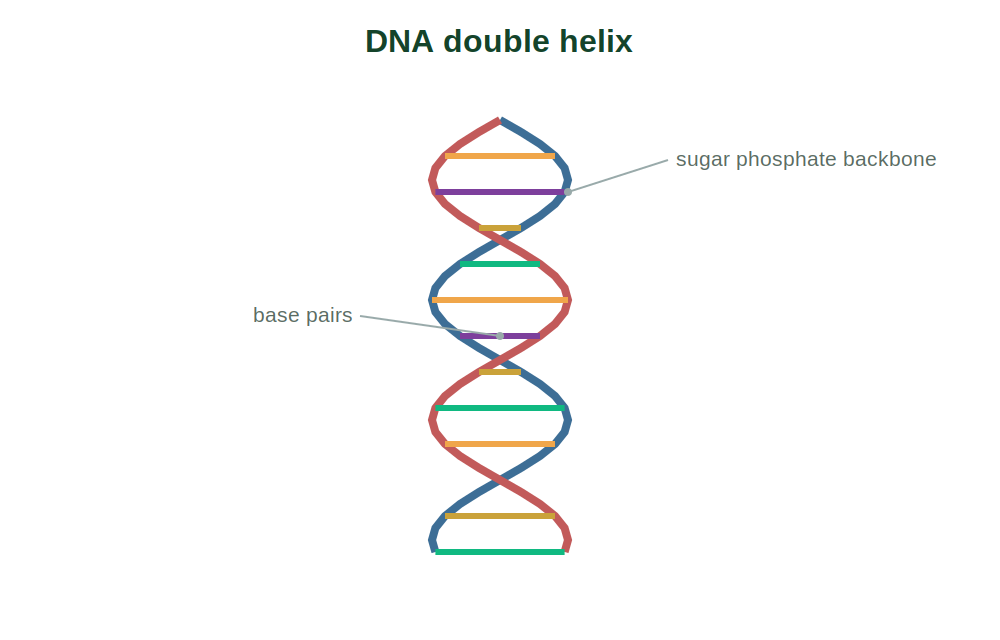
Nucleic acids store and carry the instructions of life. DNA holds the genetic code in the nucleus, and RNA helps to read it and build proteins. Their monomers are nucleotides, and in DNA two strands twist into a double helix held together by paired bases. The order of these bases is the code that is passed from parents to offspring.
|
Diagram 3 – The DNA Double Helix
Fig 3. DNA is a double helix of two strands held together by paired bases, storing the genetic code. |
6. Enzymes |
Enzymes are proteins that act as biological catalysts, speeding up the reactions of the cell without being used up. Each enzyme has a particular shape that fits its substrate like a lock and key, so it works on one kind of reaction. Enzymes let reactions that would be far too slow happen fast enough to support life, and they work best at a particular temperature and acidity.
7. Key Reasoning (Principles) |
|
Principle 1: Polymers are built from monomers Most biomolecules are long chains assembled from small repeating units, so a few kinds of monomer can build an enormous variety of large molecules. |
|
Principle 2: Shape decides function The folded shape of a protein, or the paired strands of DNA, determines what the molecule can do, so structure and function are tightly linked. |
|
Principle 3: Enzymes speed reactions without being used up An enzyme lowers the energy a reaction needs to start and emerges unchanged, so a small amount can drive a reaction again and again. |
8. Worked Examples |
| Example 1 |
|
Q: Name the four classes of biomolecule. ▶ Show SolutionCarbohydrates, proteins, lipids and nucleic acids. Answer: Carbohydrates, proteins, lipids, nucleic acids. |
| Example 2 |
|
Q: What is the main role of carbohydrates? ▶ Show SolutionCarbohydrates are the main source of quick energy. Answer: Quick energy. |
| Example 3 |
|
Q: What are the monomers of proteins? ▶ Show SolutionProteins are built from amino acids. Answer: Amino acids. |
| Example 4 |
|
Q: What decides a protein’s function? ▶ Show SolutionIts folded shape decides what it can do. Answer: Its shape. |
| Example 5 |
|
Q: What are the two main roles of lipids? ▶ Show SolutionLipids store energy and build membranes. Answer: Energy storage and membranes. |
| Example 6 |
|
Q: Which biomolecule stores the genetic code? ▶ Show SolutionDNA, a nucleic acid, stores the genetic code. Answer: DNA (a nucleic acid). |
| Example 7 |
|
Q: What are the monomers of nucleic acids? ▶ Show SolutionNucleic acids are built from nucleotides. Answer: Nucleotides. |
| Example 8 |
|
Q: What is an enzyme? ▶ Show SolutionA protein that acts as a biological catalyst, speeding reactions. Answer: A biological catalyst. |
| Example 9 |
|
Q: Why is an enzyme not used up in a reaction? ▶ Show SolutionIt only speeds the reaction and is released unchanged at the end. Answer: It is released unchanged. |
| Example 10 |
|
Q: What shape do the two strands of DNA form? ▶ Show SolutionThe two strands twist into a double helix. Answer: A double helix. |
9. Practice Sets A to D |
| Set A – Multiple Choice (Basic) |
|
1. The main energy biomolecule is: (a) protein (b) carbohydrate (c) lipid (d) nucleic acid 2. The monomers of proteins are: (a) sugars (b) amino acids (c) fatty acids (d) nucleotides 3. Membranes are built mainly from: (a) carbohydrates (b) lipids (c) proteins only (d) DNA 4. The genetic code is stored in: (a) starch (b) DNA (c) fat (d) glucose 5. An enzyme is a biological: (a) fuel (b) catalyst (c) membrane (d) sugar ▶ Reveal Answers1. (b) carbohydrate. 2. (b) amino acids. 3. (b) lipids. 4. (b) DNA. 5. (b) catalyst. |
| Set B – Short Answer (Understanding) |
|
1. Name the four biomolecules and a role of each. 2. What is the difference between a monomer and a polymer? 3. Why does the shape of a protein matter? 4. What are the monomers of nucleic acids? 5. What does an enzyme do? ▶ Reveal Answers1. Carbohydrates (energy), proteins (building and enzymes), lipids (storage and membranes), nucleic acids (information). 2. A monomer is a single small unit; a polymer is a long chain of many monomers joined together. 3. Because its folded shape decides which job it can carry out. 4. Nucleotides. 5. It speeds up a reaction as a biological catalyst, without being used up. |
| Set C – Application and Reasoning |
|
1. Which biomolecule would you eat for quick energy? 2. Which biomolecule forms the cell membrane? 3. Why can twenty amino acids build so many proteins? 4. Why is DNA described as a double helix? 5. Why does a small amount of enzyme work on a large amount of substrate? ▶ Reveal Answers1. A carbohydrate. 2. A lipid. 3. Because they can be arranged in countless different orders, each folding into a different protein. 4. Because its two strands twist around each other in a spiral. 5. Because the enzyme is released unchanged after each reaction and used again and again. |
| Set D – Higher Order (Challenge) |
|
1. Explain how a few kinds of monomer can build the huge variety of life’s molecules. 2. Explain why a high temperature can stop an enzyme working. 3. Relate the water hating nature of lipids to their role in the membrane. 4. Explain why the order of bases in DNA is so important. 5. Compare the roles of carbohydrates and lipids in energy. ▶ Reveal Answers1. A small set of monomers can be joined in different numbers and orders, giving an almost limitless range of polymers. 2. Heat changes the enzyme’s shape so its substrate no longer fits, and it stops working. 3. Because lipids do not mix with water, they form a barrier that separates the watery inside of the cell from its watery surroundings. 4. Because the order of bases is the code that carries the instructions passed from parents to offspring. 5. Carbohydrates give quick, easily released energy, while lipids store more energy in a compact, longer term form. |
|
Chapter Summary
|
|||||||||||||||||||||||||||||||
| 8-Point Exam Quick-Check | ||||||||||||||||||||||||||||||||
|
||||||||||||||||||||||||||||||||
|
School Revise Virtual Lab Explore these ideas with interactive simulations and visual tools.
|
|
Class 11 Biology Chapter 9: Biomolecules, Complete Notes and Practice This revision guide follows the current NCERT Class 11 Biology syllabus and develops the biomolecules, covering the idea of monomers and polymers and the four classes, carbohydrates for energy, proteins built from amino acids, lipids for storage and membranes, and nucleic acids that store the genetic code, together with enzymes as biological catalysts, with three diagrams, ten worked examples and graded practice. Visit SchoolRevise.com to revise, practise and excel. |
 Google