Curriculum
Science Grade XI Biology
Science Grade XI Biology
0/19
-
Chapter 1: The Living World
 Preview
 -
Chapter 2: Biological Classification
Preview
-
Chapter 3: Plant Kingdom
Preview
-
Chapter 4: Animal Kingdom
Preview
-
Chapter 5: Morphology of Flowering Plants
Preview
-
Chapter 6: Anatomy of Flowering Plants
Preview
-
Chapter 7: Structural Organisation in Animals
Preview
-
Chapter 8: Cell: The Unit of Life
Preview
-
Chapter 9: Biomolecules
Preview
-
Chapter 10: Cell Cycle and Cell Division
Preview
-
Chapter 11: Photosynthesis in Higher Plants
Preview
-
Chapter 12: Respiration in Plants
Preview
-
Chapter 13: Plant Growth and Development
Preview
-
Chapter 14: Breathing and Exchange of Gases
Preview
-
Chapter 15: Body Fluids and Circulation
Preview
-
Chapter 16: Excretory Products and their Elimination
Preview
-
Chapter 17: Locomotion and Movement
Preview
-
Chapter 18: Neural Control and Coordination
Preview
-
Chapter 19: Chemical Coordination and Integration
Preview
Work Sheets
0/19

Chapter 3: Plant Kingdom
|
Grade 11 Science | Chapter 3 Plant KingdomThe plant kingdom ranges from simple algae to flowering plants. This chapter classifies the major groups, traces the move onto land, and explains the alternation of generations and the monocot dicot split.
|
|
Contents
|
1. Introduction: The Variety of Plants |
Kingdom Plantae includes every plant, from the simplest water living algae to the towering trees and the flowering plants that feed the world. This chapter sorts plants into their major groups in order of increasing complexity, follows their gradual conquest of the land, and explains two great themes of plant life: the alternation of generations and the division of flowering plants into monocots and dicots.
|
Core idea Plants are grouped, simplest to most complex, as algae, bryophytes, pteridophytes, gymnosperms and angiosperms. Their life cycle alternates between a haploid gametophyte and a diploid sporophyte.
|
|
Diagram 1 – Major Plant Groups
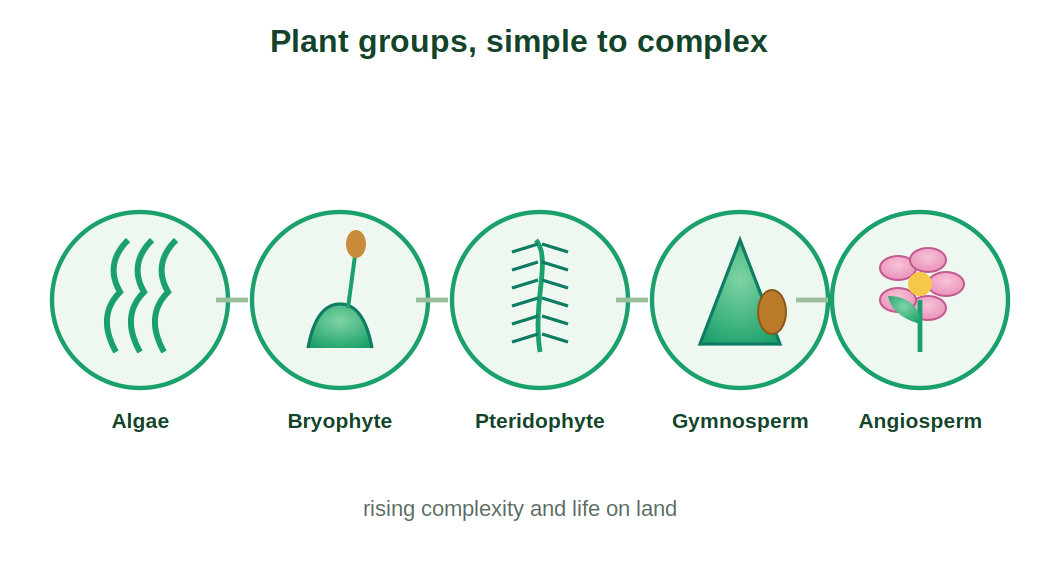
Fig 1. The plant groups arranged from simple water living algae to complex flowering angiosperms. |
2. Algae |
Algae are simple plants, mostly living in water, that make their own food by photosynthesis but have no true roots, stems or leaves. They range from single cells to large seaweeds. Because they live in water, they release their reproductive cells directly into it, and they form the base of aquatic food chains while producing much of the world’s oxygen.
3. Bryophytes and Pteridophytes |
Bryophytes, such as mosses, are the first plants to live on land, but they need moisture to reproduce and have no proper tissue to carry water, so they stay small and grow in damp places; they are often called the amphibians of the plant kingdom. Pteridophytes, such as ferns, are the first plants with vascular tissue, the pipes that carry water and food, which lets them grow larger and live more fully on land, though they still reproduce by spores in moist conditions.
4. Gymnosperms and Angiosperms |
Gymnosperms, such as pines, are seed plants whose seeds are not enclosed but borne naked, often on cones; the seed freed plants from needing water to reproduce. Angiosperms, the flowering plants, enclose their seeds in a fruit and reproduce through flowers, the most advanced and widespread group. The flower and the protected seed are the great innovations that made angiosperms dominate the land.
5. Alternation of Generations |
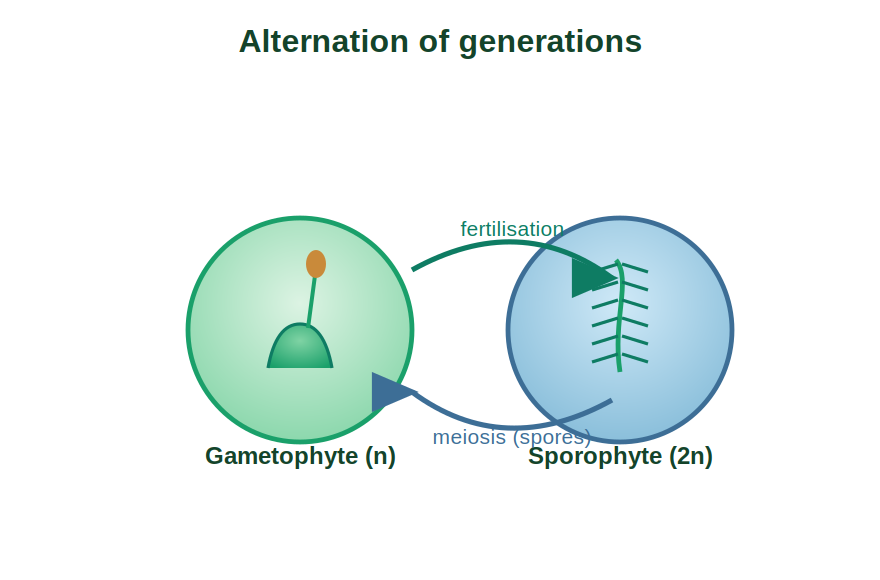
Every plant life cycle alternates between two phases. The gametophyte is haploid, carrying one set of chromosomes, and produces gametes; when two gametes fuse in fertilisation they form the sporophyte, which is diploid. The sporophyte later produces spores by meiosis, which grow into new gametophytes. This alternation of generations repeats in every plant, though the dominant phase differs from group to group.
|
Diagram 2 – Alternation of Generations
Fig 2. The plant life cycle alternates between a haploid gametophyte and a diploid sporophyte, linked by fertilisation and meiosis. |
6. Monocots and Dicots |
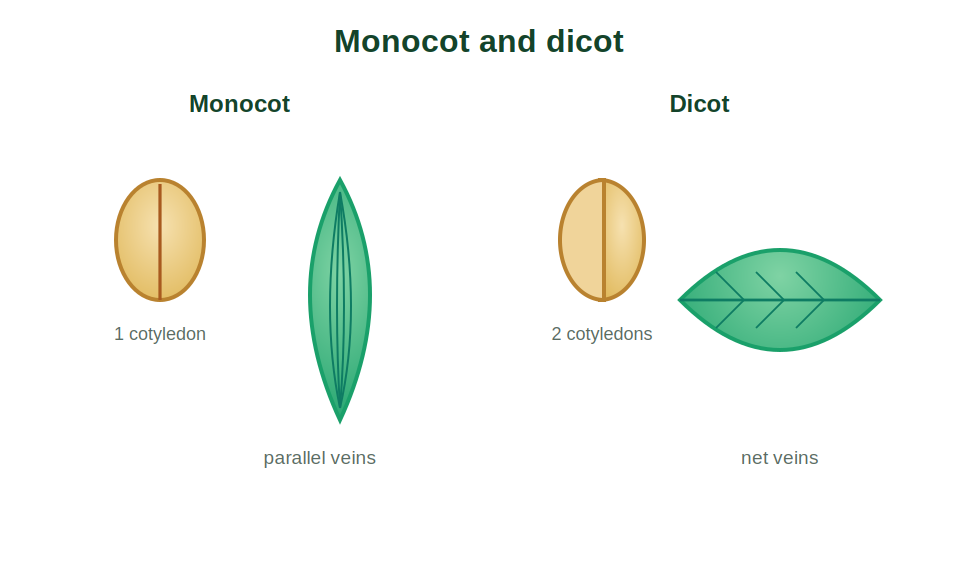
The flowering plants split into two great classes by the number of seed leaves, or cotyledons, in the seed. Monocots, such as grasses and cereals, have a single cotyledon, parallel leaf veins and flower parts in threes. Dicots, such as beans and roses, have two cotyledons, a net of leaf veins and flower parts in fours or fives. This simple difference predicts many features of the whole plant.
|
Diagram 3 – Monocot and Dicot
Fig 3. Monocots have one cotyledon and parallel veins; dicots have two cotyledons and net veins. |
7. Key Reasoning (Principles) |
|
Principle 1: Complexity rises with life on land From algae to angiosperms, plants gained vascular tissue, seeds and flowers, each step freeing them further from water and letting them grow larger and spread. |
|
Principle 2: Every plant alternates generations The life cycle swings between a haploid gametophyte and a diploid sporophyte, linked by fertilisation and meiosis, in all plant groups. |
|
Principle 3: Cotyledon number splits the flowering plants The single feature of one or two cotyledons divides angiosperms into monocots and dicots and predicts their veins, roots and flower parts. |
8. Worked Examples |
| Example 1 |
|
Q: Name the five major plant groups in order of increasing complexity. ▶ Show SolutionAlgae, bryophytes, pteridophytes, gymnosperms and angiosperms. Answer: Algae to angiosperms. |
| Example 2 |
|
Q: Why are bryophytes called the amphibians of the plant kingdom? ▶ Show SolutionThey live on land but need water to reproduce. Answer: They need water to reproduce. |
| Example 3 |
|
Q: Which group first developed vascular tissue? ▶ Show SolutionPteridophytes (ferns) were the first with vascular tissue. Answer: Pteridophytes. |
| Example 4 |
|
Q: What is special about a gymnosperm seed? ▶ Show SolutionIts seed is naked, not enclosed in a fruit. Answer: It is naked (not enclosed). |
| Example 5 |
|
Q: What encloses the seed of an angiosperm? ▶ Show SolutionThe seed is enclosed in a fruit. Answer: A fruit. |
| Example 6 |
|
Q: What is the haploid phase of the plant life cycle called? ▶ Show SolutionThe haploid, gamete forming phase is the gametophyte. Answer: The gametophyte. |
| Example 7 |
|
Q: What links the gametophyte to the sporophyte? ▶ Show SolutionThe fusion of gametes in fertilisation forms the diploid sporophyte. Answer: Fertilisation. |
| Example 8 |
|
Q: How many cotyledons does a monocot seed have? ▶ Show SolutionA monocot has one cotyledon. Answer: One. |
| Example 9 |
|
Q: What type of leaf veins do dicots have? ▶ Show SolutionDicots have a net, or reticulate, arrangement of veins. Answer: Net (reticulate) veins. |
| Example 10 |
|
Q: Which group is the most advanced and widespread? ▶ Show SolutionThe flowering plants, the angiosperms. Answer: Angiosperms. |
9. Practice Sets A to D |
| Set A – Multiple Choice (Basic) |
|
1. The simplest plants, mostly aquatic, are: (a) ferns (b) algae (c) pines (d) mosses 2. The first plants with vascular tissue are: (a) algae (b) bryophytes (c) pteridophytes (d) angiosperms 3. Naked seeds are found in: (a) angiosperms (b) gymnosperms (c) mosses (d) ferns 4. The haploid phase of a plant is the: (a) sporophyte (b) gametophyte (c) zygote (d) fruit 5. A monocot has cotyledons numbering: (a) one (b) two (c) three (d) four ▶ Reveal Answers1. (b) algae. 2. (c) pteridophytes. 3. (b) gymnosperms. 4. (b) gametophyte. 5. (a) one. |
| Set B – Short Answer (Understanding) |
|
1. List the major plant groups from simple to complex. 2. Why are bryophytes restricted to moist places? 3. What advantage did the seed give to gymnosperms? 4. Define alternation of generations. 5. State two differences between monocots and dicots. ▶ Reveal Answers1. Algae, bryophytes, pteridophytes, gymnosperms, angiosperms. 2. They have no proper water carrying tissue and need water to reproduce. 3. It freed them from needing water for reproduction and let them spread on dry land. 4. The plant life cycle alternates between a haploid gametophyte and a diploid sporophyte. 5. Monocots have one cotyledon and parallel veins; dicots have two cotyledons and net veins. |
| Set C – Application and Reasoning |
|
1. A plant has flowers and seeds enclosed in fruit. Which group is it? 2. Which phase produces gametes? 3. Why can pteridophytes grow larger than bryophytes? 4. A seed has two cotyledons. Monocot or dicot? 5. Why do algae release reproductive cells into water? ▶ Reveal Answers1. Angiosperms. 2. The gametophyte. 3. Because they have vascular tissue to carry water and food. 4. Dicot. 5. Because they live in water, which carries the cells to fertilise others. |
| Set D – Higher Order (Challenge) |
|
1. Trace how plants became progressively independent of water across the groups. 2. Explain why the sporophyte is diploid but the gametophyte is haploid. 3. Predict the leaf venation and flower parts of a grass, and justify. 4. Explain why the flower is regarded as a major evolutionary advance. 5. A fern reproduces by spores in damp soil. Explain why it still depends on moisture. ▶ Reveal Answers1. Algae live in water, bryophytes need moisture, pteridophytes gained vascular tissue, gymnosperms gained seeds, and angiosperms added the protected seed and flower. 2. The sporophyte forms from the fusion of two gametes, so it has two sets of chromosomes; the gametophyte arises from spores made by meiosis, so it has one set. 3. Parallel veins and flower parts in threes, because a grass is a monocot. 4. Because it allows controlled, attractive reproduction and leads to the protected seed in a fruit, helping angiosperms dominate the land. 5. Its spores and the gametes they produce still need a film of water to swim and fertilise. |
|
Chapter Summary
|
|||||||||||||||||||||||||||||||
| 8-Point Exam Quick-Check | ||||||||||||||||||||||||||||||||
|
||||||||||||||||||||||||||||||||
|
School Revise Virtual Lab Explore these ideas with interactive simulations and visual tools.
|
|
Class 11 Biology Chapter 3: Plant Kingdom, Complete Notes and Practice This revision guide follows the current NCERT Class 11 Biology syllabus and develops the plant kingdom, covering the major groups from algae through bryophytes, pteridophytes and gymnosperms to angiosperms, the gradual move onto land, the alternation of haploid gametophyte and diploid sporophyte generations, and the division of flowering plants into monocots and dicots, with three diagrams, ten worked examples and graded practice. Visit SchoolRevise.com to revise, practise and excel. |
 Google