Curriculum
Science Grade XI Biology
Science Grade XI Biology
0/19
-
Chapter 1: The Living World
 Preview
 -
Chapter 2: Biological Classification
Preview
-
Chapter 3: Plant Kingdom
Preview
-
Chapter 4: Animal Kingdom
Preview
-
Chapter 5: Morphology of Flowering Plants
Preview
-
Chapter 6: Anatomy of Flowering Plants
Preview
-
Chapter 7: Structural Organisation in Animals
Preview
-
Chapter 8: Cell: The Unit of Life
Preview
-
Chapter 9: Biomolecules
Preview
-
Chapter 10: Cell Cycle and Cell Division
Preview
-
Chapter 11: Photosynthesis in Higher Plants
Preview
-
Chapter 12: Respiration in Plants
Preview
-
Chapter 13: Plant Growth and Development
Preview
-
Chapter 14: Breathing and Exchange of Gases
Preview
-
Chapter 15: Body Fluids and Circulation
Preview
-
Chapter 16: Excretory Products and their Elimination
Preview
-
Chapter 17: Locomotion and Movement
Preview
-
Chapter 18: Neural Control and Coordination
Preview
-
Chapter 19: Chemical Coordination and Integration
Preview
Work Sheets
0/19

Chapter 11: Photosynthesis in Higher Plants
|
Grade 11 Science | Chapter 12 Respiration in PlantsRespiration releases the energy stored in food. This chapter develops the respiration equation, glycolysis and the mitochondrial stages, aerobic and anaerobic respiration, and the role of ATP.
|
|
Contents
|
1. Introduction: Releasing Energy |
Making food in photosynthesis stores energy, but to use it a cell must release it again. Respiration is the process that breaks down glucose to release its stored energy in a form the cell can use. Every living cell respires, day and night, plant and animal alike. This chapter follows how the energy is released and captured.
|
Core idea In respiration, glucose is broken down, usually with oxygen, to release energy. The energy is captured in molecules of ATP, the cell’s energy currency, with carbon dioxide and water as products.
|
2. The Respiration Equation |
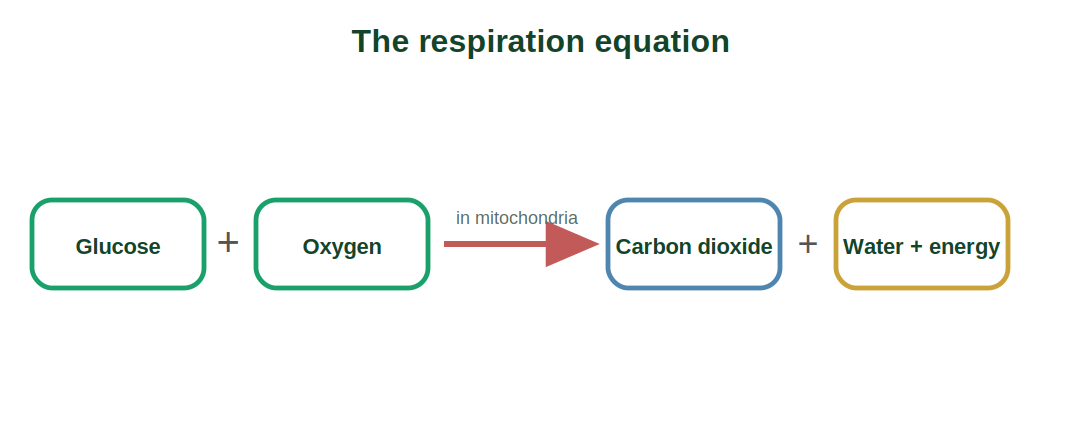
Aerobic respiration is the reverse of photosynthesis in summary. Glucose and oxygen react to give carbon dioxide, water and a large amount of energy. The glucose is the fuel, the oxygen lets it be fully broken down, and the energy released is captured to power the cell’s activities.
|
Diagram 1 – The Respiration Equation
Fig 1. Glucose and oxygen are broken down to carbon dioxide, water and energy. |
3. Glycolysis and the Mitochondrial Stages |
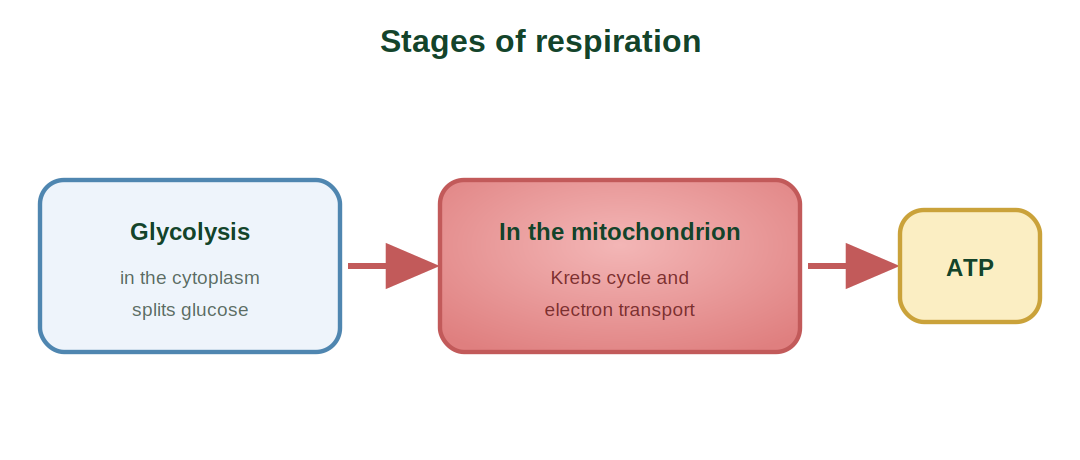
Respiration occurs in stages. It begins with glycolysis in the cytoplasm, where glucose is split into smaller molecules, releasing a little energy. These molecules then enter the mitochondrion, where the Krebs cycle and the electron transport chain release most of the energy, in the presence of oxygen. This is why the mitochondrion is the powerhouse of the cell.
|
Diagram 2 – The Stages of Respiration
Fig 2. Glycolysis in the cytoplasm feeds the mitochondrion, where most of the ATP is made. |
4. Aerobic and Anaerobic Respiration |
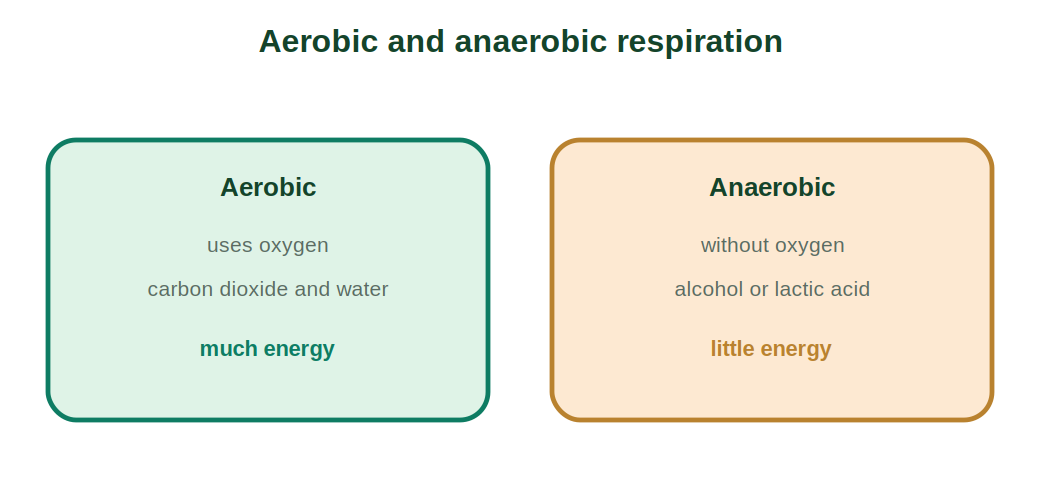
Respiration can happen with or without oxygen. Aerobic respiration uses oxygen, fully breaks down glucose, and releases a large amount of energy, giving carbon dioxide and water. Anaerobic respiration happens without oxygen, only partly breaks down glucose, and releases far less energy, giving alcohol in plants and yeast, or lactic acid in animal muscle.
|
Diagram 3 – Aerobic and Anaerobic Respiration
Fig 3. Aerobic respiration uses oxygen and releases much energy; anaerobic respiration works without oxygen and releases little. |
5. ATP, the Energy Currency |
The energy released in respiration is not used directly; it is first captured in a molecule called ATP. ATP acts as the cell’s energy currency, storing energy in a form ready to be spent on any task, from building molecules to moving materials. Aerobic respiration makes far more ATP from each glucose than anaerobic respiration can.
6. Respiration and Photosynthesis Compared |
Respiration and photosynthesis are opposite in summary but both essential. Photosynthesis builds glucose and stores energy, using carbon dioxide and water and giving out oxygen, and needs light. Respiration breaks glucose down and releases energy, using oxygen and giving out carbon dioxide and water, at all times. Together they cycle carbon and energy through living things.
7. Key Reasoning (Principles) |
|
Principle 1: Respiration releases stored energy Glucose holds the energy captured in photosynthesis, and respiration breaks it down to release that energy in a usable form for the cell. |
|
Principle 2: Oxygen allows full breakdown With oxygen, glucose is fully broken down and releases much energy; without it, only a partial breakdown is possible, releasing far less. |
|
Principle 3: ATP carries the energy The released energy is captured in ATP, a ready to spend currency, so the cell can power its many activities on demand. |
8. Worked Examples |
| Example 1 |
|
Q: What is the purpose of respiration? ▶ Show SolutionTo release the energy stored in glucose for the cell to use. Answer: To release stored energy. |
| Example 2 |
|
Q: Write the word equation of aerobic respiration. ▶ Show SolutionGlucose plus oxygen gives carbon dioxide plus water plus energy. Answer: Glucose + oxygen gives CO2 + water + energy. |
| Example 3 |
|
Q: Where does glycolysis take place? ▶ Show SolutionGlycolysis takes place in the cytoplasm. Answer: In the cytoplasm. |
| Example 4 |
|
Q: Where is most of the energy released? ▶ Show SolutionIn the mitochondrion, in the Krebs cycle and electron transport. Answer: In the mitochondrion. |
| Example 5 |
|
Q: What is the difference between aerobic and anaerobic respiration? ▶ Show SolutionAerobic uses oxygen and releases much energy; anaerobic uses none and releases little. Answer: Use of oxygen and amount of energy. |
| Example 6 |
|
Q: What does anaerobic respiration produce in plants and yeast? ▶ Show SolutionAlcohol (and carbon dioxide). Answer: Alcohol. |
| Example 7 |
|
Q: What does anaerobic respiration produce in animal muscle? ▶ Show SolutionLactic acid. Answer: Lactic acid. |
| Example 8 |
|
Q: What molecule captures the released energy? ▶ Show SolutionATP captures the energy. Answer: ATP. |
| Example 9 |
|
Q: Which releases more energy per glucose, aerobic or anaerobic? ▶ Show SolutionAerobic respiration releases far more energy. Answer: Aerobic. |
| Example 10 |
|
Q: Do plant cells respire only at night? ▶ Show SolutionNo, every living cell respires at all times. Answer: No, all the time. |
9. Practice Sets A to D |
| Set A – Multiple Choice (Basic) |
|
1. Respiration releases energy from: (a) water (b) glucose (c) oxygen (d) carbon dioxide 2. Glycolysis occurs in the: (a) nucleus (b) cytoplasm (c) mitochondrion (d) chloroplast 3. Most ATP is made in the: (a) cytoplasm (b) mitochondrion (c) wall (d) vacuole 4. Anaerobic respiration in muscle makes: (a) alcohol (b) lactic acid (c) glucose (d) oxygen 5. The energy currency of the cell is: (a) DNA (b) ATP (c) glucose (d) water ▶ Reveal Answers1. (b) glucose. 2. (b) cytoplasm. 3. (b) mitochondrion. 4. (b) lactic acid. 5. (b) ATP. |
| Set B – Short Answer (Understanding) |
|
1. State the purpose of respiration. 2. Write the aerobic respiration equation. 3. Name the two main locations of the stages. 4. Give the products of anaerobic respiration in yeast and in muscle. 5. What is the role of ATP? ▶ Reveal Answers1. To release the energy stored in glucose in a form the cell can use. 2. Glucose plus oxygen gives carbon dioxide plus water plus energy. 3. Glycolysis in the cytoplasm and the later stages in the mitochondrion. 4. Alcohol in yeast and lactic acid in muscle. 5. It captures and carries the released energy, ready to be spent by the cell. |
| Set C – Application and Reasoning |
|
1. A muscle works hard with little oxygen. Which respiration occurs? 2. Why does aerobic respiration release more energy than anaerobic? 3. Why is the mitochondrion called the powerhouse? 4. Do plants respire during the day? 5. Why is respiration described as almost the reverse of photosynthesis? ▶ Reveal Answers1. Anaerobic respiration. 2. Because oxygen allows glucose to be fully broken down, releasing much more energy. 3. Because most of the cell’s energy is released there. 4. Yes, plants respire at all times, day and night. 5. Because it uses glucose and oxygen to give carbon dioxide and water, the opposite of what photosynthesis does. |
| Set D – Higher Order (Challenge) |
|
1. Explain how photosynthesis and respiration together cycle energy and carbon. 2. Explain why a sprinter’s muscles may switch to anaerobic respiration. 3. Explain why ATP is needed rather than using glucose energy directly. 4. A yeast in a sealed jar of sugar produces alcohol. Explain. 5. Compare the energy yield and products of the two kinds of respiration. ▶ Reveal Answers1. Photosynthesis stores energy in glucose using carbon dioxide and releasing oxygen; respiration releases that energy using oxygen and returning carbon dioxide, so the two cycle energy and carbon. 2. Because hard work outpaces the oxygen supply, so muscles release some energy without oxygen, producing lactic acid. 3. Because ATP carries energy in small, ready to use amounts that can power any task on demand. 4. With no oxygen, the yeast respires anaerobically, breaking sugar down to alcohol and carbon dioxide. 5. Aerobic uses oxygen, gives carbon dioxide and water, and much ATP; anaerobic uses none, gives alcohol or lactic acid, and little ATP. |
|
Chapter Summary
|
|||||||||||||||||||||||||||||||
| 8-Point Exam Quick-Check | ||||||||||||||||||||||||||||||||
|
||||||||||||||||||||||||||||||||
|
School Revise Virtual Lab Explore these ideas with interactive simulations and visual tools.
|
|
Class 11 Biology Chapter 12: Respiration in Plants, Complete Notes and Practice This revision guide follows the current NCERT Class 11 Biology syllabus and develops respiration, covering its purpose of releasing energy, the aerobic equation, glycolysis in the cytoplasm and the Krebs cycle and electron transport in the mitochondrion, the difference between aerobic and anaerobic respiration, and the role of ATP as the energy currency, with three diagrams, ten worked examples and graded practice. Visit SchoolRevise.com to revise, practise and excel. |
 Google