Curriculum
Science Grade XI Biology
Science Grade XI Biology
0/19
-
Chapter 1: The Living World
 Preview
 -
Chapter 2: Biological Classification
Preview
-
Chapter 3: Plant Kingdom
Preview
-
Chapter 4: Animal Kingdom
Preview
-
Chapter 5: Morphology of Flowering Plants
Preview
-
Chapter 6: Anatomy of Flowering Plants
Preview
-
Chapter 7: Structural Organisation in Animals
Preview
-
Chapter 8: Cell: The Unit of Life
Preview
-
Chapter 9: Biomolecules
Preview
-
Chapter 10: Cell Cycle and Cell Division
Preview
-
Chapter 11: Photosynthesis in Higher Plants
Preview
-
Chapter 12: Respiration in Plants
Preview
-
Chapter 13: Plant Growth and Development
Preview
-
Chapter 14: Breathing and Exchange of Gases
Preview
-
Chapter 15: Body Fluids and Circulation
Preview
-
Chapter 16: Excretory Products and their Elimination
Preview
-
Chapter 17: Locomotion and Movement
Preview
-
Chapter 18: Neural Control and Coordination
Preview
-
Chapter 19: Chemical Coordination and Integration
Preview
Work Sheets
0/19

Chapter 19: Chemical Coordination and Integration
|
Grade 11 Science | Chapter 19 Chemical Coordination and IntegrationHormones give slow, lasting control of the body. This chapter develops the endocrine glands, how a hormone acts, the major hormones, and how hormonal control compares with nervous control.
|
|
Contents
|
1. Introduction: Chemical Messengers |
Besides the fast nervous system, the body has a second, slower means of control that uses chemical messengers called hormones. Made by endocrine glands and carried in the blood, hormones bring about changes that are slower to start but longer lasting, such as growth and the control of sugar. This chapter looks at the glands, how hormones act, and how this control fits with the nervous system.
|
Core idea Hormones are chemical messengers made by endocrine glands and carried in the blood to target organs, giving slow but long lasting control of the body.
|
2. The Endocrine Glands |
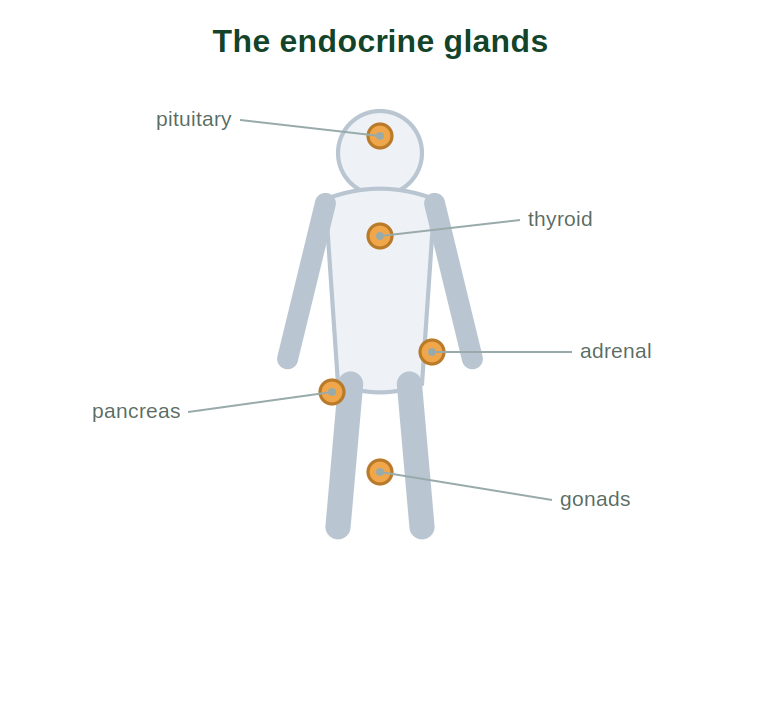
The endocrine glands make hormones and release them straight into the blood. The pituitary in the head controls other glands. The thyroid in the neck sets the body’s rate of working. The adrenal glands prepare the body for action, the pancreas controls blood sugar, and the gonads govern reproduction. Together they form the body’s chemical control system.
|
Diagram 1 – The Endocrine Glands
Fig 1. The main endocrine glands and where they lie in the body. |
3. How a Hormone Acts |
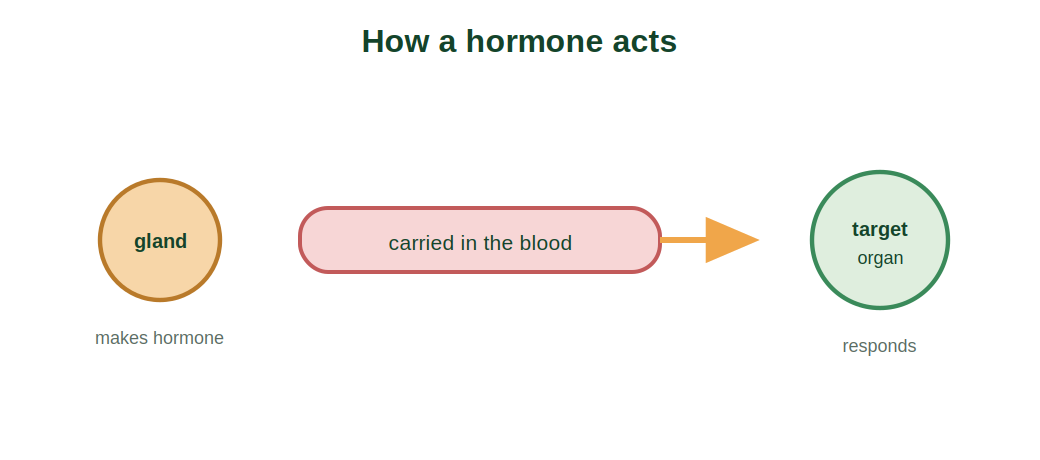
A hormone works by travelling to a distant organ. An endocrine gland releases the hormone into the blood, which carries it all around the body. Although it reaches every part, the hormone only affects its target organ, the one built to respond to it, which then changes its activity. This is why a tiny amount of hormone can control an organ far from the gland.
|
Diagram 2 – How a Hormone Acts
Fig 2. A gland releases a hormone into the blood, which carries it to its target organ. |
4. Some Major Hormones |
A few hormones show the range of their work. Insulin, from the pancreas, lowers blood sugar after a meal. Thyroxine, from the thyroid, sets how fast the body uses energy. Adrenaline, from the adrenal glands, readies the body for sudden effort, raising the heartbeat and breathing. Growth hormone, from the pituitary, controls how the body grows. Each acts on its own target.
5. Nervous and Hormonal Control |
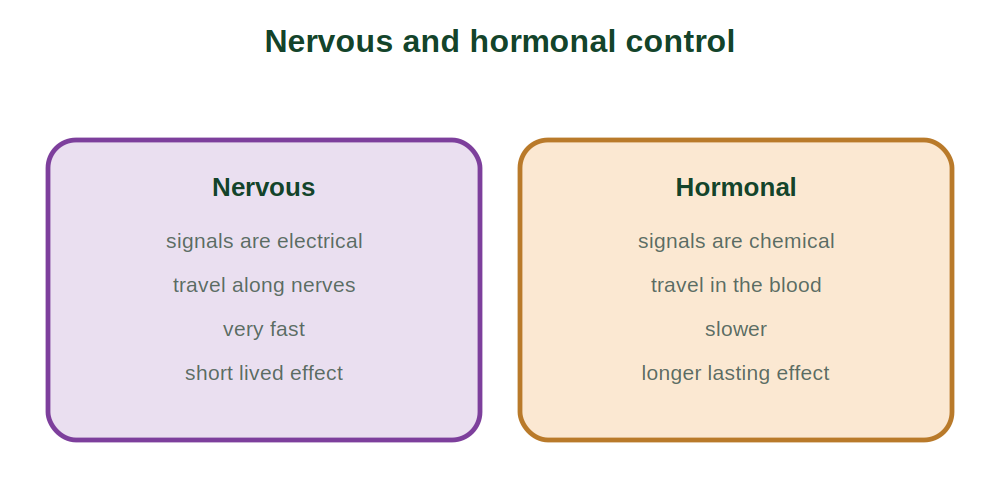
The two control systems work in different ways and suit different tasks. Nervous control uses fast electrical signals along nerves, giving quick, short lived responses. Hormonal control uses chemical messengers in the blood, giving slower but longer lasting effects. The body uses the nervous system for instant reactions and the hormones for gradual, sustained changes.
|
Diagram 3 – Nervous and Hormonal Control
Fig 3. Nervous control is fast and electrical; hormonal control is slower, chemical and longer lasting. |
6. Keeping the Body in Balance |
Hormones help keep the body’s internal conditions steady. When a level moves away from normal, a hormone acts to bring it back, and once it is corrected the signal eases off. For example, after a meal insulin lowers the raised blood sugar, and as the sugar falls the insulin reduces. This kind of self correcting control keeps the body’s conditions within safe limits.
7. Key Reasoning (Principles) |
|
Principle 1: Hormones are blood-borne messengers Endocrine glands release hormones into the blood, which carries them to distant target organs, so control can reach the whole body. |
|
Principle 2: A hormone affects only its target Although a hormone reaches every part of the body, only the target organ built to respond to it is affected, so control is precise. |
|
Principle 3: Two systems suit two kinds of task Nervous control gives fast, short responses and hormonal control gives slow, lasting ones, so the body uses each where it fits best. |
8. Worked Examples |
| Example 1 |
|
Q: What is a hormone? ▶ Show SolutionA chemical messenger made by an endocrine gland and carried in the blood. Answer: A chemical messenger. |
| Example 2 |
|
Q: Where do endocrine glands release their hormones? ▶ Show SolutionStraight into the blood. Answer: Into the blood. |
| Example 3 |
|
Q: Which gland controls the others? ▶ Show SolutionThe pituitary. Answer: The pituitary. |
| Example 4 |
|
Q: Which gland controls blood sugar? ▶ Show SolutionThe pancreas. Answer: The pancreas. |
| Example 5 |
|
Q: How is a hormone carried to its target? ▶ Show SolutionIn the blood. Answer: In the blood. |
| Example 6 |
|
Q: Why does a hormone affect only some organs? ▶ Show SolutionOnly its target organ is built to respond to it. Answer: Only the target responds. |
| Example 7 |
|
Q: Which hormone lowers blood sugar? ▶ Show SolutionInsulin. Answer: Insulin. |
| Example 8 |
|
Q: Which hormone readies the body for sudden effort? ▶ Show SolutionAdrenaline. Answer: Adrenaline. |
| Example 9 |
|
Q: How does nervous control differ from hormonal control in speed? ▶ Show SolutionNervous control is fast and short; hormonal control is slow and lasting. Answer: Fast versus slow. |
| Example 10 |
|
Q: Give an example of hormones keeping the body in balance. ▶ Show SolutionInsulin lowers raised blood sugar after a meal, then eases as it falls. Answer: Insulin balancing blood sugar. |
9. Practice Sets A to D |
| Set A – Multiple Choice (Basic) |
|
1. Hormones are made by: (a) neurons (b) endocrine glands (c) bones (d) alveoli 2. Hormones are carried in the: (a) nerves (b) blood (c) air (d) urine 3. Blood sugar is controlled by the: (a) thyroid (b) pancreas (c) pituitary (d) adrenal 4. A hormone affects: (a) every organ (b) only its target organ (c) no organ (d) nerves only 5. Compared with nerves, hormonal effects are: (a) faster (b) slower and longer lasting (c) electrical (d) instant ▶ Reveal Answers1. (b) endocrine glands. 2. (b) blood. 3. (b) pancreas. 4. (b) only its target organ. 5. (b) slower and longer lasting. |
| Set B – Short Answer (Understanding) |
|
1. What is a hormone and where is it made? 2. Name three endocrine glands and a role of each. 3. Describe how a hormone reaches its target. 4. Name two hormones and what each does. 5. Compare nervous and hormonal control. ▶ Reveal Answers1. A chemical messenger made by an endocrine gland. 2. Pituitary (controls other glands), thyroid (rate of working), pancreas (blood sugar). 3. The gland releases it into the blood, which carries it to the target organ that responds. 4. Insulin lowers blood sugar; adrenaline readies the body for sudden effort. 5. Nervous control is fast, electrical and short; hormonal control is slower, chemical and longer lasting. |
| Set C – Application and Reasoning |
|
1. Why can a tiny amount of hormone control a distant organ? 2. Why does adrenaline raise the heartbeat before a race? 3. Why does insulin act after a meal? 4. Why does the body need both control systems? 5. Why does the pituitary have wide effects? ▶ Reveal Answers1. Because the blood carries it everywhere, and the target organ is very sensitive to it. 2. To ready the body for sudden effort by supplying muscles with more oxygen and fuel. 3. Because a meal raises blood sugar, and insulin lowers it back to normal. 4. Because some responses must be instant (nervous) and others gradual and lasting (hormonal). 5. Because it controls several other glands, so its hormones affect many parts of the body. |
| Set D – Higher Order (Challenge) |
|
1. Explain how a hormone can be carried everywhere yet act in only one place. 2. Explain why hormonal control suits growth while nervous control suits a reflex. 3. Explain how insulin shows self correcting control. 4. Explain how the nervous and hormonal systems together keep the body coordinated. 5. Explain why damage to the pituitary could affect many other glands. ▶ Reveal Answers1. The blood carries it to every organ, but only the target organ has the means to respond, so its effect is felt in just one place. 2. Growth is a slow, lasting change suited to hormones, while a reflex must be instant, suited to fast nerve signals. 3. After a meal it lowers the raised blood sugar, and as the sugar falls the insulin eases off, so the level is held steady. 4. The nervous system gives quick reactions and the hormones give sustained adjustments, so together they control both fast and slow needs. 5. Because the pituitary controls several other glands, so harming it would disturb all the glands it directs. |
|
Chapter Summary
|
|||||||||||||||||||||||||||||||
| 8-Point Exam Quick-Check | ||||||||||||||||||||||||||||||||
|
||||||||||||||||||||||||||||||||
|
School Revise Virtual Lab Explore these ideas with interactive simulations and visual tools.
|
|
Class 11 Biology Chapter 19: Chemical Coordination and Integration, Complete Notes and Practice This revision guide follows the current NCERT Class 11 Biology syllabus and develops chemical coordination, covering hormones as chemical messengers, the endocrine glands such as the pituitary, thyroid, adrenal, pancreas and gonads, how a hormone travels in the blood to its target organ, major hormones such as insulin and adrenaline, the comparison of nervous and hormonal control, and how hormones keep the body in balance, with three diagrams, ten worked examples and graded practice. Visit SchoolRevise.com to revise, practise and excel. |
 Google