Curriculum
Science Grade XI Biology
Science Grade XI Biology
0/19
-
Chapter 1: The Living World
 Preview
 -
Chapter 2: Biological Classification
Preview
-
Chapter 3: Plant Kingdom
Preview
-
Chapter 4: Animal Kingdom
Preview
-
Chapter 5: Morphology of Flowering Plants
Preview
-
Chapter 6: Anatomy of Flowering Plants
Preview
-
Chapter 7: Structural Organisation in Animals
Preview
-
Chapter 8: Cell: The Unit of Life
Preview
-
Chapter 9: Biomolecules
Preview
-
Chapter 10: Cell Cycle and Cell Division
Preview
-
Chapter 11: Photosynthesis in Higher Plants
Preview
-
Chapter 12: Respiration in Plants
Preview
-
Chapter 13: Plant Growth and Development
Preview
-
Chapter 14: Breathing and Exchange of Gases
Preview
-
Chapter 15: Body Fluids and Circulation
Preview
-
Chapter 16: Excretory Products and their Elimination
Preview
-
Chapter 17: Locomotion and Movement
Preview
-
Chapter 18: Neural Control and Coordination
Preview
-
Chapter 19: Chemical Coordination and Integration
Preview
Work Sheets
0/19

Chapter 18: Neural Control and Coordination
|
Grade 11 Science | Chapter 18 Neural Control and CoordinationThe nervous system carries fast signals around the body. This chapter develops the neuron, the brain, and the reflex arc that gives quick, automatic responses.
|
|
Contents
|
1. Introduction: Staying Coordinated |
The many parts of the body must work together, and respond quickly to the world. The nervous system provides this fast control. It senses changes, decides what to do, and sends signals to act, all in a fraction of a second. This chapter looks at the cell that carries these signals, the brain that directs them, and the quick reflex response.
|
Core idea The nervous system carries fast electrical signals along neurons. The brain and spinal cord process them, and a reflex arc gives an automatic response to danger.
|
2. The Neuron |
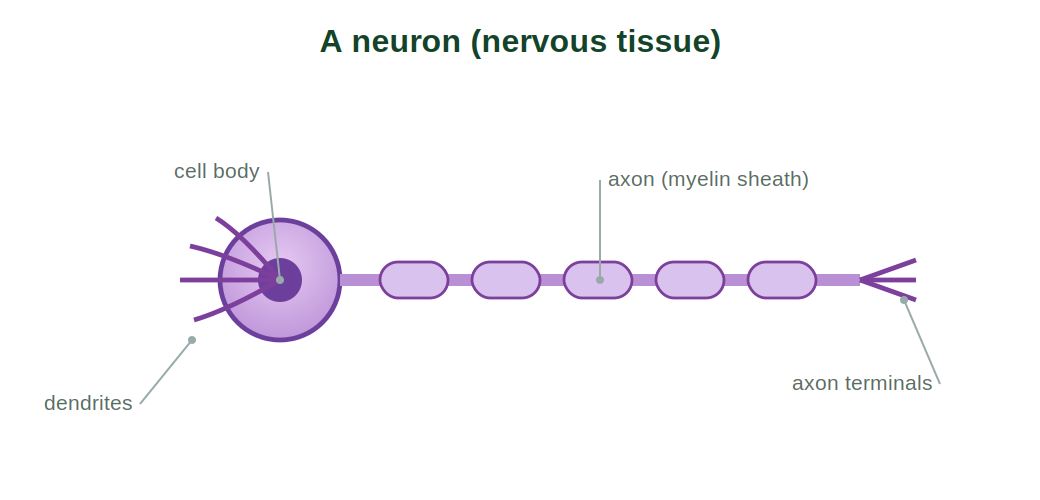
The neuron, or nerve cell, is the unit of the nervous system, built to carry signals. It has a cell body with the nucleus, branching dendrites that receive signals, and a long fibre, the axon, that carries the signal away to its ends. Many axons are wrapped in a fatty myelin sheath that lets the signal travel faster.
|
Diagram 1 – A Neuron
Fig 1. A neuron has a cell body, dendrites that receive signals, and an axon that carries them away. |
3. The Brain |
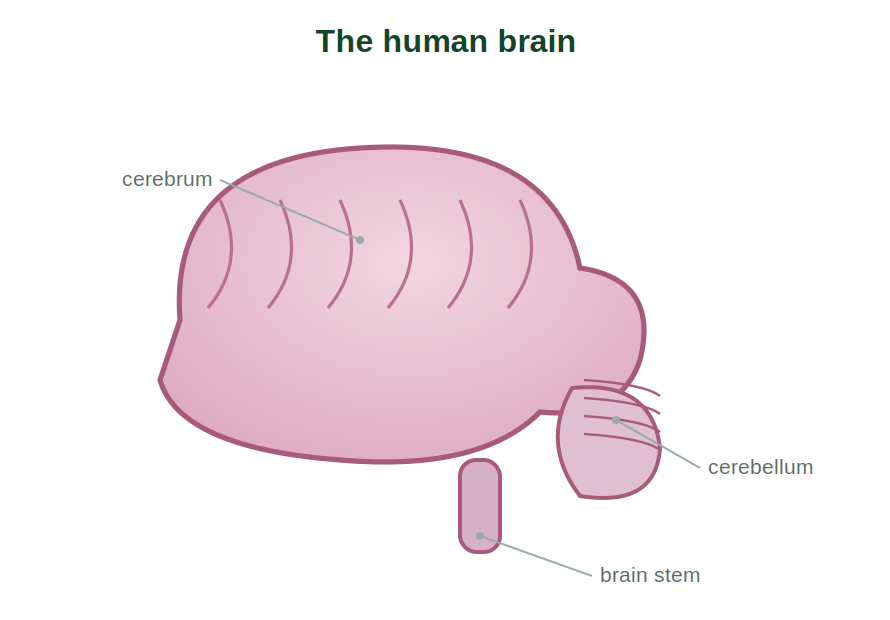
The brain is the control centre of the nervous system. Its largest part, the cerebrum, handles thinking, memory and the senses, and controls movement we choose to make. The cerebellum, at the back, looks after balance and smooth, coordinated movement. The brain stem, joining the spinal cord, controls vital actions such as breathing and heartbeat.
|
Diagram 2 – The Human Brain
Fig 2. The cerebrum handles thinking, the cerebellum balance, and the brain stem vital actions. |
4. The Reflex Arc |
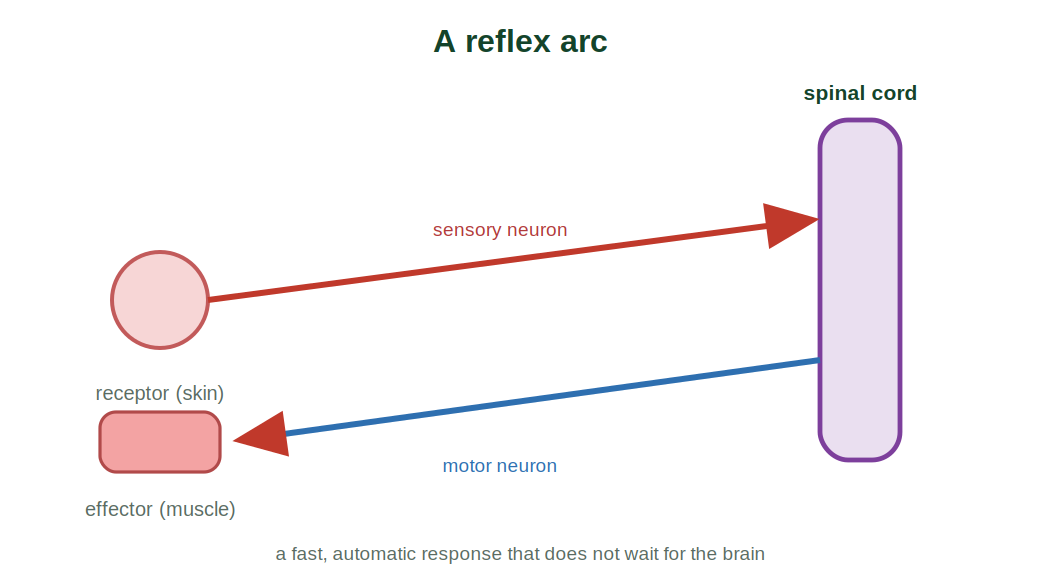
Some responses are too urgent to wait for thought. A reflex is a fast, automatic response, such as pulling the hand from a hot object. The signal travels a short path called the reflex arc: a receptor detects the danger, a sensory neuron carries the signal to the spinal cord, and a motor neuron carries the order to a muscle, the effector, which acts at once.
|
Diagram 3 – A Reflex Arc
Fig 3. In a reflex, the signal goes from receptor to spinal cord to muscle, without waiting for the brain. |
5. How a Nerve Signal Travels |
A nerve signal is an electrical message that travels along the axon of a neuron very quickly. Where one neuron meets the next there is a tiny gap called a synapse; here the signal is passed on by a chemical that crosses the gap and starts the signal again in the next neuron. In this way signals travel from cell to cell across the whole nervous system.
6. The Importance of the Nervous System |
The nervous system lets the body act with great speed and precision. It senses the surroundings, coordinates the muscles and organs, and allows learning, memory and thought. Its fast electrical signals make it the system the body relies on whenever a quick response is needed, working alongside the slower chemical control of hormones.
7. Key Reasoning (Principles) |
|
Principle 1: The neuron is built to carry signals Its dendrites receive signals, its long axon carries them far, and its myelin sheath speeds them, so it is shaped for fast communication. |
|
Principle 2: The brain divides the work Different parts of the brain handle thinking, balance and vital actions, so the body is controlled efficiently by specialised regions. |
|
Principle 3: A reflex saves time by skipping thought By routing the urgent signal through the spinal cord to the muscle, the reflex arc gives a response before the brain has time to decide. |
8. Worked Examples |
| Example 1 |
|
Q: What does the nervous system do? ▶ Show SolutionIt carries fast signals to sense, coordinate and respond. Answer: Carries fast signals to coordinate. |
| Example 2 |
|
Q: What is the unit cell of the nervous system? ▶ Show SolutionThe neuron. Answer: The neuron. |
| Example 3 |
|
Q: Which part of the neuron receives signals? ▶ Show SolutionThe dendrites. Answer: The dendrites. |
| Example 4 |
|
Q: Which part carries the signal away? ▶ Show SolutionThe axon. Answer: The axon. |
| Example 5 |
|
Q: Which part of the brain controls thinking? ▶ Show SolutionThe cerebrum. Answer: The cerebrum. |
| Example 6 |
|
Q: Which part controls balance and coordination? ▶ Show SolutionThe cerebellum. Answer: The cerebellum. |
| Example 7 |
|
Q: What is a reflex? ▶ Show SolutionA fast, automatic response to a stimulus. Answer: A fast automatic response. |
| Example 8 |
|
Q: Name the parts of a reflex arc in order. ▶ Show SolutionReceptor, sensory neuron, spinal cord, motor neuron, effector. Answer: Receptor, sensory, cord, motor, effector. |
| Example 9 |
|
Q: What is the gap between two neurons called? ▶ Show SolutionA synapse. Answer: A synapse. |
| Example 10 |
|
Q: Why is a reflex faster than a thought out action? ▶ Show SolutionBecause the signal goes through the spinal cord without waiting for the brain to decide. Answer: It skips the brain’s decision. |
9. Practice Sets A to D |
| Set A – Multiple Choice (Basic) |
|
1. The unit of the nervous system is the: (a) nephron (b) neuron (c) alveolus (d) villus 2. Signals are received by the: (a) axon (b) dendrites (c) myelin (d) synapse 3. Thinking is controlled by the: (a) cerebellum (b) cerebrum (c) brain stem (d) spine 4. A reflex is: (a) slow and planned (b) fast and automatic (c) chemical (d) optional 5. The gap between neurons is the: (a) axon (b) synapse (c) dendrite (d) sheath ▶ Reveal Answers1. (b) neuron. 2. (b) dendrites. 3. (b) cerebrum. 4. (b) fast and automatic. 5. (b) synapse. |
| Set B – Short Answer (Understanding) |
|
1. Name the parts of a neuron and a role of each. 2. Name the three main parts of the brain and what each does. 3. What is a reflex? 4. List the parts of a reflex arc. 5. How does a signal cross from one neuron to the next? ▶ Reveal Answers1. Cell body (holds the nucleus), dendrites (receive signals), axon (carries the signal away). 2. Cerebrum (thinking and senses), cerebellum (balance), brain stem (vital actions). 3. A fast, automatic response to a stimulus. 4. Receptor, sensory neuron, spinal cord, motor neuron, effector. 5. By a chemical that crosses the tiny gap, the synapse, and starts the signal again. |
| Set C – Application and Reasoning |
|
1. Why does a hand pull back from a flame before you feel the pain? 2. Why is the axon long? 3. Why does the myelin sheath matter? 4. Which brain part keeps you balanced on a bicycle? 5. Why is fast signalling useful to an animal? ▶ Reveal Answers1. Because it is a reflex, routed through the spinal cord, acting before the brain registers the pain. 2. So the signal can be carried a long distance from one part of the body to another. 3. It speeds up the signal along the axon. 4. The cerebellum. 5. It lets the animal respond quickly to danger or opportunity. |
| Set D – Higher Order (Challenge) |
|
1. Explain how the structure of a neuron suits carrying signals. 2. Explain why a reflex does not need the brain to decide. 3. Explain how the brain controls both thinking and breathing without confusion. 4. Explain the role of the synapse in linking neurons. 5. Compare why the body needs both fast nervous control and slower hormonal control. ▶ Reveal Answers1. The dendrites gather signals, the long axon carries them far, the myelin sheath speeds them, and the terminals pass them on, so the whole cell is built for fast communication. 2. Because the reflex arc routes the urgent signal through the spinal cord straight to the muscle, giving a response before the brain can act. 3. Different regions specialise, the cerebrum for thinking and the brain stem for breathing, so each task is handled separately. 4. It is the gap where one neuron passes its signal to the next using a chemical, linking neurons into pathways. 5. Fast nervous control gives quick, short responses, while hormonal control gives slower, longer lasting effects, so the body needs both. |
|
Chapter Summary
|
|||||||||||||||||||||||||||||||
| 8-Point Exam Quick-Check | ||||||||||||||||||||||||||||||||
|
||||||||||||||||||||||||||||||||
|
School Revise Virtual Lab Explore these ideas with interactive simulations and visual tools.
|
|
Class 11 Biology Chapter 18: Neural Control and Coordination, Complete Notes and Practice This revision guide follows the current NCERT Class 11 Biology syllabus and develops neural control, covering the nervous system, the neuron with its cell body, dendrites and axon, the brain with its cerebrum, cerebellum and brain stem, the reflex arc from receptor to effector, how a nerve signal travels and crosses a synapse, and the importance of fast coordination, with three diagrams, ten worked examples and graded practice. Visit SchoolRevise.com to revise, practise and excel. |
 Google