Curriculum
Science Grade XI Biology
Science Grade XI Biology
0/19
-
Chapter 1: The Living World
 Preview
 -
Chapter 2: Biological Classification
Preview
-
Chapter 3: Plant Kingdom
Preview
-
Chapter 4: Animal Kingdom
Preview
-
Chapter 5: Morphology of Flowering Plants
Preview
-
Chapter 6: Anatomy of Flowering Plants
Preview
-
Chapter 7: Structural Organisation in Animals
Preview
-
Chapter 8: Cell: The Unit of Life
Preview
-
Chapter 9: Biomolecules
Preview
-
Chapter 10: Cell Cycle and Cell Division
Preview
-
Chapter 11: Photosynthesis in Higher Plants
Preview
-
Chapter 12: Respiration in Plants
Preview
-
Chapter 13: Plant Growth and Development
Preview
-
Chapter 14: Breathing and Exchange of Gases
Preview
-
Chapter 15: Body Fluids and Circulation
Preview
-
Chapter 16: Excretory Products and their Elimination
Preview
-
Chapter 17: Locomotion and Movement
Preview
-
Chapter 18: Neural Control and Coordination
Preview
-
Chapter 19: Chemical Coordination and Integration
Preview
Work Sheets
0/19

Chapter 7: Structural Organisation in Animals
|
Grade 11 Science | Chapter 7 Structural Organisation in AnimalsAnimal bodies are built in levels. This chapter explains the four basic tissues, how they form organs and organ systems, and shows the structure of epithelium and the nerve cell.
|
|
Contents
|
1. Introduction: Levels in the Animal Body |
An animal body is organised in rising levels of complexity. Similar cells group into a tissue; different tissues combine into an organ; and organs work together as an organ system. This chapter examines the four basic animal tissues from which every organ is built, and shows how they are assembled into the systems that keep an animal alive.
|
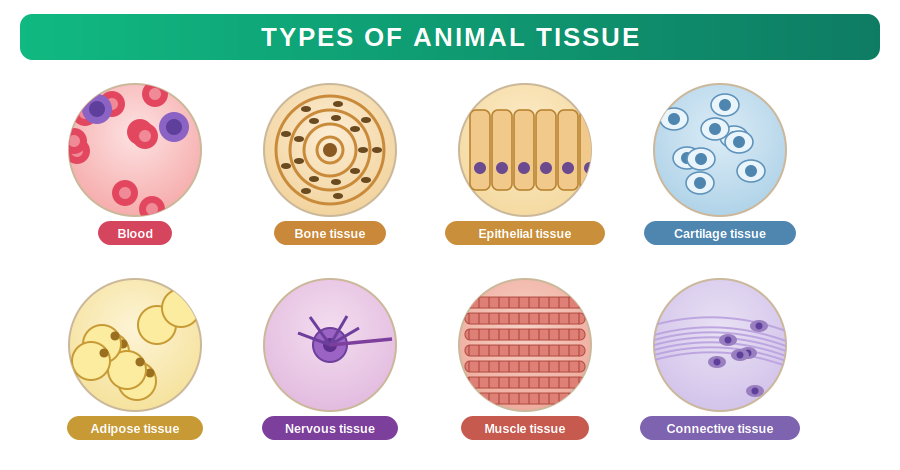
Core idea All animal organs are built from four tissues: epithelial (covering and lining), connective (binding and supporting), muscular (movement) and nervous (control).
|
|
Diagram 1 – The Four Animal Tissues
Fig 1. Animal organs are built from four tissues: epithelial, connective, muscular and nervous. |
2. Epithelial Tissue |
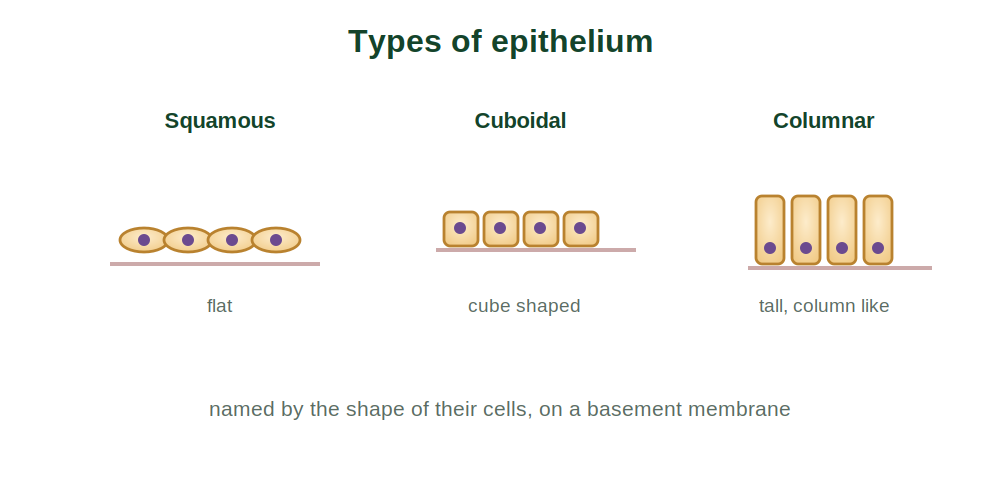
Epithelial tissue covers the outside of the body and lines its inner surfaces and cavities, forming a protective and sometimes absorbing boundary. Its cells sit closely packed on a base with little material between them. Epithelium is named by the shape of its cells: flat squamous, cube shaped cuboidal or tall columnar, each suited to a different surface.
|
Diagram 2 – Types of Epithelium
Fig 2. Epithelium is named by cell shape: flat squamous, cube shaped cuboidal and tall columnar. |
3. Connective Tissue |
Connective tissue binds, supports and links the other tissues, and is the most widespread tissue in the body. Its cells are spread out in a large amount of material between them, the matrix, which may be fluid as in blood, firm as in cartilage, or hard as in bone. Connective tissue holds the body together, stores energy as fat, and carries materials in the blood.
4. Muscular Tissue |
Muscular tissue is made of long cells that can contract, producing movement. There are three kinds: skeletal muscle, attached to bones and under our control, that moves the body; smooth muscle in the walls of internal organs, working automatically; and cardiac muscle, found only in the heart, which contracts tirelessly throughout life.
5. Nervous Tissue |
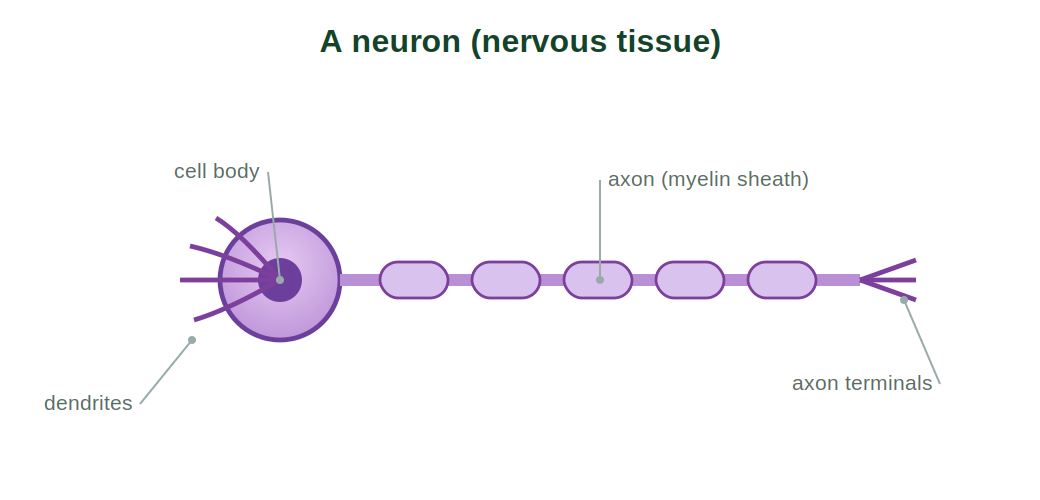
Nervous tissue controls and coordinates the body by carrying electrical signals. Its basic unit is the neuron, a cell with branching dendrites that receive signals, a cell body, and a long axon that passes the signal on to the next cell. A network of neurons lets the animal sense its surroundings and respond quickly and precisely.
|
Diagram 3 – A Neuron
Fig 3. A neuron receives signals through its dendrites and passes them along its axon to the next cell. |
6. Organs and Organ Systems |
The four tissues combine into organs, each performing a particular task, such as the stomach or the heart. Organs that cooperate on a larger function form an organ system, such as the digestive system or the circulatory system. The whole animal is the sum of these systems working together, each built from the same four basic tissues.
7. Key Reasoning (Principles) |
|
Principle 1: Four tissues build every organ Every organ in the animal body is assembled from epithelial, connective, muscular and nervous tissue, combined in different proportions for different tasks. |
|
Principle 2: Structure of a tissue fits its role Flat squamous epithelium suits surfaces for exchange, fluid connective tissue carries materials, contractile muscle moves, and neurons signal, each form matching its function. |
|
Principle 3: Organisation rises tissue to system Cells form tissues, tissues form organs, and organs form systems, so that simple units combine into a body capable of complex life. |
8. Worked Examples |
| Example 1 |
|
Q: Name the four basic animal tissues. ▶ Show SolutionEpithelial, connective, muscular and nervous. Answer: Epithelial, connective, muscular, nervous. |
| Example 2 |
|
Q: What is the role of epithelial tissue? ▶ Show SolutionIt covers the body and lines its surfaces and cavities. Answer: Covering and lining. |
| Example 3 |
|
Q: How is epithelium named? ▶ Show SolutionBy the shape of its cells, squamous, cuboidal or columnar. Answer: By cell shape. |
| Example 4 |
|
Q: What is the matrix of a connective tissue? ▶ Show SolutionThe material between the cells, which may be fluid, firm or hard. Answer: Material between the cells. |
| Example 5 |
|
Q: Name a connective tissue with a fluid matrix. ▶ Show SolutionBlood has a fluid matrix. Answer: Blood. |
| Example 6 |
|
Q: Which muscle is under our voluntary control? ▶ Show SolutionSkeletal muscle, attached to bones, is voluntary. Answer: Skeletal muscle. |
| Example 7 |
|
Q: Which muscle is found only in the heart? ▶ Show SolutionCardiac muscle is found only in the heart. Answer: Cardiac muscle. |
| Example 8 |
|
Q: What is the basic unit of nervous tissue? ▶ Show SolutionThe neuron is the basic unit of nervous tissue. Answer: The neuron. |
| Example 9 |
|
Q: Which part of a neuron passes the signal to the next cell? ▶ Show SolutionThe long axon passes the signal onward. Answer: The axon. |
| Example 10 |
|
Q: What do organs combine to form? ▶ Show SolutionOrgans working together form an organ system. Answer: An organ system. |
9. Practice Sets A to D |
| Set A – Multiple Choice (Basic) |
|
1. The tissue that covers and lines the body is: (a) connective (b) epithelial (c) muscular (d) nervous 2. Blood is an example of: (a) epithelial (b) connective (c) muscular (d) nervous tissue 3. Muscle found only in the heart is: (a) skeletal (b) smooth (c) cardiac (d) striated 4. The basic unit of nervous tissue is the: (a) axon (b) neuron (c) dendrite (d) synapse 5. Flat epithelial cells are called: (a) cuboidal (b) columnar (c) squamous (d) striated ▶ Reveal Answers1. (b) epithelial. 2. (b) connective. 3. (c) cardiac. 4. (b) neuron. 5. (c) squamous. |
| Set B – Short Answer (Understanding) |
|
1. Name the four animal tissues and a role of each. 2. How is epithelium classified? 3. What is the matrix, and give three forms it can take? 4. Name the three types of muscle. 5. Describe the parts of a neuron. ▶ Reveal Answers1. Epithelial (covering), connective (binding), muscular (movement) and nervous (control). 2. By the shape of its cells: squamous, cuboidal or columnar. 3. The material between connective tissue cells; it may be fluid (blood), firm (cartilage) or hard (bone). 4. Skeletal, smooth and cardiac. 5. Branching dendrites that receive signals, a cell body, and a long axon that passes the signal on. |
| Set C – Application and Reasoning |
|
1. Which tissue would line the inside of the stomach? 2. Which muscle works automatically in the gut wall? 3. Why is flat squamous epithelium suited to surfaces of exchange? 4. What level of organisation is the heart? 5. Which tissue allows quick response to a stimulus? ▶ Reveal Answers1. Epithelial tissue. 2. Smooth muscle. 3. Because its thinness lets materials pass through easily. 4. An organ. 5. Nervous tissue. |
| Set D – Higher Order (Challenge) |
|
1. Explain how an organ such as the stomach contains all four tissues. 2. Relate the structure of a neuron to its function of signalling. 3. Explain why connective tissue is the most widespread tissue in the body. 4. Compare voluntary and involuntary muscle with examples. 5. Trace the levels of organisation from a cell to the whole animal. ▶ Reveal Answers1. The stomach is lined by epithelium, supported and supplied by connective tissue, moved by muscle, and controlled by nervous tissue. 2. Dendrites gather signals, the cell body integrates them, and the long axon carries the signal quickly to the next cell. 3. Because it binds and supports all the other tissues and includes blood, bone, cartilage and fat throughout the body. 4. Skeletal muscle is voluntary and moves bones; smooth and cardiac muscle are involuntary, in the gut and heart respectively. 5. Cells form tissues, tissues form organs, organs form organ systems, and the systems together form the animal. |
|
Chapter Summary
|
|||||||||||||||||||||||||||||||
| 8-Point Exam Quick-Check | ||||||||||||||||||||||||||||||||
|
||||||||||||||||||||||||||||||||
|
School Revise Virtual Lab Explore these ideas with interactive simulations and visual tools.
|
|
Class 11 Biology Chapter 7: Structural Organisation in Animals, Complete Notes and Practice This revision guide follows the current NCERT Class 11 Biology syllabus and develops structural organisation in animals, covering the levels from cell to organ system and the four basic tissues, epithelial, connective, muscular and nervous, with the shapes of epithelium, the types of muscle, the structure of the neuron, and the way tissues combine into organs and systems, with three diagrams, ten worked examples and graded practice. Visit SchoolRevise.com to revise, practise and excel. |
 Google