Curriculum
Science Grade XI Biology
Science Grade XI Biology
0/19
-
Chapter 1: The Living World
 Preview
 -
Chapter 2: Biological Classification
Preview
-
Chapter 3: Plant Kingdom
Preview
-
Chapter 4: Animal Kingdom
Preview
-
Chapter 5: Morphology of Flowering Plants
Preview
-
Chapter 6: Anatomy of Flowering Plants
Preview
-
Chapter 7: Structural Organisation in Animals
Preview
-
Chapter 8: Cell: The Unit of Life
Preview
-
Chapter 9: Biomolecules
Preview
-
Chapter 10: Cell Cycle and Cell Division
Preview
-
Chapter 11: Photosynthesis in Higher Plants
Preview
-
Chapter 12: Respiration in Plants
Preview
-
Chapter 13: Plant Growth and Development
Preview
-
Chapter 14: Breathing and Exchange of Gases
Preview
-
Chapter 15: Body Fluids and Circulation
Preview
-
Chapter 16: Excretory Products and their Elimination
Preview
-
Chapter 17: Locomotion and Movement
Preview
-
Chapter 18: Neural Control and Coordination
Preview
-
Chapter 19: Chemical Coordination and Integration
Preview
Work Sheets
0/19

Chapter 13: Plant Growth and Development
|
Grade 11 Science | Chapter 13 Plant Growth and DevelopmentPlants grow throughout their lives. This chapter develops growth and its phases, where growth happens, the plant hormones that control it, and how plants respond to their surroundings.
|
|
Contents
|
1. Introduction: Growth and Development |
Unlike most animals, plants grow throughout their lives. Growth is a permanent increase in size, while development is the whole sequence of changes from a seed to a mature plant. This chapter looks at how growth proceeds, where in the plant it occurs, and the hormones and signals that guide it.
|
Core idea Plants grow at meristems in a typical S-shaped pattern. Hormones coordinate growth and development, and plants respond to light, gravity and other stimuli by directed growth called tropisms.
|
2. The Phases of Growth |
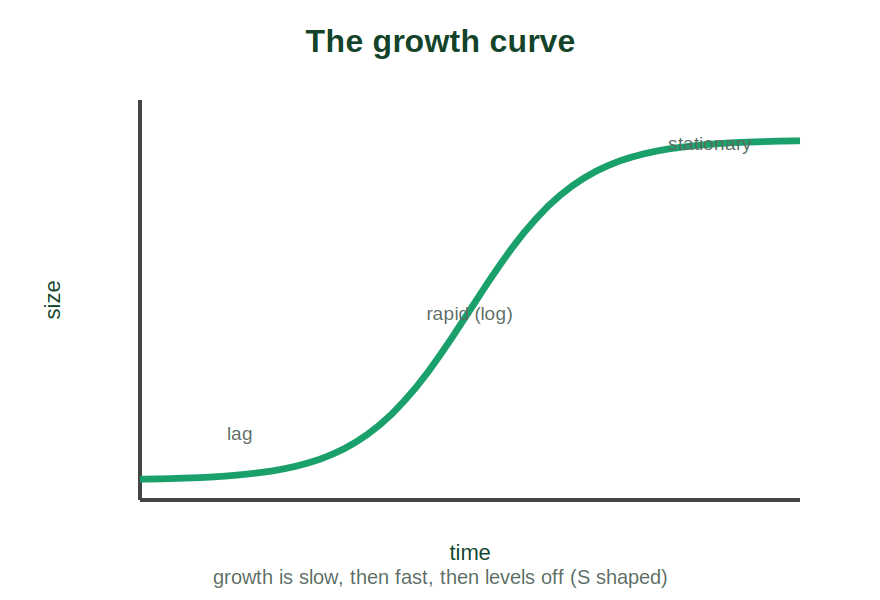
When growth is measured over time it follows a typical S-shaped curve with three phases. In the lag phase growth is slow as the plant prepares. In the rapid or log phase growth is fast as cells divide and enlarge. In the stationary phase growth slows and levels off as the plant matures. The same pattern appears in a single organ or a whole plant.
|
Diagram 1 – The Growth Curve
Fig 1. Growth is slow at first, then rapid, then levels off, giving an S-shaped curve. |
3. Where Growth Happens |
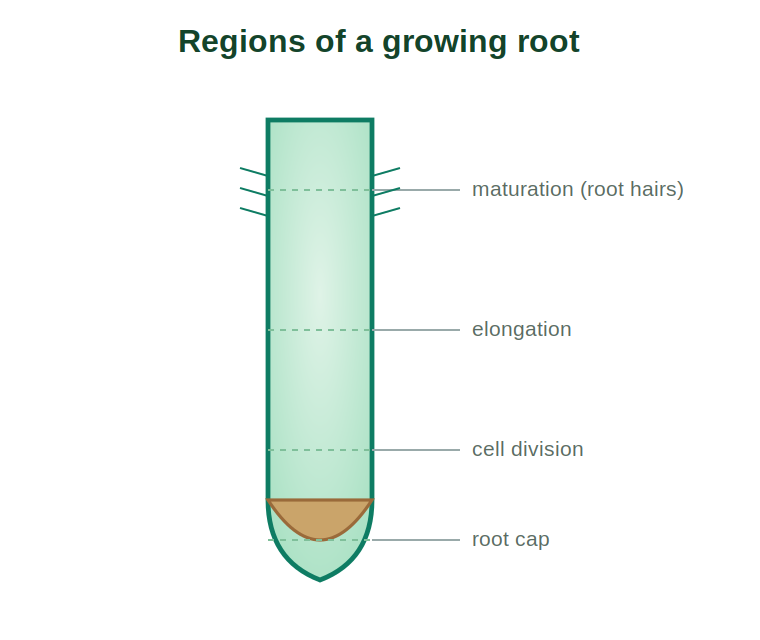
Growth is concentrated in regions of dividing cells called meristems, found at the tips of roots and shoots. Just behind the protective root cap lies the zone of cell division, then the zone of elongation where cells lengthen, and then the zone of maturation where cells specialise and root hairs appear. So a root grows mainly at its tip.
|
Diagram 2 – Regions of a Growing Root
Fig 2. A root grows in zones, from the dividing cells behind the cap, through elongation, to maturation. |
4. Plant Hormones |
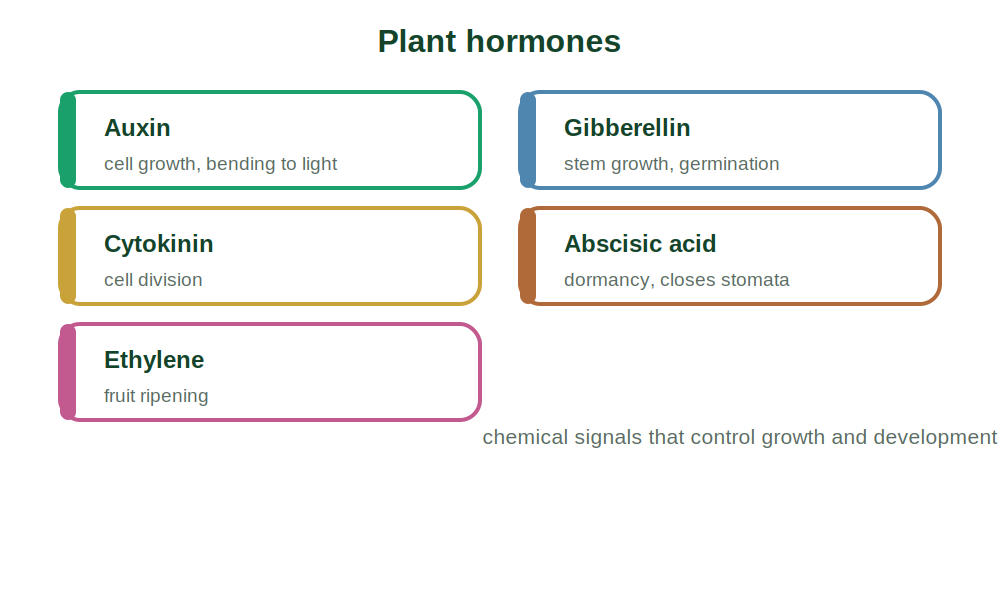
Growth is coordinated by chemical signals called plant hormones. Auxin drives cell growth and the bending of a shoot toward light. Gibberellins promote stem growth and seed germination. Cytokinins promote cell division. Abscisic acid brings on dormancy and closes the leaf pores in dry conditions, while ethylene ripens fruit. Together they balance growth against the conditions.
|
Diagram 3 – Plant Hormones
Fig 3. The main plant hormones and the growth processes they control. |
5. Responses to Stimuli (Tropisms) |
Plants cannot move, but they respond to their surroundings by directed growth called a tropism. In phototropism a shoot grows toward light, because auxin gathers on the shaded side and makes it grow faster, bending the shoot. In gravitropism roots grow downward and shoots upward in response to gravity. These responses help the plant reach light, water and support.
6. Development and Differentiation |
Beyond simply getting bigger, a plant develops: its cells differentiate into the many specialised types, and organs form in the right places at the right times. The same set of genes can give rise to a root cell or a leaf cell depending on signals. Development also includes events such as flowering, which many plants time by the length of day and night.
7. Key Reasoning (Principles) |
|
Principle 1: Growth is concentrated at meristems Because only meristematic cells divide, growth happens mainly at the tips of roots and shoots, and a root lengthens just behind its cap. |
|
Principle 2: Hormones coordinate growth Chemical signals such as auxin, gibberellins and cytokinins control where and how fast the plant grows, balancing growth against the conditions. |
|
Principle 3: Directed growth lets a fixed plant respond Through tropisms a plant grows toward or away from a stimulus such as light or gravity, so even without moving it can reach what it needs. |
8. Worked Examples |
| Example 1 |
|
Q: What is the difference between growth and development? ▶ Show SolutionGrowth is an increase in size; development is the whole sequence of changes from seed to mature plant. Answer: Size versus the whole change. |
| Example 2 |
|
Q: What shape is the typical growth curve? ▶ Show SolutionAn S shape. Answer: An S shape. |
| Example 3 |
|
Q: Name the three phases of growth. ▶ Show SolutionLag, rapid (log) and stationary. Answer: Lag, rapid, stationary. |
| Example 4 |
|
Q: Where is growth concentrated in a plant? ▶ Show SolutionAt the meristems, at the tips of roots and shoots. Answer: At the meristems. |
| Example 5 |
|
Q: Name the zones of a growing root from the tip. ▶ Show SolutionRoot cap, cell division, elongation and maturation. Answer: Cap, division, elongation, maturation. |
| Example 6 |
|
Q: Which hormone makes a shoot bend toward light? ▶ Show SolutionAuxin. Answer: Auxin. |
| Example 7 |
|
Q: Which hormone ripens fruit? ▶ Show SolutionEthylene. Answer: Ethylene. |
| Example 8 |
|
Q: What is a tropism? ▶ Show SolutionA directed growth response of a plant to a stimulus. Answer: A directed growth response. |
| Example 9 |
|
Q: In which direction do roots grow in response to gravity? ▶ Show SolutionDownward. Answer: Downward. |
| Example 10 |
|
Q: What is differentiation? ▶ Show SolutionThe process by which cells become specialised for particular jobs. Answer: Cells becoming specialised. |
9. Practice Sets A to D |
| Set A – Multiple Choice (Basic) |
|
1. The growth curve is shaped like the letter: (a) V (b) S (c) L (d) T 2. Growth is concentrated at the: (a) leaves (b) meristems (c) flowers (d) bark 3. The hormone that bends a shoot to light is: (a) ethylene (b) auxin (c) cytokinin (d) abscisic acid 4. Fruit ripening is promoted by: (a) auxin (b) ethylene (c) gibberellin (d) cytokinin 5. A root growing downward shows: (a) phototropism (b) gravitropism (c) dormancy (d) ripening ▶ Reveal Answers1. (b) S. 2. (b) meristems. 3. (b) auxin. 4. (b) ethylene. 5. (b) gravitropism. |
| Set B – Short Answer (Understanding) |
|
1. Define growth and development. 2. Name the three phases of the growth curve. 3. List the zones of a growing root. 4. Name three plant hormones and a role of each. 5. What is a tropism? ▶ Reveal Answers1. Growth is a permanent increase in size; development is the full sequence of changes from seed to mature plant. 2. Lag, rapid (log) and stationary. 3. Root cap, zone of cell division, zone of elongation and zone of maturation. 4. Auxin (growth and bending to light), gibberellin (stem growth and germination), cytokinin (cell division). 5. A directed growth response to a stimulus such as light or gravity. |
| Set C – Application and Reasoning |
|
1. A shoot on a windowsill bends toward the window. Name the response. 2. Which hormone causes that bending? 3. Where does a root grow fastest? 4. Which hormone helps a plant survive drought, and how? 5. Why does a seedling root grow downward? ▶ Reveal Answers1. Phototropism. 2. Auxin. 3. Just behind the tip, in the zones of division and elongation. 4. Abscisic acid, which closes the leaf pores to reduce water loss. 5. Because of gravitropism, the directed growth response to gravity. |
| Set D – Higher Order (Challenge) |
|
1. Explain how auxin causes a shoot to bend toward light. 2. Explain why the growth curve levels off in the stationary phase. 3. Explain why growth being at meristems means a tree gets taller only at its tips. 4. Explain how a plant, though fixed, can still reach light and water. 5. Explain how the same genes can make different cell types. ▶ Reveal Answers1. Auxin gathers on the shaded side of the shoot and makes those cells grow longer, so that side lengthens more and the shoot bends toward the light. 2. Because the plant or organ approaches its mature size and cell division and enlargement slow down. 3. Because the dividing cells are at the shoot tips, so new length is added there, while older parts do not lengthen. 4. Through tropisms, growing toward light and downward toward water, it positions itself without moving. 5. Signals switch different genes on or off in different places, so cells differentiate into roots, leaves or other types. |
|
Chapter Summary
|
|||||||||||||||||||||||||||||||
| 8-Point Exam Quick-Check | ||||||||||||||||||||||||||||||||
|
||||||||||||||||||||||||||||||||
|
School Revise Virtual Lab Explore these ideas with interactive simulations and visual tools.
|
|
Class 11 Biology Chapter 13: Plant Growth and Development, Complete Notes and Practice This revision guide follows the current NCERT Class 11 Biology syllabus and develops plant growth, covering growth and development, the S-shaped growth curve with its lag, rapid and stationary phases, the meristems and zones of a growing root, the plant hormones such as auxin, gibberellin, cytokinin, abscisic acid and ethylene, and the directed growth responses called tropisms, with three diagrams, ten worked examples and graded practice. Visit SchoolRevise.com to revise, practise and excel. |
 Google