Curriculum
Science Grade XI Biology
Science Grade XI Biology
0/19
-
Chapter 1: The Living World
 Preview
 -
Chapter 2: Biological Classification
Preview
-
Chapter 3: Plant Kingdom
Preview
-
Chapter 4: Animal Kingdom
Preview
-
Chapter 5: Morphology of Flowering Plants
Preview
-
Chapter 6: Anatomy of Flowering Plants
Preview
-
Chapter 7: Structural Organisation in Animals
Preview
-
Chapter 8: Cell: The Unit of Life
Preview
-
Chapter 9: Biomolecules
Preview
-
Chapter 10: Cell Cycle and Cell Division
Preview
-
Chapter 11: Photosynthesis in Higher Plants
Preview
-
Chapter 12: Respiration in Plants
Preview
-
Chapter 13: Plant Growth and Development
Preview
-
Chapter 14: Breathing and Exchange of Gases
Preview
-
Chapter 15: Body Fluids and Circulation
Preview
-
Chapter 16: Excretory Products and their Elimination
Preview
-
Chapter 17: Locomotion and Movement
Preview
-
Chapter 18: Neural Control and Coordination
Preview
-
Chapter 19: Chemical Coordination and Integration
Preview
Work Sheets
0/19

Chapter 6: Anatomy of Flowering Plants
|
Grade 11 Science | Chapter 6 Anatomy of Flowering PlantsAnatomy looks inside the plant. This chapter explains the meristematic and permanent tissues, the tissue systems, the internal structure of stem, root and leaf, and the conducting tissues xylem and phloem.
|
|
Contents
|
1. Introduction: Inside the Plant |
Anatomy is the study of the internal structure of an organism. A plant is built from tissues, groups of cells that work together. This chapter explains the two great classes of plant tissue, how they are arranged into systems, and how the inside of the stem, root and leaf is organised, including the tissues that carry water and food through the plant.
|
Core idea Plant tissues are either meristematic, still dividing to make new cells, or permanent, matured for a fixed task. The conducting tissues, xylem and phloem, carry water and food.
|
2. Meristematic Tissue |
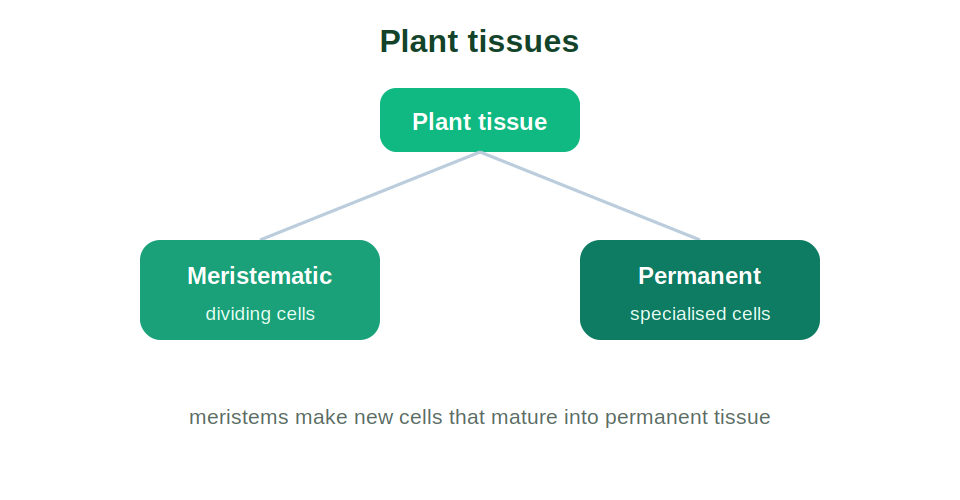
Meristematic tissue is made of small, thin walled cells that keep dividing to produce new cells, found at the growing tips of roots and shoots and in a ring within the stem. Growth in length comes from the tips, while growth in girth comes from the side meristems. All other tissues of the plant are formed from meristematic cells.
|
Diagram 1 – Plant Tissues
Fig 1. Plant tissues are meristematic (dividing) or permanent (specialised); meristems give rise to permanent tissue. |
3. Permanent Tissue |
Permanent tissue is made of cells that have stopped dividing and taken on a fixed form and function. Simple permanent tissues are made of one cell type, such as the soft packing tissue or the supporting tissue, while complex permanent tissues contain several cell types working together, as in the conducting tissues. Permanent tissues form the bulk of the mature plant body.
4. Tissue Systems and the Stem |
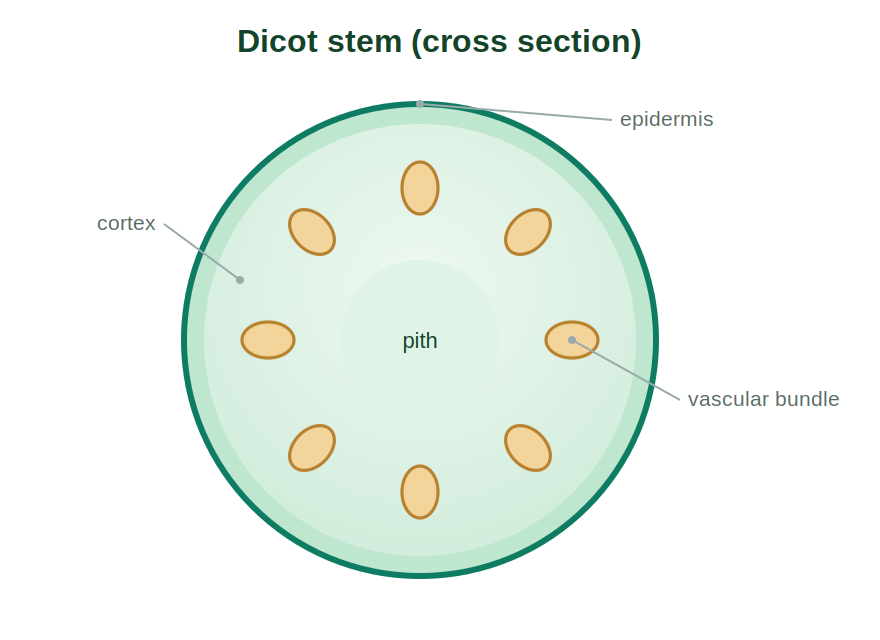
The tissues are grouped into systems. The epidermis is the protective outer layer; the ground tissue, including the cortex and pith, fills most of the body; and the vascular tissue conducts water and food. In a dicot stem the vascular bundles are arranged in a ring near the edge, with a central pith, while in a monocot stem they are scattered.
|
Diagram 2 – Dicot Stem in Cross Section
Fig 2. A dicot stem has an outer epidermis, a cortex, vascular bundles arranged in a ring, and a central pith. |
5. Xylem and Phloem |
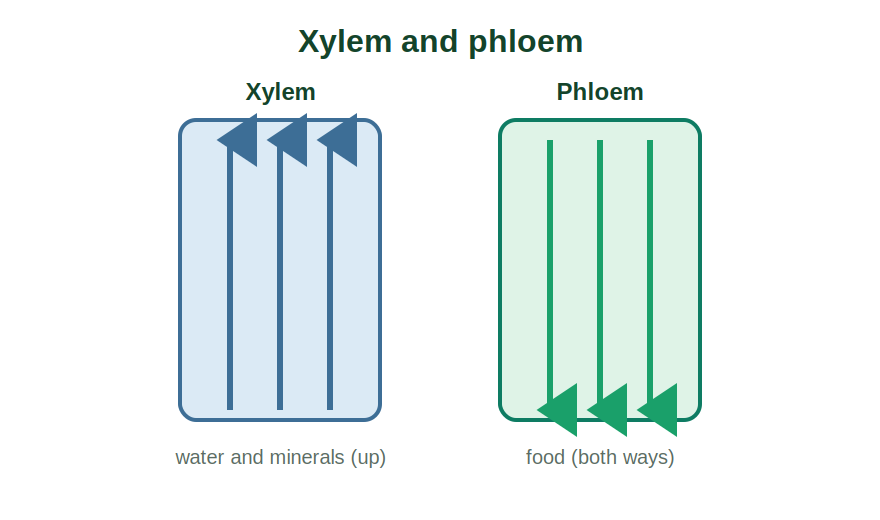
The vascular tissue has two parts. Xylem conducts water and minerals upward from the roots and also supports the plant; its main cells are dead, hollow tubes. Phloem conducts food, made in the leaves, to all parts of the plant, in either direction; its cells are living. Together they form a continuous transport network from root to leaf.
|
Diagram 3 – Xylem and Phloem
Fig 3. Xylem carries water and minerals upward; phloem carries food made in the leaves throughout the plant. |
6. Anatomy of Root and Leaf |
The same tissue systems appear in the root and leaf, arranged for their tasks. The root has a surface layer with fine root hairs that increase the area for absorbing water, with vascular tissue at its centre. The leaf has an outer epidermis, often with a waxy layer to reduce water loss, packed inside with photosynthetic tissue and threaded with veins of xylem and phloem, and dotted with tiny pores called stomata for gas exchange.
7. Key Reasoning (Principles) |
|
Principle 1: Meristems are the source of all tissue Because only meristematic cells divide, all the permanent tissues of the plant trace back to them, and growth occurs only where meristems are active. |
|
Principle 2: Tissue systems suit their position The epidermis protects, the ground tissue fills and stores, and the vascular tissue conducts, each placed where its task is best performed. |
|
Principle 3: Xylem and phloem move opposite cargoes Xylem carries water and minerals upward in dead tubes, while phloem carries food in living cells, so the two together supply every part of the plant. |
8. Worked Examples |
| Example 1 |
|
Q: What are the two main classes of plant tissue? ▶ Show SolutionMeristematic (dividing) and permanent (specialised). Answer: Meristematic and permanent. |
| Example 2 |
|
Q: Where is meristematic tissue found? ▶ Show SolutionAt the growing tips of roots and shoots and in side meristems. Answer: At growing tips. |
| Example 3 |
|
Q: What is the difference between simple and complex permanent tissue? ▶ Show SolutionSimple tissue has one cell type; complex tissue has several. Answer: One versus several cell types. |
| Example 4 |
|
Q: Name the protective outer tissue system of a plant. ▶ Show SolutionThe epidermis is the protective outer layer. Answer: The epidermis. |
| Example 5 |
|
Q: How are vascular bundles arranged in a dicot stem? ▶ Show SolutionIn a ring near the edge, with a central pith. Answer: In a ring. |
| Example 6 |
|
Q: What does xylem conduct? ▶ Show SolutionXylem conducts water and minerals upward. Answer: Water and minerals. |
| Example 7 |
|
Q: What does phloem conduct? ▶ Show SolutionPhloem conducts food made in the leaves. Answer: Food. |
| Example 8 |
|
Q: Which conducting tissue is made of living cells? ▶ Show SolutionPhloem cells are living; xylem tubes are dead. Answer: Phloem. |
| Example 9 |
|
Q: What increases the surface area for water uptake in a root? ▶ Show SolutionThe fine root hairs increase the absorbing area. Answer: Root hairs. |
| Example 10 |
|
Q: What are the tiny pores in a leaf for gas exchange called? ▶ Show SolutionThe pores for gas exchange are the stomata. Answer: Stomata. |
9. Practice Sets A to D |
| Set A – Multiple Choice (Basic) |
|
1. Dividing plant cells form: (a) permanent (b) meristematic (c) vascular (d) epidermal tissue 2. The protective outer layer of a plant is the: (a) cortex (b) pith (c) epidermis (d) xylem 3. Xylem mainly carries: (a) food (b) water and minerals (c) air (d) hormones 4. Phloem is made of cells that are: (a) dead (b) living (c) hollow (d) woody 5. Pores for gas exchange in a leaf are: (a) veins (b) stomata (c) hairs (d) bundles ▶ Reveal Answers1. (b) meristematic. 2. (c) epidermis. 3. (b) water and minerals. 4. (b) living. 5. (b) stomata. |
| Set B – Short Answer (Understanding) |
|
1. Distinguish meristematic from permanent tissue. 2. Name the three tissue systems of a plant. 3. How do vascular bundles differ between dicot and monocot stems? 4. State the functions of xylem and phloem. 5. What is the role of root hairs? ▶ Reveal Answers1. Meristematic tissue keeps dividing to make new cells; permanent tissue has matured for a fixed task. 2. The epidermis (protective), the ground tissue (filling and storage) and the vascular tissue (conducting). 3. In dicots they form a ring near the edge; in monocots they are scattered. 4. Xylem carries water and minerals upward and supports the plant; phloem carries food throughout. 5. They increase the surface area for absorbing water and minerals from the soil. |
| Set C – Application and Reasoning |
|
1. A stem has scattered vascular bundles. Dicot or monocot? 2. Why are xylem tubes hollow and dead? 3. Where does growth in length of a plant occur? 4. Why does a leaf have a waxy outer layer? 5. Which tissue makes all the others? ▶ Reveal Answers1. Monocot. 2. So that water can flow freely up the empty tubes without obstruction. 3. At the meristems in the growing tips. 4. To reduce the loss of water by evaporation. 5. Meristematic tissue. |
| Set D – Higher Order (Challenge) |
|
1. Explain why a plant can grow in both length and girth. 2. Explain how xylem and phloem together meet the needs of a leaf. 3. A root tip is removed. Predict the effect on the root and explain. 4. Explain why the epidermis of a leaf has stomata as well as a waxy layer. 5. Relate the arrangement of vascular bundles to the support of a dicot stem. ▶ Reveal Answers1. Tip meristems add length while side meristems add girth, so both kinds of growth are possible. 2. Xylem brings water and minerals to the leaf for photosynthesis, and phloem carries away the food it makes. 3. The root stops growing in length, because the tip meristem that makes new cells has been removed. 4. The waxy layer cuts water loss, while the stomata still allow the gas exchange needed for photosynthesis. 5. The ring of bundles near the edge stiffens the stem against bending, like girders near the surface of a beam. |
|
Chapter Summary
|
|||||||||||||||||||||||||||||||
| 8-Point Exam Quick-Check | ||||||||||||||||||||||||||||||||
|
||||||||||||||||||||||||||||||||
|
School Revise Virtual Lab Explore these ideas with interactive simulations and visual tools.
|
|
Class 11 Biology Chapter 6: Anatomy of Flowering Plants, Complete Notes and Practice This revision guide follows the current NCERT Class 11 Biology syllabus and develops plant anatomy, covering the meristematic and permanent tissues, the simple and complex tissue types, the epidermal, ground and vascular tissue systems, the internal arrangement of dicot and monocot stems, and the conducting tissues xylem and phloem along with root and leaf structure, with three diagrams, ten worked examples and graded practice. Visit SchoolRevise.com to revise, practise and excel. |
 Google