Curriculum
Science Grade XI Biology
Science Grade XI Biology
0/19
-
Chapter 1: The Living World
 Preview
 -
Chapter 2: Biological Classification
Preview
-
Chapter 3: Plant Kingdom
Preview
-
Chapter 4: Animal Kingdom
Preview
-
Chapter 5: Morphology of Flowering Plants
Preview
-
Chapter 6: Anatomy of Flowering Plants
Preview
-
Chapter 7: Structural Organisation in Animals
Preview
-
Chapter 8: Cell: The Unit of Life
Preview
-
Chapter 9: Biomolecules
Preview
-
Chapter 10: Cell Cycle and Cell Division
Preview
-
Chapter 11: Photosynthesis in Higher Plants
Preview
-
Chapter 12: Respiration in Plants
Preview
-
Chapter 13: Plant Growth and Development
Preview
-
Chapter 14: Breathing and Exchange of Gases
Preview
-
Chapter 15: Body Fluids and Circulation
Preview
-
Chapter 16: Excretory Products and their Elimination
Preview
-
Chapter 17: Locomotion and Movement
Preview
-
Chapter 18: Neural Control and Coordination
Preview
-
Chapter 19: Chemical Coordination and Integration
Preview
Work Sheets
0/19

Chapter 14: Breathing and Exchange of Gases
|
Grade 11 Science | Chapter 14 Breathing and Exchange of GasesThe body needs oxygen and must remove carbon dioxide. This chapter develops the respiratory system, the mechanism of breathing, and gas exchange at the alveoli.
|
|
Contents
|
1. Introduction: Why We Breathe |
Every cell needs oxygen to release energy from food, and every cell produces carbon dioxide as waste. Breathing brings fresh air into the body and removes the used air, so that oxygen can be taken up and carbon dioxide given off. This chapter follows the air’s path and the exchange of gases.
|
Core idea Breathing moves air in and out of the lungs. At the thin walled alveoli, oxygen passes into the blood and carbon dioxide passes out, the real purpose of breathing.
|
2. The Respiratory System |
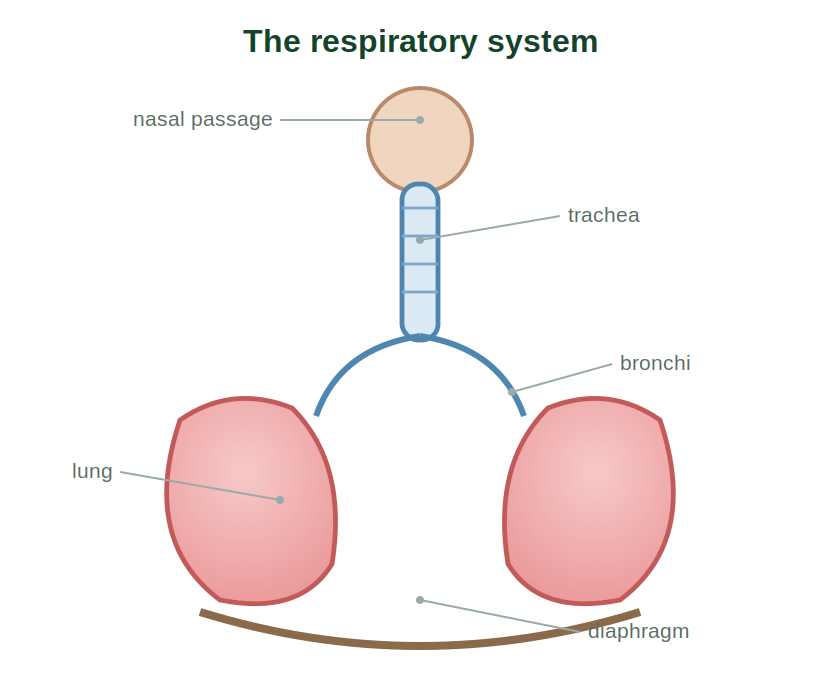
Air enters through the nose, where it is warmed and cleaned, and passes down the trachea, a tube held open by rings. The trachea divides into two bronchi, one to each lung, and these branch again and again into ever finer tubes ending in tiny air sacs. Below the lungs lies a sheet of muscle, the diaphragm, which drives breathing.
|
Diagram 1 – The Respiratory System
Fig 1. Air passes from the nose down the trachea, through the bronchi, into the lungs, above the diaphragm. |
3. The Mechanism of Breathing |
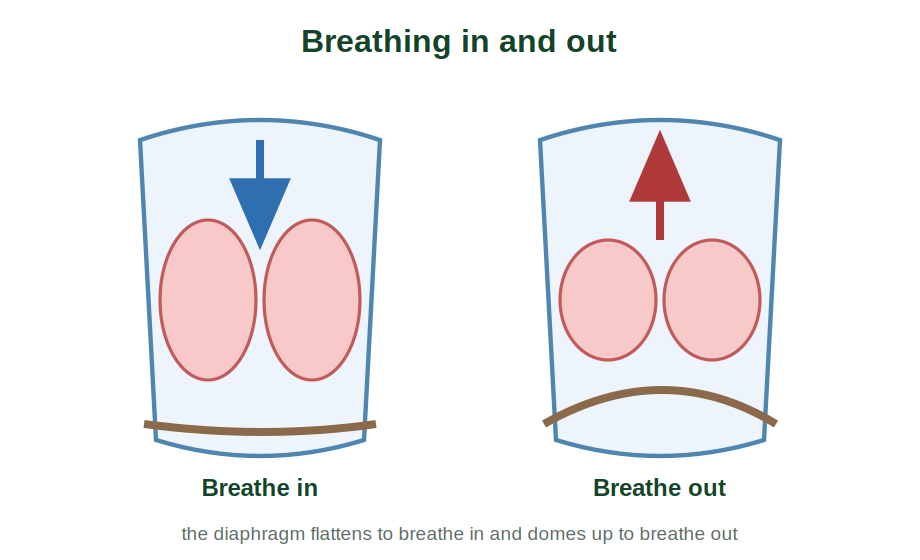
Breathing is caused by changes in the size of the chest. To breathe in, the diaphragm flattens and the ribs lift, making the chest bigger, so air rushes into the lungs. To breathe out, the diaphragm domes upward and the ribs fall, making the chest smaller, so air is pushed out. Breathing is mostly automatic, controlled by the brain.
|
Diagram 2 – Breathing In and Out
Fig 2. The diaphragm flattens to draw air in and domes up to push air out. |
4. Gas Exchange in the Alveoli |
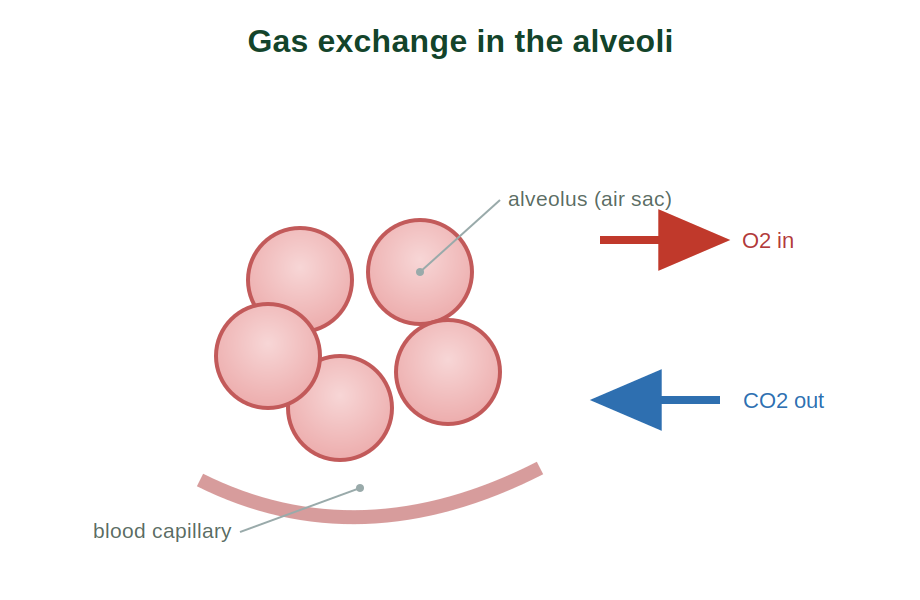
The real exchange happens in millions of tiny air sacs called alveoli. Each alveolus has a very thin wall wrapped in blood capillaries. Oxygen passes from the air in the alveolus into the blood, while carbon dioxide passes from the blood into the alveolus to be breathed out. The huge number of alveoli gives an enormous surface for this exchange.
|
Diagram 3 – Gas Exchange in the Alveoli
Fig 3. At the alveolus, oxygen passes into the blood and carbon dioxide passes out. |
5. Transport of Gases |
Once in the blood, oxygen is carried mostly by the red pigment haemoglobin in the red blood cells, which picks up oxygen in the lungs and releases it to the body’s cells. Carbon dioxide is carried back, mostly dissolved in the blood, from the cells to the lungs. So the blood is the carrier that links breathing to every cell.
6. Breathing and Respiration Compared |
It is important not to confuse the two. Breathing is the physical movement of air in and out of the lungs and the exchange of gases. Respiration is the chemical process inside cells that releases energy from food using that oxygen. Breathing supplies the oxygen and removes the carbon dioxide that respiration needs and makes.
7. Key Reasoning (Principles) |
|
Principle 1: Breathing serves gas exchange The movement of air in and out exists so that oxygen can reach the blood and carbon dioxide can leave it, at the alveoli. |
|
Principle 2: Size change drives air flow When the diaphragm and ribs enlarge the chest, air flows in; when they shrink it, air flows out, so muscle action moves the air. |
|
Principle 3: A large thin surface speeds exchange The millions of thin walled alveoli wrapped in capillaries give a vast surface, so gases cross quickly between air and blood. |
8. Worked Examples |
| Example 1 |
|
Q: Why does the body need to breathe? ▶ Show SolutionTo take in oxygen for the cells and to remove carbon dioxide. Answer: For oxygen in and carbon dioxide out. |
| Example 2 |
|
Q: Name the tube that carries air from the nose toward the lungs. ▶ Show SolutionThe trachea. Answer: The trachea. |
| Example 3 |
|
Q: What are the tiny air sacs in the lungs called? ▶ Show SolutionThe alveoli. Answer: The alveoli. |
| Example 4 |
|
Q: Which muscle flattens when we breathe in? ▶ Show SolutionThe diaphragm. Answer: The diaphragm. |
| Example 5 |
|
Q: What happens to the chest when we breathe in? ▶ Show SolutionIt gets bigger, so air rushes in. Answer: It enlarges. |
| Example 6 |
|
Q: Which gas passes from the alveolus into the blood? ▶ Show SolutionOxygen. Answer: Oxygen. |
| Example 7 |
|
Q: Which gas passes from the blood into the alveolus? ▶ Show SolutionCarbon dioxide. Answer: Carbon dioxide. |
| Example 8 |
|
Q: What carries oxygen in the blood? ▶ Show SolutionHaemoglobin in the red blood cells. Answer: Haemoglobin. |
| Example 9 |
|
Q: Why do the lungs have millions of alveoli? ▶ Show SolutionTo give a very large surface for fast gas exchange. Answer: For a large exchange surface. |
| Example 10 |
|
Q: What is the difference between breathing and respiration? ▶ Show SolutionBreathing moves air; respiration releases energy in cells using oxygen. Answer: Air movement versus energy release. |
9. Practice Sets A to D |
| Set A – Multiple Choice (Basic) |
|
1. Air reaches the lungs through the: (a) gullet (b) trachea (c) ureter (d) artery 2. Gas exchange happens in the: (a) bronchi (b) alveoli (c) trachea (d) nose 3. Breathing in is caused by the diaphragm: (a) doming up (b) flattening (c) tearing (d) resting 4. Oxygen is carried in blood by: (a) plasma only (b) haemoglobin (c) platelets (d) white cells 5. Respiration is a: (a) physical movement (b) chemical energy release (c) gas (d) muscle ▶ Reveal Answers1. (b) trachea. 2. (b) alveoli. 3. (b) flattening. 4. (b) haemoglobin. 5. (b) chemical energy release. |
| Set B – Short Answer (Understanding) |
|
1. Trace the path of air from the nose to an alveolus. 2. Describe how breathing in happens. 3. What is exchanged at the alveoli? 4. How is oxygen carried in the blood? 5. Distinguish breathing from respiration. ▶ Reveal Answers1. Nose, trachea, bronchi, finer tubes, alveoli. 2. The diaphragm flattens and the ribs lift, the chest enlarges, and air rushes in. 3. Oxygen passes into the blood and carbon dioxide passes out. 4. Mostly by haemoglobin in the red blood cells. 5. Breathing moves air in and out; respiration releases energy in cells using the oxygen. |
| Set C – Application and Reasoning |
|
1. Why does the chest expand when we breathe in? 2. Why are alveoli walls very thin? 3. Why does hard exercise make us breathe faster? 4. Why is the trachea held open by rings? 5. Why is breathing automatic? ▶ Reveal Answers1. Because the diaphragm flattens and the ribs lift, enlarging the chest so air flows in. 2. So that gases can cross quickly between the air and the blood. 3. Because the muscles need more oxygen and make more carbon dioxide, so faster breathing supplies and removes them. 4. So it stays open for air to pass through at all times. 5. So the body keeps supplying oxygen and removing carbon dioxide without conscious effort. |
| Set D – Higher Order (Challenge) |
|
1. Explain how the structure of an alveolus suits gas exchange. 2. Explain why breathing and respiration depend on each other. 3. Explain what would happen to gas exchange if the alveoli were few and thick walled. 4. Explain how a single sheet of muscle can drive breathing. 5. Explain why blood is essential to link the lungs to the body’s cells. ▶ Reveal Answers1. It has a very thin wall, a large surface in great numbers, and a rich capillary supply, so gases cross quickly into and out of the blood. 2. Breathing supplies the oxygen and removes the carbon dioxide that respiration uses and produces, so neither works alone. 3. Exchange would be slow and limited, so the body could not get enough oxygen. 4. By flattening it enlarges the chest to draw air in, and by doming it shrinks the chest to push air out. 5. Because blood carries the oxygen from the lungs to the cells and returns the carbon dioxide, connecting the two. |
|
Chapter Summary
|
|||||||||||||||||||||||||||||||
| 8-Point Exam Quick-Check | ||||||||||||||||||||||||||||||||
|
||||||||||||||||||||||||||||||||
|
School Revise Virtual Lab Explore these ideas with interactive simulations and visual tools.
|
|
Class 11 Biology Chapter 14: Breathing and Exchange of Gases, Complete Notes and Practice This revision guide follows the current NCERT Class 11 Biology syllabus and develops breathing, covering the purpose of taking in oxygen and removing carbon dioxide, the respiratory pathway from nose to alveoli, the mechanism of breathing driven by the diaphragm and ribs, gas exchange at the alveoli, the transport of gases by haemoglobin and blood, and the difference between breathing and respiration, with three diagrams, ten worked examples and graded practice. Visit SchoolRevise.com to revise, practise and excel. |
 Google