Curriculum
Science Grade XI Biology
Science Grade XI Biology
0/19
-
Chapter 1: The Living World
 Preview
 -
Chapter 2: Biological Classification
Preview
-
Chapter 3: Plant Kingdom
Preview
-
Chapter 4: Animal Kingdom
Preview
-
Chapter 5: Morphology of Flowering Plants
Preview
-
Chapter 6: Anatomy of Flowering Plants
Preview
-
Chapter 7: Structural Organisation in Animals
Preview
-
Chapter 8: Cell: The Unit of Life
Preview
-
Chapter 9: Biomolecules
Preview
-
Chapter 10: Cell Cycle and Cell Division
Preview
-
Chapter 11: Photosynthesis in Higher Plants
Preview
-
Chapter 12: Respiration in Plants
Preview
-
Chapter 13: Plant Growth and Development
Preview
-
Chapter 14: Breathing and Exchange of Gases
Preview
-
Chapter 15: Body Fluids and Circulation
Preview
-
Chapter 16: Excretory Products and their Elimination
Preview
-
Chapter 17: Locomotion and Movement
Preview
-
Chapter 18: Neural Control and Coordination
Preview
-
Chapter 19: Chemical Coordination and Integration
Preview
Work Sheets
0/19

Chapter 4: Animal Kingdom
|
Grade 11 Science | Chapter 4 Animal KingdomAnimals show astonishing variety. This chapter explains the features used to classify them, levels of organisation, symmetry, germ layers and body cavity, and surveys the major phyla from sponges to chordates.
|
|
Contents
|
1. Introduction: Classifying Animals |
Kingdom Animalia contains many celled organisms that take in food and usually move. With more than a million known species, they are classified not by appearance but by a set of basic features of their body plan. This chapter explains those features, levels of organisation, symmetry, the number of germ layers and the presence of a body cavity, and then surveys the major phyla in which animals are grouped.
|
Core idea Animals are classified by body plan: their level of organisation, symmetry, number of germ layers and presence of a body cavity, which together place them in their phylum.
|
2. Levels of Organisation |
Animals differ in how their cells are organised. In sponges the cells work largely alone, the cellular level. In others, cells group into tissues that perform a task, then tissues form organs, and organs combine into organ systems, such as the digestive or nervous system. A higher level of organisation allows a more complex and efficient body.
3. Body Symmetry |
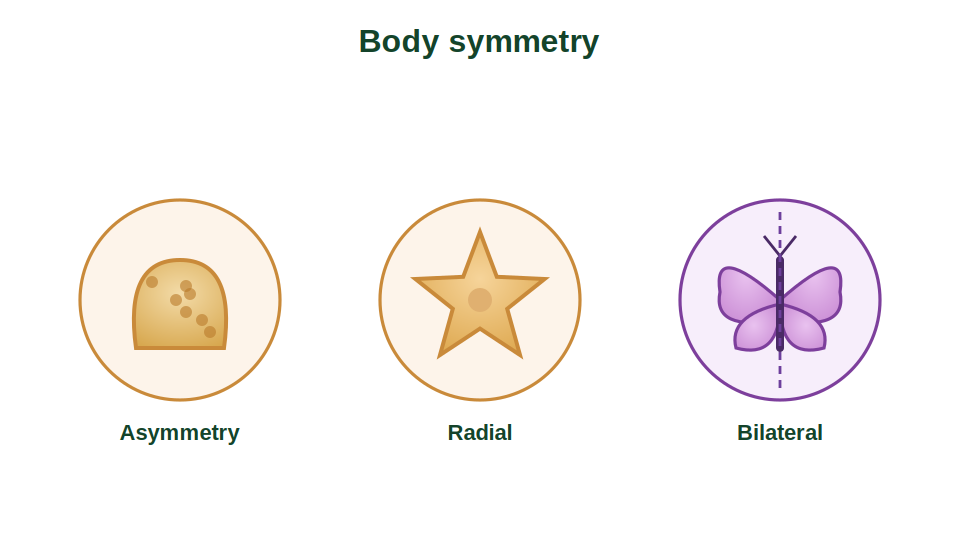
Symmetry describes how the body can be divided into matching halves. An asymmetrical animal, such as a sponge, has no plane of symmetry. A radially symmetrical animal, such as a jellyfish, can be cut into similar halves by any plane through its centre. A bilaterally symmetrical animal, such as a worm or a human, has only one such plane, giving a clear left and right, head and tail, which suits directed movement.
|
Diagram 1 – Body Symmetry
Fig 1. Animals may be asymmetrical, radially symmetrical or bilaterally symmetrical. |
4. Germ Layers and Body Cavity |
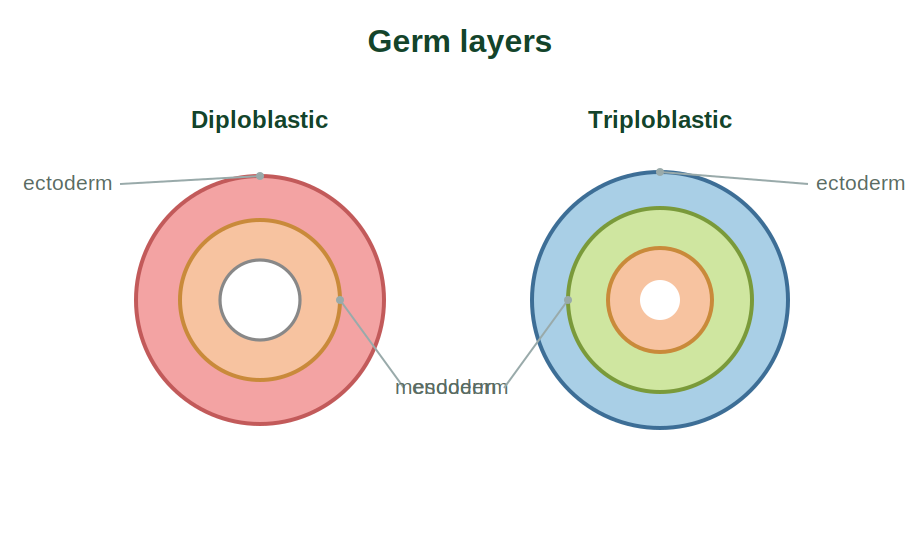
During development the embryo forms germ layers. Diploblastic animals have two layers, an outer ectoderm and an inner endoderm. Triploblastic animals add a middle mesoderm, from which muscles and many organs form, allowing far greater complexity. Triploblastic animals may also have a body cavity, the coelom, a fluid filled space that cushions the organs and lets them develop independently of the body wall.
|
Diagram 2 – Germ Layers
Fig 2. Diploblastic animals have two germ layers; triploblastic animals add a middle mesoderm. |
5. The Major Phyla |
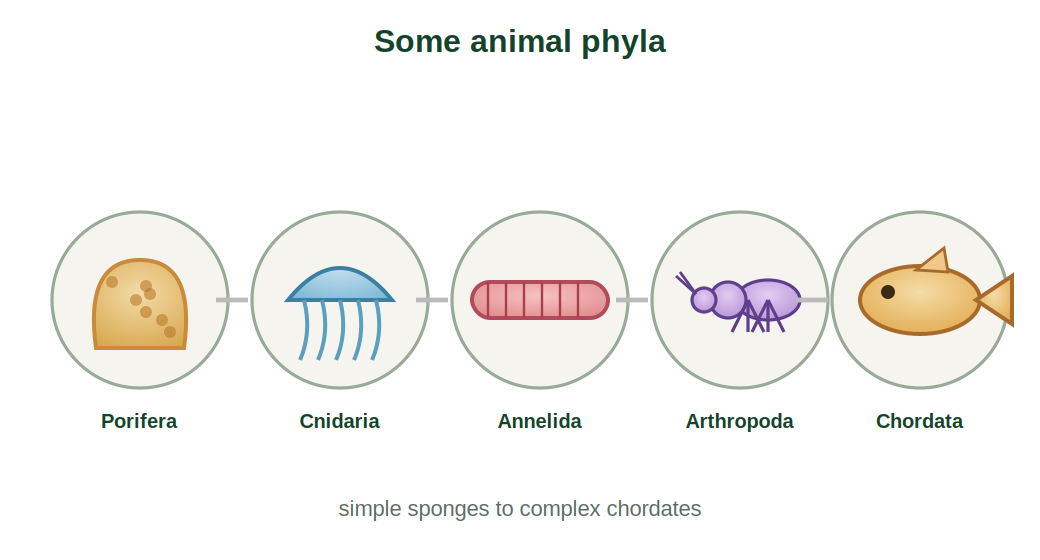
Using these features, animals are grouped into phyla. Porifera are the sponges, with a cellular level of organisation. Cnidaria, such as jellyfish, are radial and diploblastic. Platyhelminthes are flatworms, the first bilaterally symmetrical, triploblastic animals. Annelida are segmented worms with a true coelom, and Arthropoda, the largest phylum, includes insects and crabs with jointed legs and a hard exoskeleton.
|
Diagram 3 – Some Animal Phyla
Fig 3. The major animal phyla arranged from the simple sponges to the complex chordates. |
6. From Invertebrates to Chordates |
Most animals are invertebrates, lacking a backbone. The phylum Chordata is set apart by a stiffening rod called the notochord, a hollow nerve cord and gill slits at some stage of life. The vertebrates, animals with a backbone, are a part of this phylum and include fish, amphibians, reptiles, birds and mammals. The chordate body plan supports the largest and most active animals on Earth.
7. Key Reasoning (Principles) |
|
Principle 1: Body plan, not looks, classifies animals Animals are grouped by shared features of their body plan, level of organisation, symmetry, germ layers and coelom, rather than by superficial appearance. |
|
Principle 2: A third germ layer allows complexity The middle mesoderm of triploblastic animals forms muscles and organs and makes possible a coelom, supporting far more complex bodies than two layers can. |
|
Principle 3: Bilateral symmetry suits directed movement A single plane of symmetry gives a clear front and back, allowing a head to lead and organs to specialise, which suits active, directed movement. |
8. Worked Examples |
| Example 1 |
|
Q: On what basis are animals classified? ▶ Show SolutionBy basic features of their body plan, not appearance. Answer: Body plan features. |
| Example 2 |
|
Q: Name the highest level of organisation among animals. ▶ Show SolutionCells form tissues, then organs, then organ systems. The organ system level is highest. Answer: Organ system level. |
| Example 3 |
|
Q: What symmetry does a jellyfish show? ▶ Show SolutionA jellyfish can be cut into similar halves by any plane through the centre. Radial symmetry. Answer: Radial. |
| Example 4 |
|
Q: How many germ layers does a diploblastic animal have? ▶ Show SolutionA diploblastic animal has two germ layers. Answer: Two. |
| Example 5 |
|
Q: What is the middle germ layer called? ▶ Show SolutionThe middle layer in triploblastic animals is the mesoderm. Answer: Mesoderm. |
| Example 6 |
|
Q: What is the coelom? ▶ Show SolutionA fluid filled body cavity that cushions the organs. Answer: A body cavity. |
| Example 7 |
|
Q: Which phylum contains the sponges? ▶ Show SolutionThe sponges are in phylum Porifera. Answer: Porifera. |
| Example 8 |
|
Q: Which is the largest animal phylum? ▶ Show SolutionArthropoda, including insects and crabs, is the largest. Answer: Arthropoda. |
| Example 9 |
|
Q: What three features define a chordate? ▶ Show SolutionA notochord, a hollow nerve cord and gill slits at some stage. Answer: Notochord, nerve cord, gill slits. |
| Example 10 |
|
Q: What distinguishes a vertebrate from other chordates? ▶ Show SolutionA vertebrate has a backbone. Answer: A backbone. |
9. Practice Sets A to D |
| Set A – Multiple Choice (Basic) |
|
1. Animals are classified mainly by their: (a) colour (b) body plan (c) size (d) habitat 2. A jellyfish shows symmetry that is: (a) absent (b) radial (c) bilateral (d) spiral 3. A triploblastic animal has germ layers numbering: (a) one (b) two (c) three (d) four 4. The middle germ layer is the: (a) ectoderm (b) endoderm (c) mesoderm (d) coelom 5. The phylum with jointed legs and an exoskeleton is: (a) Porifera (b) Cnidaria (c) Arthropoda (d) Chordata ▶ Reveal Answers1. (b) body plan. 2. (b) radial. 3. (c) three. 4. (c) mesoderm. 5. (c) Arthropoda. |
| Set B – Short Answer (Understanding) |
|
1. List the levels of organisation in animals. 2. Define bilateral symmetry. 3. Distinguish diploblastic from triploblastic animals. 4. What is a coelom and why is it useful? 5. Name the three defining features of chordates. ▶ Reveal Answers1. Cellular, tissue, organ and organ system levels. 2. A body that can be divided into mirror halves by only one plane, giving a left and right. 3. Diploblastic animals have two germ layers; triploblastic animals add a middle mesoderm. 4. A fluid filled body cavity that cushions the organs and lets them develop independently of the body wall. 5. A notochord, a hollow nerve cord and gill slits at some stage of life. |
| Set C – Application and Reasoning |
|
1. An animal has no plane of symmetry. Give its likely phylum. 2. Why does bilateral symmetry suit active movement? 3. Which germ layer forms muscles? 4. Name a phylum that is radial and diploblastic. 5. Why is Arthropoda so successful? ▶ Reveal Answers1. Porifera (the sponges). 2. Because it gives a definite front to lead and lets organs specialise for direction. 3. The mesoderm. 4. Cnidaria. 5. Because jointed legs and a protective, supportive exoskeleton allow varied movement and life in many habitats. |
| Set D – Higher Order (Challenge) |
|
1. Explain how the body plan grows more complex from Porifera to Chordata. 2. Explain why the appearance of mesoderm was a turning point in animal evolution. 3. An animal is bilaterally symmetrical, triploblastic and has a backbone. Classify it as far as you can. 4. Compare the level of organisation of a sponge and a flatworm. 5. Explain why a head end develops in bilaterally symmetrical animals. ▶ Reveal Answers1. Organisation rises from cellular to organ systems, symmetry from absent to bilateral, germ layers from two to three, and a coelom appears, ending in the chordate body plan. 2. The mesoderm forms muscles and organs and allows a coelom, making possible the complex, active bodies of higher animals. 3. It is a vertebrate, within phylum Chordata. 4. A sponge works at the cellular level, while a flatworm has true organs. 5. Because directed movement favours sense organs and a nerve concentration at the leading end, forming a head. |
|
Chapter Summary
|
|||||||||||||||||||||||||||||||
| 8-Point Exam Quick-Check | ||||||||||||||||||||||||||||||||
|
||||||||||||||||||||||||||||||||
|
School Revise Virtual Lab Explore these ideas with interactive simulations and visual tools.
|
|
Class 11 Biology Chapter 4: Animal Kingdom, Complete Notes and Practice This revision guide follows the current NCERT Class 11 Biology syllabus and develops the animal kingdom, covering the basis of classification by body plan, the levels of organisation, body symmetry, the germ layers and the coelom, and a survey of the major phyla from Porifera through Arthropoda to the Chordata that include the vertebrates, with three diagrams, ten worked examples and graded practice. Visit SchoolRevise.com to revise, practise and excel. |
 Google