Curriculum
Science Grade XI Biology
Science Grade XI Biology
0/19
-
Chapter 1: The Living World
 Preview
 -
Chapter 2: Biological Classification
Preview
-
Chapter 3: Plant Kingdom
Preview
-
Chapter 4: Animal Kingdom
Preview
-
Chapter 5: Morphology of Flowering Plants
Preview
-
Chapter 6: Anatomy of Flowering Plants
Preview
-
Chapter 7: Structural Organisation in Animals
Preview
-
Chapter 8: Cell: The Unit of Life
Preview
-
Chapter 9: Biomolecules
Preview
-
Chapter 10: Cell Cycle and Cell Division
Preview
-
Chapter 11: Photosynthesis in Higher Plants
Preview
-
Chapter 12: Respiration in Plants
Preview
-
Chapter 13: Plant Growth and Development
Preview
-
Chapter 14: Breathing and Exchange of Gases
Preview
-
Chapter 15: Body Fluids and Circulation
Preview
-
Chapter 16: Excretory Products and their Elimination
Preview
-
Chapter 17: Locomotion and Movement
Preview
-
Chapter 18: Neural Control and Coordination
Preview
-
Chapter 19: Chemical Coordination and Integration
Preview
Work Sheets
0/19

Chapter 2: Biological Classification
|
Grade 11 Science | Chapter 2 Biological ClassificationWith millions of species, life needs an orderly system. This chapter explains the five kingdoms of life, how organisms are grouped by cell type and nutrition, and the special cases of viruses and lichens.
|
|
Contents
|
1. Introduction: Sorting the Living World |
The living world holds an enormous variety of organisms, and to study them they must be grouped in a logical way. Biological classification sorts organisms by shared features into a hierarchy of groups. This chapter follows how the systems of classification developed, settles on the widely used five kingdom system, and looks at organisms that do not fit neatly, such as viruses and lichens.
|
Core idea Whittaker’s five kingdom system groups life by cell type (prokaryote or eukaryote), body organisation and mode of nutrition into Monera, Protista, Fungi, Plantae and Animalia.
|
2. Early Systems of Classification |
The earliest systems simply split life into plants and animals, the two kingdom system of Linnaeus. But this could not place organisms such as bacteria and fungi, which share features of both or neither. As microscopes revealed the difference between cells with and without a nucleus, a richer system was needed, leading step by step to the five kingdoms.
3. The Five Kingdom System |
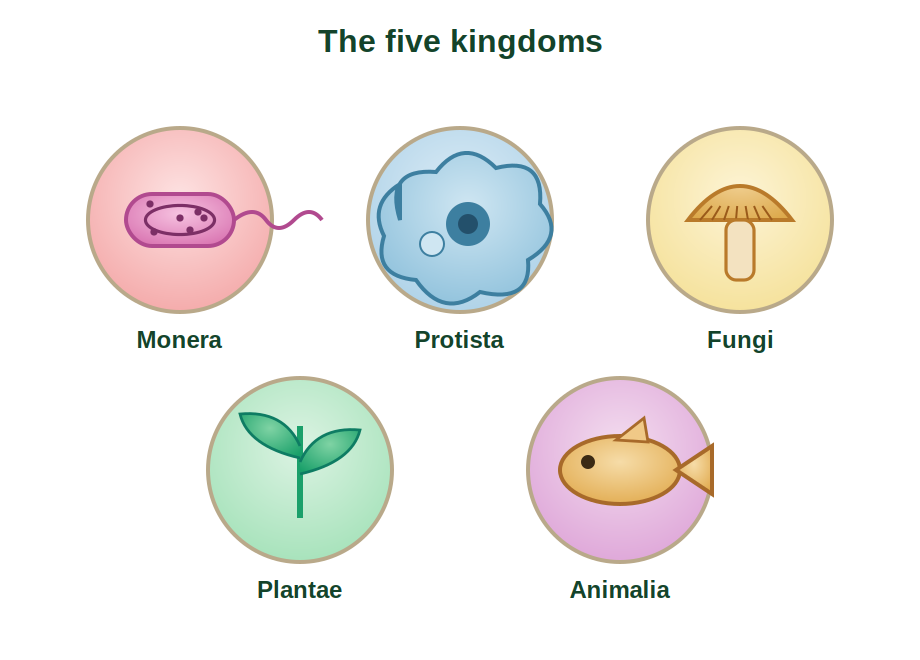
In 1969 Whittaker proposed the five kingdom system, grouping organisms by three main criteria: their cell type (prokaryotic or eukaryotic), their body organisation (single celled or many celled), and their mode of nutrition (making their own food or taking it in). The five kingdoms are Monera, Protista, Fungi, Plantae and Animalia.
|
Diagram 1 – The Five Kingdoms
Fig 1. Whittaker grouped all living organisms into five kingdoms based on cell type, body organisation and nutrition. |
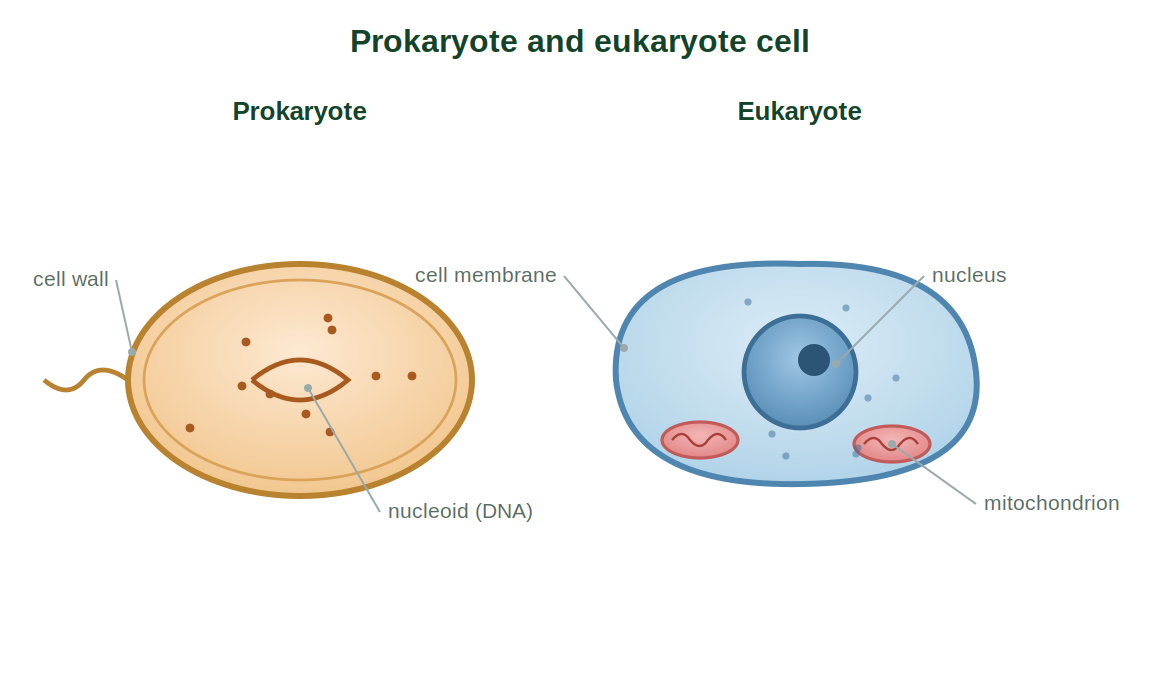
A key distinction underlying the system is between the prokaryotic cell, which has no true nucleus and carries its DNA as a circular loop, and the eukaryotic cell, which has a membrane bound nucleus and organelles. Only the bacteria of kingdom Monera are prokaryotic; the other four kingdoms are eukaryotic.
|
Diagram 2 – Prokaryote and Eukaryote
Fig 2. A prokaryotic cell has no nucleus and circular DNA, while a eukaryotic cell has a true nucleus and organelles. |
4. Kingdoms Monera and Protista |
Monera contains the bacteria, the only prokaryotes, which may make their own food or absorb it and live almost everywhere. Protista contains single celled eukaryotes, such as the amoeba and the algae diatoms, that form a bridge between the simple Monera and the complex plants, fungi and animals. Both kingdoms include organisms vital to ecosystems.
5. Kingdoms Fungi, Plantae and Animalia |
Fungi are eukaryotes that absorb their food, acting as decomposers and recyclers, with bodies made of thread like hyphae. Plantae are many celled eukaryotes that make their own food by photosynthesis, using the green pigment chlorophyll. Animalia are many celled eukaryotes that take in food, the only kingdom that lacks a cell wall, allowing the movement that animals are known for.
6. Viruses, Viroids and Lichens |
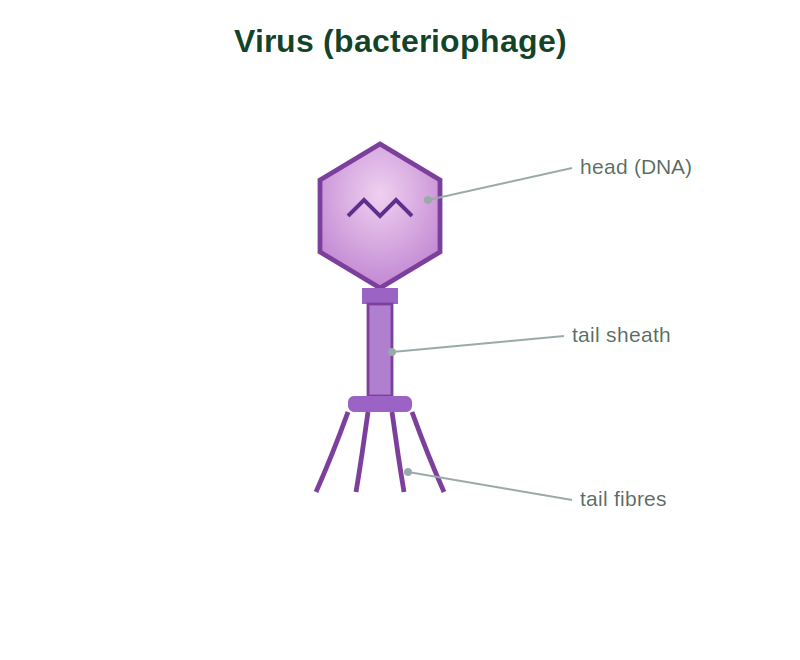
Some entities do not fit the five kingdoms. A virus is a piece of genetic material wrapped in a protein coat; it is inert outside a host but multiplies inside living cells, so it sits at the border of the living and non living. Viroids are even simpler, just naked genetic material. Lichens are not single organisms at all but a partnership of a fungus and an alga living together.
|
Diagram 3 – Structure of a Virus
Fig 3. A virus is genetic material enclosed in a protein coat; it can multiply only inside a living host cell. |
7. Key Reasoning (Principles) |
|
Principle 1: Classification reflects shared features Organisms are grouped by features they share, so the system reflects how similar they are and helps us study and name the millions of species. |
|
Principle 2: Cell type and nutrition divide the kingdoms Whether a cell has a nucleus, whether the body is single or many celled, and how the organism feeds together place it in one of the five kingdoms. |
|
Principle 3: Viruses blur the line of life A virus is inert on its own but reproduces inside a host, showing that the boundary between living and non living is not always sharp. |
8. Worked Examples |
| Example 1 |
|
Q: How many kingdoms are there in Whittaker’s system? ▶ Show SolutionWhittaker’s system has five kingdoms. Answer: Five. |
| Example 2 |
|
Q: Which kingdom contains only prokaryotes? ▶ Show SolutionBacteria are the only prokaryotes, in kingdom Monera. Answer: Monera. |
| Example 3 |
|
Q: What are the three main criteria of the five kingdom system? ▶ Show SolutionCell type, body organisation and mode of nutrition. Answer: Cell type, organisation and nutrition. |
| Example 4 |
|
Q: Which kingdom makes its own food by photosynthesis? ▶ Show SolutionPlants use chlorophyll to photosynthesise, in kingdom Plantae. Answer: Plantae. |
| Example 5 |
|
Q: What is the main role of fungi in an ecosystem? ▶ Show SolutionFungi absorb food and act as decomposers. Answer: Decomposers. |
| Example 6 |
|
Q: What is the difference between a prokaryotic and a eukaryotic cell? ▶ Show SolutionA prokaryote has no true nucleus; a eukaryote has a membrane bound nucleus. Answer: Presence of a nucleus. |
| Example 7 |
|
Q: What is a virus made of? ▶ Show SolutionA virus is genetic material in a protein coat. Answer: Genetic material and a protein coat. |
| Example 8 |
|
Q: Why is a virus said to be on the border of living and non living? ▶ Show SolutionIt is inert outside a host but multiplies inside living cells. Answer: It multiplies only inside a host. |
| Example 9 |
|
Q: What is a lichen? ▶ Show SolutionA partnership of a fungus and an alga living together. Answer: A fungus and alga partnership. |
| Example 10 |
|
Q: Which kingdom lacks a cell wall? ▶ Show SolutionAnimals lack a cell wall, allowing movement. Answer: Animalia. |
9. Practice Sets A to D |
| Set A – Multiple Choice (Basic) |
|
1. The five kingdom system was proposed by: (a) Linnaeus (b) Whittaker (c) Darwin (d) Mendel 2. The only prokaryotic kingdom is: (a) Protista (b) Fungi (c) Monera (d) Plantae 3. Fungi obtain food by: (a) photosynthesis (b) absorption (c) ingestion (d) chemosynthesis 4. A virus consists of genetic material and a: (a) cell wall (b) protein coat (c) nucleus (d) flagellum 5. Plants make food using the pigment: (a) haemoglobin (b) melanin (c) chlorophyll (d) carotene only ▶ Reveal Answers1. (b) Whittaker. 2. (c) Monera. 3. (b) absorption. 4. (b) protein coat. 5. (c) chlorophyll. |
| Set B – Short Answer (Understanding) |
|
1. Name the five kingdoms. 2. State the three criteria used to classify organisms in the five kingdom system. 3. Distinguish a prokaryotic from a eukaryotic cell. 4. Why are viruses not placed in the five kingdoms? 5. What is a lichen? ▶ Reveal Answers1. Monera, Protista, Fungi, Plantae and Animalia. 2. Cell type, body organisation and mode of nutrition. 3. A prokaryote has no true nucleus and circular DNA; a eukaryote has a membrane bound nucleus and organelles. 4. Because they are inert outside a host and multiply only inside living cells, blurring the line of life. 5. A partnership of a fungus and an alga living closely together. |
| Set C – Application and Reasoning |
|
1. To which kingdom does a many celled organism that ingests food and has no cell wall belong? 2. Why was the two kingdom system replaced? 3. Which kingdom acts mainly as decomposers? 4. Give an example organism of kingdom Protista. 5. Why is the amoeba placed in Protista, not Animalia? ▶ Reveal Answers1. Animalia. 2. Because it could not place organisms such as bacteria and fungi that fit neither plants nor animals well. 3. Fungi. 4. The amoeba (or a diatom). 5. Because it is a single celled eukaryote, while animals are many celled. |
| Set D – Higher Order (Challenge) |
|
1. Explain why kingdom Protista is described as a bridge between Monera and the higher kingdoms. 2. A scientist finds a single celled organism with no nucleus. To which kingdom does it belong, and why? 3. Explain how mode of nutrition separates Plantae, Fungi and Animalia. 4. Why is a viroid considered even simpler than a virus? 5. Explain why classification is essential to the study of biology. ▶ Reveal Answers1. Because it holds single celled eukaryotes, more complex than the prokaryotic Monera but simpler than the many celled plants, fungi and animals. 2. Kingdom Monera, because a single celled organism without a nucleus is a prokaryote, and bacteria are the only prokaryotes. 3. Plants make their own food by photosynthesis, fungi absorb food, and animals ingest food. 4. Because a viroid is naked genetic material with no protein coat at all. 5. Because with millions of species, grouping by shared features lets us name, study and understand relationships among them. |
|
Chapter Summary
|
|||||||||||||||||||||||||||||||
| 8-Point Exam Quick-Check | ||||||||||||||||||||||||||||||||
|
||||||||||||||||||||||||||||||||
|
School Revise Virtual Lab Explore these ideas with interactive simulations and visual tools.
|
|
Class 11 Biology Chapter 2: Biological Classification, Complete Notes and Practice This revision guide follows the current NCERT Class 11 Biology syllabus and develops biological classification, covering the early two kingdom system, Whittaker’s five kingdom system and its criteria of cell type, organisation and nutrition, the kingdoms Monera, Protista, Fungi, Plantae and Animalia, and the special cases of viruses, viroids and lichens, with three diagrams, ten worked examples and graded practice. Visit SchoolRevise.com to revise, practise and excel. |
 Google