Curriculum
Science Grade IX
Science Grade 9
0/13

Exploration Work Sheets
0/13

Motion
School Revise · Grade 9 · Advanced Science (Optional) · Chapter 2
Understanding Motion through Experience
Science at Advanced Level, Class 9. This optional chapter looks more closely at motion. We learn that motion depends on the observer, tell scalars from vectors, add vectors, and use the equations of motion.
|
|
||
|
|
What this chapter is about
Whether something is moving depends on where you watch from. In this chapter we meet the idea of a frame of reference, separate quantities that have direction from those that do not, add two vectors to find a single resultant, and use the equations of constant acceleration.
1. Frame of reference
|
Frame of reference a frame of reference is the point or object from which we describe motion A frame at rest or moving at steady speed is an inertial frame, where Newton’s laws hold as they are. A frame that is speeding up or slowing is a non inertial frame. Without a reference point we cannot say whether a thing moves. In real life: Two passengers walking together in a train feel still relative to each other, yet both are moving relative to the platform. |
2. Scalars and vectors
|
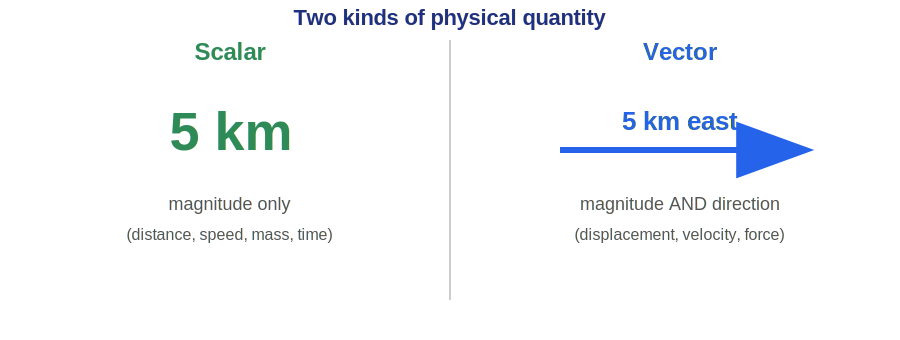
Scalars and vectors a scalar has magnitude only; a vector has both magnitude and direction Distance, speed, mass and time are scalars. Displacement, velocity and force are vectors, and to give them fully you must state a direction as well as a size. In real life: Telling a friend to walk 5 km is not enough, they also need the direction, that is why displacement is a vector. |
3. Adding vectors
|
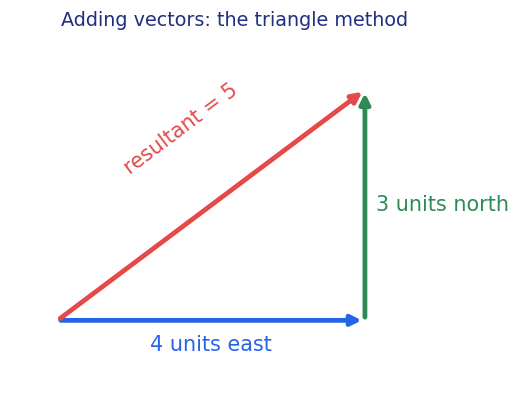
The triangle method draw the vectors head to tail; the line from the first tail to the last head is the resultant When two vectors act, the single vector with the same effect is their resultant. Placed head to tail at right angles, a 4 and a 3 give a resultant of 5 by the Pythagoras theorem. In real life: A boat pushed 4 units east by its engine and 3 units north by a current ends up 5 units from the start. |
|
Worked example 1 Question. A body starts from rest (u = 0) and accelerates at 4 m/s². Find the distance it travels in the 6th second.
Answer: It travels 22 m during the 6th second. |
|
Worked example 2 Question. Find the resultant of a 4 unit displacement east and a 3 unit displacement north.
Answer: The resultant is 5 units. |
Practise with the interactive
Try this chapter hands on: change the values and watch the result update live and animate. The interactive opens right here in the lesson.
Practice set A, multiple choice
1. Which of these is a vector?
Velocity. It has both magnitude and direction, unlike speed, distance or mass, which are scalars.
2. In an inertial frame, Newton’s laws …
Hold without any change. An inertial frame is at rest or moving at a steady velocity.
3. The resultant of 6 units east and 8 units north is …
| 1 | Right angles, use Pythagoras. √(6² + 8²) = √(36 + 64). |
| 2 | Root. = √100 = 10 units. |
4. Distance is a scalar but displacement is a …
Vector, because displacement includes the direction from start to finish, while distance is only the length travelled.
Practice set B, short answer
1. A car starts from rest and accelerates at 2 m/s². Find the distance in the 5th second.
| 1 | Use u + (a/2)(2n − 1). 0 + (2/2)(2 × 5 − 1). |
| 2 | Work it out. = 1 × 9 = 9 m. |
2. Why must a frame of reference be stated to describe motion?
Because whether an object is moving or at rest depends entirely on the observer; the same object can be moving in one frame and at rest in another.
3. Add a 5 unit vector east and a 12 unit vector north.
| 1 | Right angles, Pythagoras. √(5² + 12²) = √(25 + 144). |
| 2 | Root. = √169 = 13 units. |
Quick summary
| Idea | The idea |
| Frame of reference | The viewpoint for describing motion. |
| Inertial frame | At rest or steady speed; laws hold. |
| Scalar | Magnitude only. |
| Vector | Magnitude and direction. |
| Resultant | The single vector with the same effect. |
| nth second | u + (a/2)(2n − 1). |
| Open the Virtual Lab |
These free Grade 9 Advanced Science notes explain frames of reference, scalars, vectors, vector addition and motion equations, with clear step by step worked examples and labelled diagrams for every student using the optional Advanced Level book.
© 2026 School Revise. All rights reserved. This lesson is original content written by School Revise, aligned to the CBSE Class 9 Science at Advanced Level (Optional) syllabus. Unauthorised copying, reproduction or redistribution is not permitted. Curriculum names are used only to indicate alignment.
 Google