Curriculum
Science Grade IX
Science Grade 9
0/13

Exploration Work Sheets
0/13

Newton-Laws
School Revise · Grade 9 · Advanced Science (Optional) · Chapter 3
Newton’s Laws of Motion
Science at Advanced Level, Class 9. This optional chapter extends Newton’s laws to accelerating frames, shows how gravity changes with height and depth, and introduces the turning effect of a force, torque.
|
|
||
|
|
What this chapter is about
Newton’s laws work cleanly only in non accelerating frames. In this chapter we see what to add when the frame itself accelerates, work out how the pull of gravity weakens above and below the surface, and measure how a force turns things.
1. Pseudo force in an accelerating frame
|
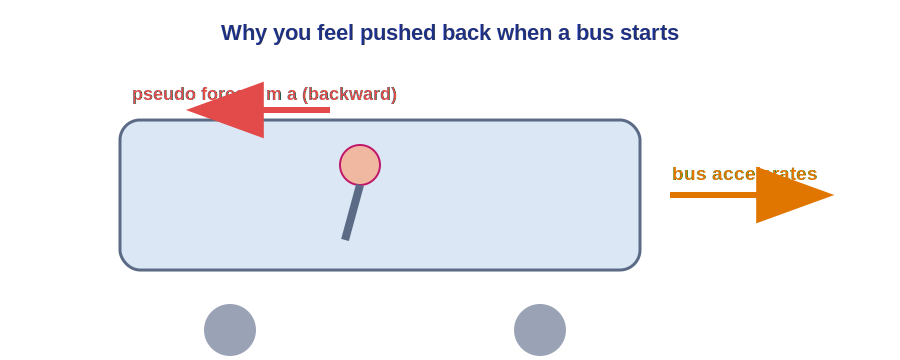
Pseudo force in an accelerating frame we add an apparent pseudo force of size m × a, opposite to the frame’s acceleration It has no real source and no reaction pair. It is only added so that Newton’s first law still appears to hold inside the accelerating frame. F(pseudo) = m × a(frame), directed backward. In real life: When a bus starts suddenly you seem thrown back, though from the road no force pushes you, your body simply keeps its state of rest. |
|
Worked example 1 Question. A lift accelerates upward at 4.5 m/s². Find the pseudo force on a 60 kg person inside it.
Answer: The pseudo force is 270 N, directed downward. |
2. How gravity changes with height and depth
|
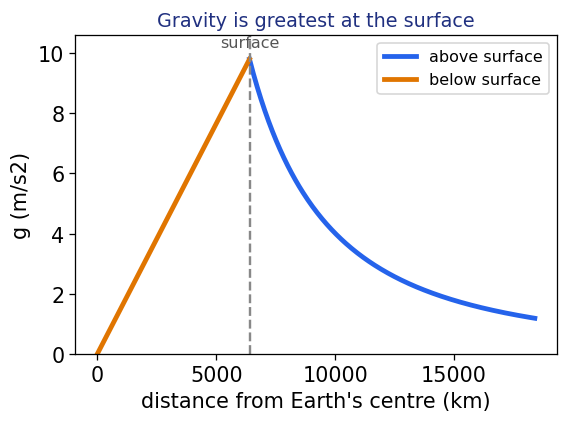
Gravity above and below the surface above the surface g(h) = g × R²/(R + h)²; below it g(d) = g(1 − d/R) Higher up you are farther from the centre, so gravity weakens with height. Below the surface only the sphere beneath you pulls, so gravity also falls with depth, reaching zero at the centre. It is greatest at the surface. In real life: Astronauts in the space station feel almost weightless not because gravity is gone, but because both they and the station are falling together. |
|
Worked example 2 Question. Find g at a height of 800 km. Take R = 6400 km and g = 9.8 m/s².
Answer: g at 800 km is about 7.74 m/s². |
3. Torque, the turning effect
|
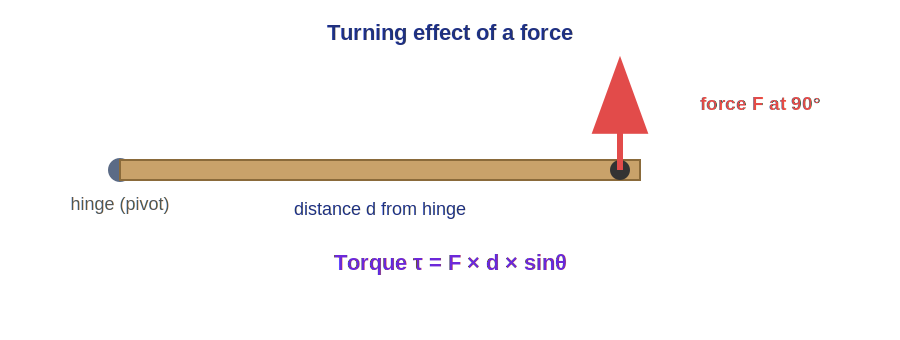
Torque (moment of force) τ = F × d × sinθ, the turning effect of a force about a pivot F is the force, d the distance from the pivot, and θ the angle between them. Torque is largest when the force is at 90° and zero when it points straight at the pivot. Its unit is the newton metre (Nm). In real life: A door opens easily at the handle, far from the hinges, because the large distance d makes a big turning effect for a small push. |
|
Worked example 3 Question. A force of 20 N acts on a door 0.8 m from the hinge, at 90°. Find the torque.
Answer: The torque is 16 Nm. |
Practise with the interactive
Try this chapter hands on: change the values and watch the result update live and animate. The interactive opens right here in the lesson.
Practice set A, multiple choice
1. A pseudo force acts …
Only in an accelerating frame, opposite to the frame’s acceleration, and has no real physical source.
2. As you rise above the Earth’s surface, g …
Decreases, because you move farther from the centre and gravity weakens with distance.
3. Torque is greatest when the force is applied at …
90° to the line from the pivot, because sin90° = 1 gives the largest turning effect.
4. At the centre of the Earth, g is …
Zero, because there is no mass below you to pull, so g(d) = g(1 − d/R) becomes zero when d = R.
Practice set B, short answer
1. Find the pseudo force on a 50 kg person in a lift accelerating at 3 m/s².
| 1 | Use F = m × a. 50 × 3. |
| 2 | Work it out. = 150 N. |
2. Find the torque of a 25 N force at 0.4 m from a pivot, at 90°.
| 1 | Use τ = F × d × sin90°. 25 × 0.4 × 1. |
| 2 | Work it out. = 10 Nm. |
3. At what depth does g become half its surface value?
| 1 | Use g(d) = g(1 − d/R) with g(d) = g/2. 1 − d/R = 1/2. |
| 2 | Solve. d/R = 1/2, so d = R/2. |
Quick summary
| Idea | The idea |
| Pseudo force | m × a, only in an accelerating frame. |
| g with height | g R²/(R + h)², falls with height. |
| g with depth | g(1 − d/R), zero at the centre. |
| Greatest g | at the surface. |
| Torque | τ = F × d × sinθ. |
| Max torque | when θ = 90°. |
| Open the Virtual Lab |
These free Grade 9 Advanced Science notes explain pseudo force, gravitation with height and depth, and turning torque, with clear step by step worked examples and labelled diagrams for every student using the optional Advanced Level book.
© 2026 School Revise. All rights reserved. This lesson is original content written by School Revise, aligned to the CBSE Class 9 Science at Advanced Level (Optional) syllabus. Unauthorised copying, reproduction or redistribution is not permitted. Curriculum names are used only to indicate alignment.
 Google