Curriculum
Science Grade IX
Science Grade 9
0/13

Exploration Work Sheets
0/13

Simple-Machines
School Revise · Grade 9 · Advanced Science (Optional) · Chapter 4
The Geometry of Power: Advanced Simple Machines
Science at Advanced Level, Class 9. This optional chapter shows how wheels, axles and pulleys let a small effort move a large load. We meet mechanical advantage, the wheel and axle, and tension in a string.
|
|
||
|
|
What this chapter is about
Machines like cranes, steering wheels and pulleys do not create energy, they rearrange force so a small effort handles a big load. In this chapter we learn to measure that gain, called mechanical advantage, and study the wheel and axle and the tension in ropes.
1. Mechanical advantage and the wheel and axle
|
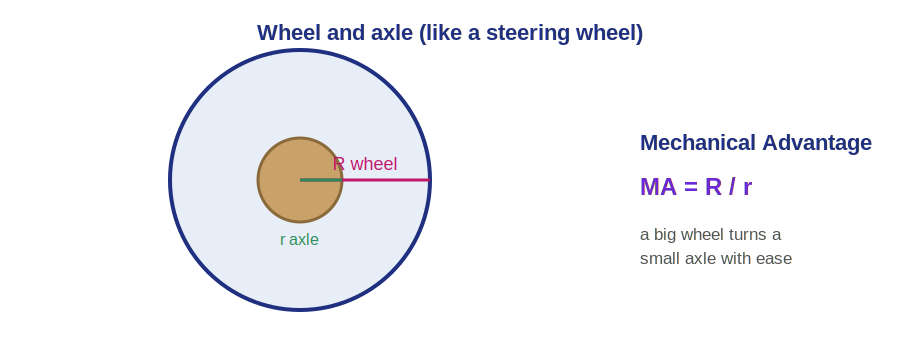
Mechanical advantage of a wheel and axle MA = radius of wheel / radius of axle Effort is applied to the large wheel and the load is moved by the small axle. Because the wheel is bigger, a small effort at its rim produces a much larger force at the axle. Effort = load / MA. In real life: A steering wheel is wide and its column narrow, so light hands on the rim turn the heavy wheels of a truck. |
|
Worked example 1 Question. A steering wheel has radius 30 cm and its axle radius 3 cm, turning a load of 1200 N. Find the MA and the effort needed.
Answer: MA = 10 and the effort needed is 120 N. |
2. Tension in a string
|
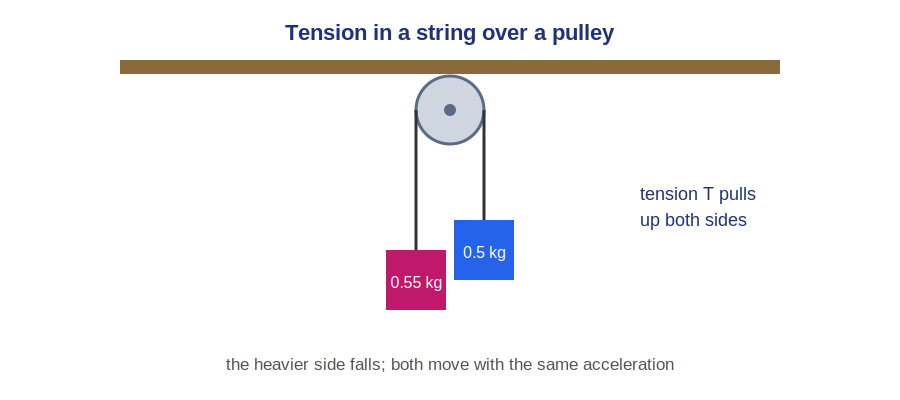
Tension tension is the pulling force carried along a stretched string, rope or cable It always acts along the string, pulling away from the object. For a hanging object at rest, the tension equals its weight, T = mg. If the object accelerates upward, T = m(g + a). In real life: The cable of a lift carries a tension equal to the car’s weight when still, and more when the car accelerates upward. |
|
Worked example 2 Question. A 5 kg object hangs at rest from a rope. Find the tension. Take g = 9.8 m/s².
Answer: The tension is 49 N. |
|
Worked example 3 Question. A 4 kg mass is lifted upward with acceleration 2 m/s². Find the tension. Take g = 9.8 m/s².
Answer: The tension is 47.2 N. |
Practise with the interactive
Try this chapter hands on: change the values and watch the result update live and animate. The interactive opens right here in the lesson.
Practice set A, multiple choice
1. Mechanical advantage of a wheel and axle is …
The radius of the wheel divided by the radius of the axle. A bigger wheel gives a larger advantage.
2. For a load hanging at rest, the tension equals …
The weight of the load, mg, because the forces are balanced.
3. A wheel of radius 40 cm turns an axle of radius 5 cm. Its MA is …
| 1 | Use MA = R / r. 40 / 5. |
| 2 | Work it out. = 8. |
4. Tension in a string always acts …
Along the string, pulling away from the object it is attached to.
Practice set B, short answer
1. A load of 900 N is moved by a wheel and axle with MA 6. Find the effort.
| 1 | Use effort = load / MA. 900 / 6. |
| 2 | Work it out. = 150 N. |
2. Find the tension holding an 8 kg mass at rest. Take g = 9.8 m/s².
| 1 | At rest, T = mg. 8 × 9.8. |
| 2 | Work it out. = 78.4 N. |
3. Why does a large steering wheel make a truck easier to turn?
Because the wide wheel gives a large mechanical advantage, MA = radius of wheel / radius of axle, so a small effort at the rim produces a large turning force at the axle.
Quick summary
| Idea | The idea |
| Machines | Rearrange force, never create energy. |
| Mechanical advantage | MA = radius of wheel / radius of axle. |
| Effort | load / MA. |
| Tension | Pull along a string. |
| At rest | T = mg. |
| Accelerating up | T = m(g + a). |
| Open the Virtual Lab |
These free Grade 9 Advanced Science notes explain mechanical advantage, the wheel and axle, tension and pulley systems, with clear step by step worked examples and labelled diagrams for every student using the optional Advanced Level book.
© 2026 School Revise. All rights reserved. This lesson is original content written by School Revise, aligned to the CBSE Class 9 Science at Advanced Level (Optional) syllabus. Unauthorised copying, reproduction or redistribution is not permitted. Curriculum names are used only to indicate alignment.
 Google