Curriculum
Science Grade IX
Science Grade 9
0/13

Exploration Work Sheets
0/13

Mixtures Seperation
School Revise · Grade 9 · Advanced Science (Optional) · Chapter 8
Mixtures and Separation of Mixtures
Science at Advanced Level, Class 9. This optional chapter covers two powerful separation methods, chromatography, which sorts by how strongly parts stick, and fractional distillation, which sorts liquids by boiling point.
|
|
||
|
|
What this chapter is about
Real materials are usually mixtures, and pulling them apart cleanly is a science of its own. In this chapter we learn chromatography, which separates by how strongly each part clings to a surface, and fractional distillation, which separates liquids whose boiling points are close.
1. Chromatography
|
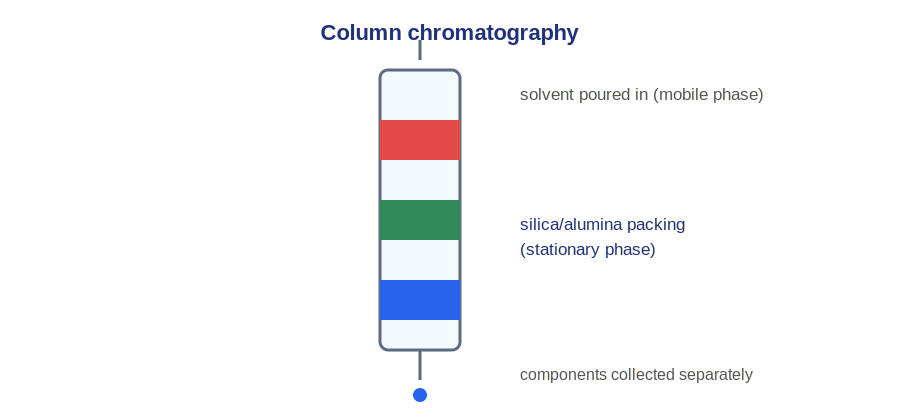
Chromatography chromatography separates a mixture by how differently its parts move through a fixed material carried by a moving liquid The fixed material is the stationary phase and the moving liquid is the mobile phase. Parts that cling weakly move fast and travel far, parts that cling strongly move slowly, so the mixture spreads into separate bands. In real life: Forensic scientists use chromatography to separate the dyes in an ink or the substances in a blood sample. |
|
Worked example 1 Question. In a column, compound A comes out before compound B. What does this tell you about A?
Answer: A is less strongly held by the stationary phase, so it moves faster. |
2. Fractional distillation
|
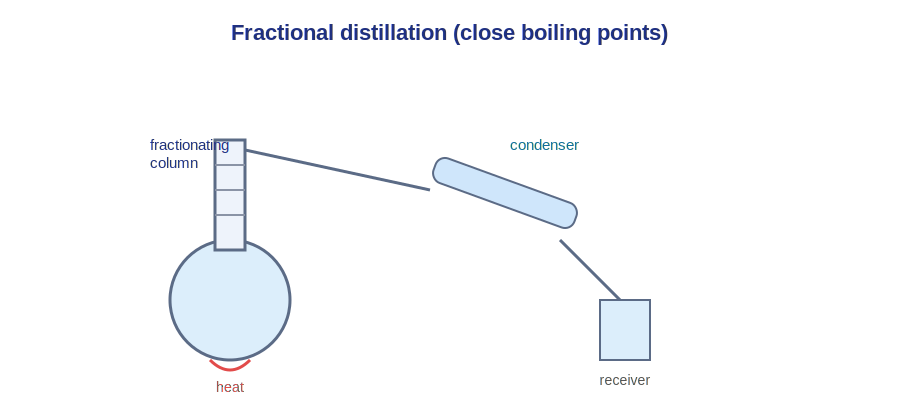
Fractional distillation fractional distillation separates two miscible liquids whose boiling points are close, using a fractionating column The column gives many surfaces where vapour condenses and re evaporates again and again. Each cycle makes the rising vapour richer in the liquid with the lower boiling point, so the liquids separate cleanly. In real life: An oil refinery uses one tall column to split crude oil into petrol, kerosene, diesel and more, each collected at its own height. |
|
Worked example 2 Question. A mixture of ethanol (boils at 78°C) and water (boils at 100°C) must be separated. Which method suits it?
Answer: Fractional distillation, because the boiling points are close (less than 25°C apart). |
|
Worked example 3 Question. In the refinery column, why is petrol collected higher up than diesel?
Answer: Because petrol boils at a lower temperature, it rises higher before condensing. |
Practise with the interactive
Try this chapter hands on: change the values and watch the result update live and animate. The interactive opens right here in the lesson.
Practice set A, multiple choice
1. In chromatography, the fixed material is called the …
Stationary phase, while the moving liquid that carries the mixture through it is the mobile phase.
2. Fractional distillation is used when two liquids have boiling points that are …
Close together, less than about 25°C apart; a fractionating column is then needed.
3. A component that clings strongly to the stationary phase moves …
Slowly, so it lags behind and separates from parts that cling weakly and move fast.
4. Crude oil is separated in a refinery by …
Fractional distillation, collecting petrol, kerosene, diesel and other fractions at different heights of the column.
Practice set B, short answer
1. Name the two phases in chromatography and what each does.
| 1 | Stationary phase. the fixed material, such as silica, that the parts cling to. |
| 2 | Mobile phase. the moving liquid that carries the mixture through it. |
2. Why does the fractionating column improve separation?
It provides many surfaces where vapour repeatedly condenses and re evaporates, and each cycle makes the vapour richer in the lower boiling liquid, giving a cleaner separation.
3. Why is simple distillation not suitable for liquids with close boiling points?
Without a fractionating column the vapours of both liquids rise together and are collected mixed, so liquids with close boiling points are not separated cleanly.
Quick summary
| Idea | The idea |
| Chromatography | Separates by how strongly parts cling. |
| Stationary phase | The fixed material. |
| Mobile phase | The moving liquid. |
| Fractional distillation | For close boiling points. |
| Fractionating column | Repeated condensing and boiling. |
| Refinery | Splits crude oil into fractions. |
| Open the Virtual Lab |
These free Grade 9 Advanced Science notes explain chromatography, column chromatography, and fractional distillation of crude oil mixtures, with clear step by step worked examples and labelled diagrams for every student using the optional Advanced Level book.
© 2026 School Revise. All rights reserved. This lesson is original content written by School Revise, aligned to the CBSE Class 9 Science at Advanced Level (Optional) syllabus. Unauthorised copying, reproduction or redistribution is not permitted. Curriculum names are used only to indicate alignment.
 Google