Curriculum
Science Grade IX
Science Grade 9
0/13

Exploration Work Sheets
0/13

Work-Energy
School Revise · Grade 9 · Advanced Science (Optional) · Chapter 5
Work and Energy
Science at Advanced Level, Class 9. This optional chapter sorts forces into conservative and non conservative, states Hooke’s law for a spring, and finds the energy stored in a stretched spring.
|
|
||
|
|
What this chapter is about
A ball thrown up returns, but a sliding book stops for good. In this chapter we see why, by sorting forces into conservative and non conservative, then study how a spring stretches under a force and how much energy it stores.
1. Conservative and non conservative forces
|
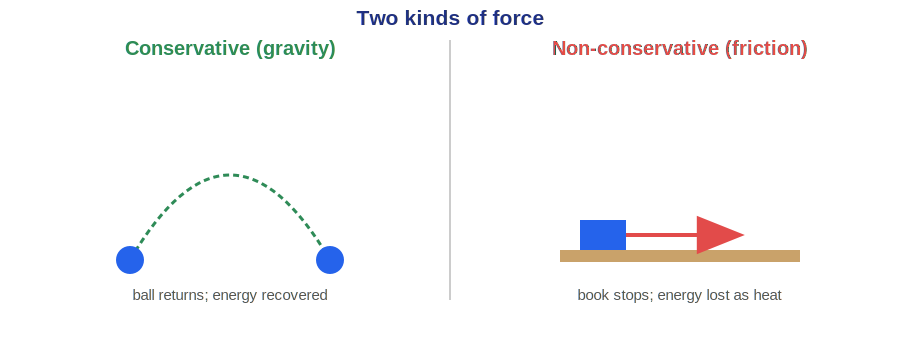
Two kinds of force a conservative force returns the energy (work round a closed path is zero); a non conservative force does not For a conservative force, like gravity or a spring, the work does not depend on the path and no energy is lost. For a non conservative force, like friction, energy is turned into heat and cannot be recovered. In real life: A thrown ball comes back with the same energy, but a book slid across a table stops as friction turns its energy into heat. |
2. Hooke’s law and the energy in a spring
|
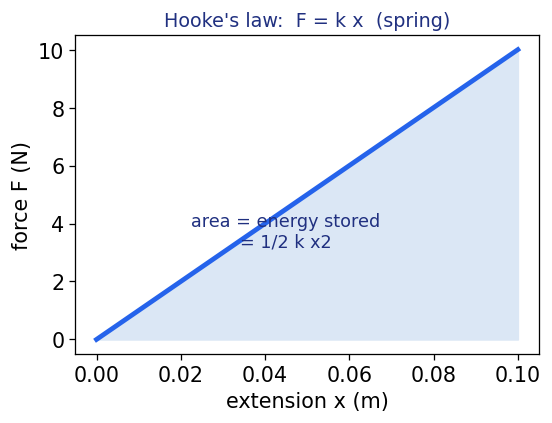
Hooke’s law the extension of a spring is proportional to the force: F = k x F is the force, x the extension and k the spring constant, a measure of stiffness. A stiff spring has a large k. The restoring force is written F = −k x, since it pulls back toward the natural length. In real life: A kitchen scale works by Hooke’s law, the heavier the load, the more the spring inside stretches, in exact proportion. |
|
Energy stored in a spring the elastic potential energy is U = ½ k x² As the spring stretches, the force rises from 0 to k x, so the average force is ½ k x. The work done, average force times extension, is ½ k x × x = ½ k x², and this is stored as energy. In real life: A wind up toy or a drawn bow stores exactly this energy in a spring or a bent limb, ready to be released. |
|
Worked example 1 Question. A spring has k = 100 N/m and is stretched by 0.06 m. Find the energy stored.
Answer: The energy stored is 0.18 J. |
|
Worked example 2 Question. That stored energy of 0.18 J is given to a 0.5 kg body. Find its top speed.
Answer: The top speed is about 0.85 m/s. |
Practise with the interactive
Try this chapter hands on: change the values and watch the result update live and animate. The interactive opens right here in the lesson.
Practice set A, multiple choice
1. Which is a conservative force?
Gravity. Work done by gravity does not depend on the path, and none of the energy is lost.
2. Friction is non conservative because …
It turns the object’s energy into heat, which cannot be fully recovered.
3. Hooke’s law states that …
The extension of a spring is proportional to the force applied, F = k x, within the elastic limit.
4. The energy stored in a stretched spring is …
½ k x², the elastic potential energy, equal to the work done in stretching it.
Practice set B, short answer
1. A spring of k = 200 N/m is stretched by 0.1 m. Find the energy stored.
| 1 | Use U = ½ k x². ½ × 200 × 0.1². |
| 2 | Work it out. = 0.5 × 200 × 0.01 = 1 J. |
2. A force of 30 N stretches a spring of k = 150 N/m. Find the extension.
| 1 | Use F = k x, so x = F / k. 30 / 150. |
| 2 | Work it out. = 0.2 m. |
3. Why does a sliding book stop but a swinging pendulum keeps going far longer?
Friction, a non conservative force, turns the book’s energy into heat and stops it, while a pendulum loses energy only slowly to air resistance, a much weaker non conservative force.
Quick summary
| Idea | The idea |
| Conservative force | Returns energy; path does not matter. |
| Non conservative | Loses energy as heat, like friction. |
| Hooke’s law | F = k x. |
| Spring constant k | Stiffness of the spring. |
| Spring energy | U = ½ k x². |
| Energy swap | Spring energy can become motion. |
| Open the Virtual Lab |
These free Grade 9 Advanced Science notes explain conservative and non conservative forces, Hooke’s law and spring energy, with clear step by step worked examples and labelled diagrams for every student using the optional Advanced Level book.
© 2026 School Revise. All rights reserved. This lesson is original content written by School Revise, aligned to the CBSE Class 9 Science at Advanced Level (Optional) syllabus. Unauthorised copying, reproduction or redistribution is not permitted. Curriculum names are used only to indicate alignment.
 Google