Curriculum
Science Grade IX
Science Grade 9
0/13

Exploration Work Sheets
0/13

Chemical-Bonding
School Revise · Grade 9 · Advanced Science (Optional) · Chapter 7
Chemical Bonding
Science at Advanced Level, Class 9. This optional chapter explains the octet rule, draws bonding with Lewis structures, meets the exceptions to the octet, and models a metal as a sea of electrons.
|
|
||
|
|
What this chapter is about
Atoms bond to reach a stable arrangement of electrons. In this chapter we state the octet rule, draw bonds as shared dots in Lewis structures, look at molecules that break the rule, and picture a metal as fixed ions in a sea of free electrons.
1. The octet rule and Lewis structures
|
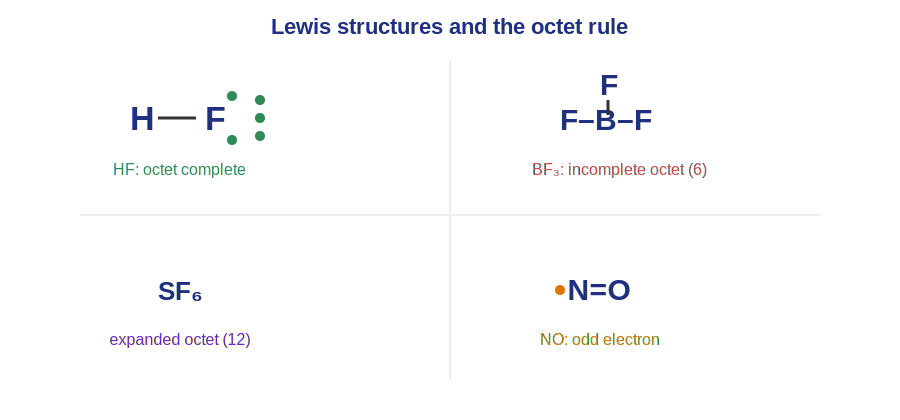
The octet rule atoms tend to gain, lose or share electrons until they are surrounded by eight valence electrons A Lewis structure draws the valence electrons as dots around each symbol, with a shared pair, a bonding pair, shown as a line. Hydrogen is content with two, a duplet, like helium. In real life: Common gases like oxygen and nitrogen in the air are held together by exactly this sharing of electrons to complete octets. |
|
Worked example 1 Question. Why does boron in BF₃ not complete its octet?
Answer: Boron has only 3 valence electrons, so it forms 3 bonds and stops at 6, an incomplete octet. |
2. Exceptions to the octet rule
|
Three kinds of exception some molecules have an incomplete octet, some an expanded octet, and some an odd number of electrons BF₃ has an incomplete octet (6 around boron). SF₆ has an expanded octet (12 around sulphur). NO has an odd total of 11 valence electrons, so one atom cannot reach eight. In real life: These exceptions matter in industry, for example sulphur hexafluoride, SF₆, is used as an insulating gas in high voltage equipment. |
|
Worked example 2 Question. Sulphur in SF₆ is surrounded by 12 electrons. What is this called?
Answer: It is an expanded octet. |
3. Metallic bonding, the electron sea
|
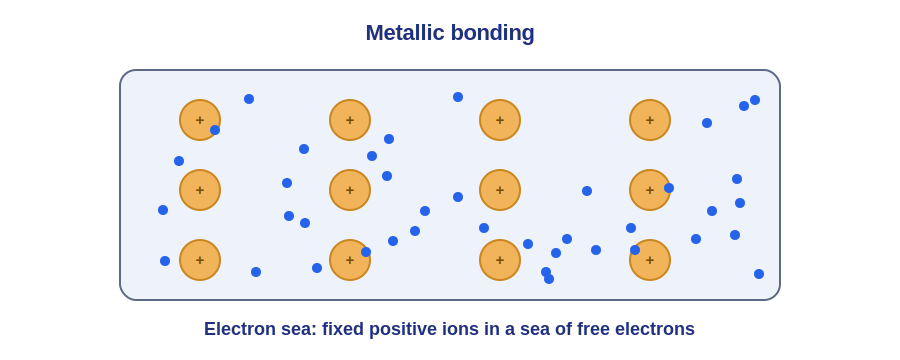
The electron sea model a metal is a set of fixed positive ions in a sea of freely moving electrons The outer electrons leave individual atoms and move freely through the whole piece. The attraction between the positive ions and this sea of electrons is the metallic bond, which is not directional. In real life: This free sea of electrons is why copper wire carries electricity so well and why gold can be beaten into thin sheets without breaking. |
|
Worked example 3 Question. Why do metals conduct electricity well?
Answer: Because their free electrons drift under a voltage, carrying a current. |
Practise with the interactive
Try this chapter hands on: change the values and watch the result update live and animate. The interactive opens right here in the lesson.
Practice set A, multiple choice
1. The octet rule says atoms tend to have … valence electrons.
Eight, reached by gaining, losing or sharing electrons; hydrogen is the exception, needing only two.
2. BF₃ is an example of a molecule with an …
Incomplete octet, because boron has only 3 valence electrons and forms only 3 bonds, giving 6.
3. In the electron sea model, the metal is held together by …
The attraction between fixed positive ions and the sea of free electrons, the metallic bond.
4. NO is unusual because it has …
An odd number of valence electrons, 11 in total, so at least one atom cannot reach a full octet.
Practice set B, short answer
1. Why is hydrogen happy with two electrons rather than eight?
Because with two electrons it has the stable arrangement of helium, a full first shell, so a duplet is enough for hydrogen.
2. Explain, using the electron sea model, why metals can be beaten into sheets.
The layers of positive ions can slide over one another while the sea of free electrons keeps holding them together, so the metal changes shape instead of breaking.
3. Name the three types of exception to the octet rule with an example of each.
| 1 | Incomplete octet. BF₃ (6 around boron). |
| 2 | Expanded octet. SF₆ (12 around sulphur). |
| 3 | Odd electron. NO (11 valence electrons). |
Quick summary
| Idea | The idea |
| Octet rule | Aim for eight valence electrons. |
| Lewis structure | Dots for electrons, a line for a bond. |
| Incomplete octet | BF₃. |
| Expanded octet | SF₆. |
| Odd electron | NO. |
| Metallic bond | Ions in a sea of electrons. |
| Open the Virtual Lab |
These free Grade 9 Advanced Science notes explain the octet rule, Lewis structures, octet exceptions and metallic bonding, with clear step by step worked examples and labelled diagrams for every student using the optional Advanced Level book.
© 2026 School Revise. All rights reserved. This lesson is original content written by School Revise, aligned to the CBSE Class 9 Science at Advanced Level (Optional) syllabus. Unauthorised copying, reproduction or redistribution is not permitted. Curriculum names are used only to indicate alignment.
 Google